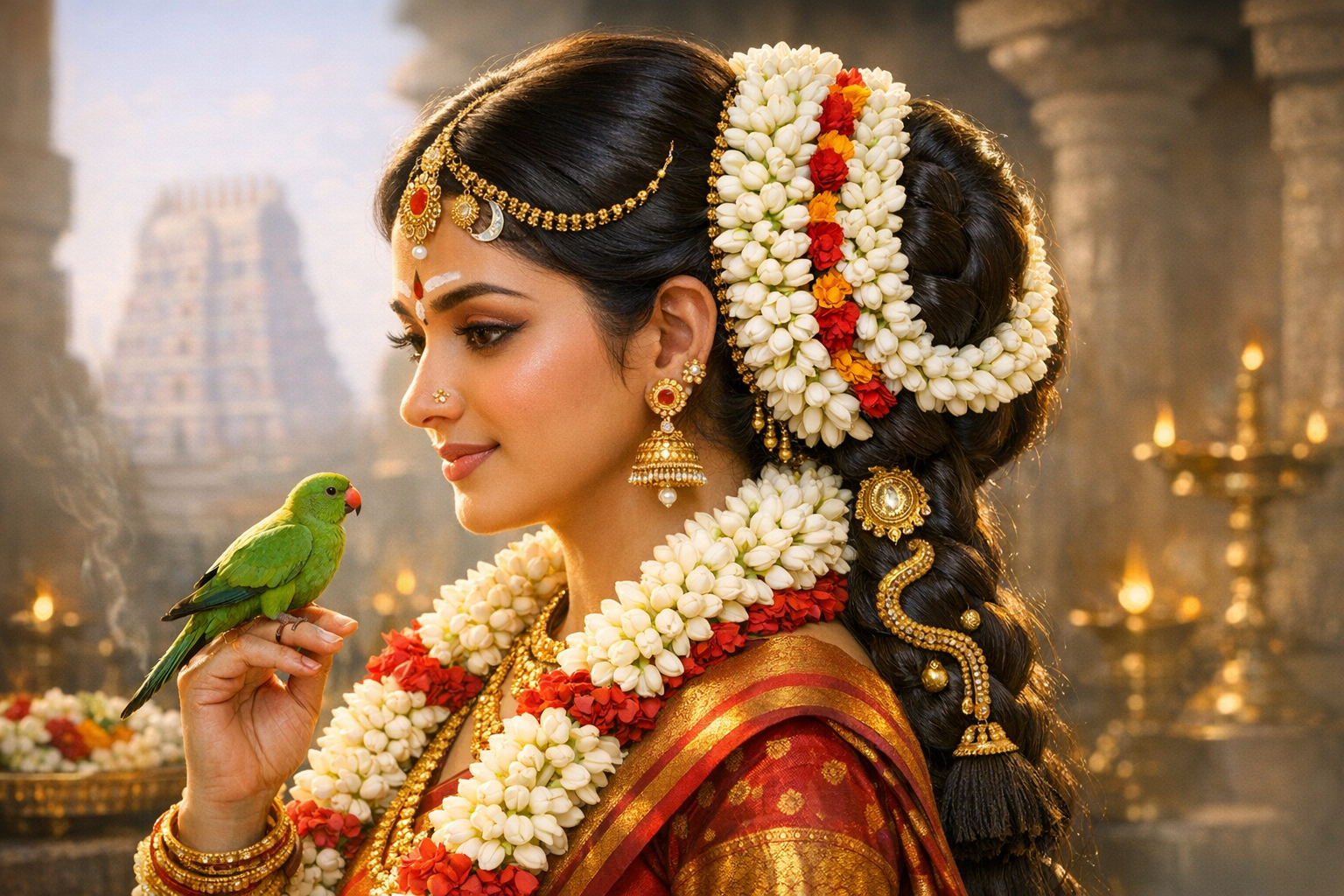
The Andal Kondai, the distinctive coiffure associated with Goda Devi (Andal), is far more than an elegant hair arrangement; it is a crystallized expression of Srivaisnava devotion, Tamil aesthetic grammar, and living temple craft. As the only female among the twelve Alwars, Andal’s voice in Thiruppavai and Nachiyar Thirumozhi and her singular iconographic silhouette together shape a devotional image that devotees across South India immediately recognize and cherish.
Situated in the early medieval Tamil milieu (often placed between the 8th and 9th centuries CE), Andal’s presence permeates both scripture and stone. At Srivilliputhur—whose soaring gopuram is the emblem of Tamil Nadu—and at Srirangam’s Ranganathaswamy Temple, her utsava-murtis and festival tableaux anchor a devotional calendar that reaches its crescendo in Aadi Pooram (Andal’s Thirunakshatram) and the Margazhi month recitation of Thiruppavai.
In iconography and ritual adornment, the Andal Kondai typically appears as a high, compact bun, often set slightly lateral to the crown and encircled by concentric rings of flowers, especially jasmine (malli). A trailing plait may extend below, ornamented with a sequence of discs and serpentine fillets. Workshop practice varies by temple and region: some images accent a posterior bun close to the occiput, while others emphasize a side-bun profile. These variations are faithful adaptations within a consistent Vaishnava visual language.
The coiffure works in concert with an established suite of ornaments—nethi chutti (forehead ornament), surya and chandra motifs, rakodi (circular discs), the jadai nagam (serpentine braid piece), and the kunjalam (tassel) at the terminal braid—together producing a luminous frame that accentuates Andal’s devotional gaze. The iconic parrot sometimes seen with Andal, as well as the layered garlands she is famed for, reinforces the union of poetry, fragrance, and sacred form.
Andal’s poetry binds this aesthetic to bhakti theology. Sringara-bhakti—devotion expressed through the language of bridal longing—infuses the coiffure with meaning: it is both a social marker of auspicious femininity and a spiritual emblem of one-pointed yearning for Vishnu. The much-cherished epithet “Soodi kodutha Sudarkodi Andal” recalls her intimate ritual gesture of wearing floral garlands before offering them to the Lord, a practice that braids fragrance, body, and prayer into one seamless act.
Temple alankara teams, often trained through hereditary knowledge, construct the Andal Kondai as part of daily and festival service. Aadi Pooram (Thiruvadipuram) focuses on Andal’s Thirukalyanam—the divine wedding—when the coiffure is executed with heightened richness, fuller floral tiers, and weightier goldwork. During Margazhi, the Thiruppavai recitation frames her adornment in an atmosphere of dawn vows and community devotion, echoing Andal’s own call to collective worship.
From a craft perspective, the Andal Kondai is a technical assembly balancing form, weight, and durability. Stylists establish a secure bun base (the kondai) with natural hair or extensions, anchor it against movement using pins and thread-wrapping, and integrate the plait so the load distribution remains even for hours of procession. Each layer—disc, flower ring, and braid piece—is integrated to avoid stress points at the scalp, a principle crucial to both deity adornment and human adaptation in weddings and performance.
The ornamentation follows an internal grammar. Rakodi discs articulate the bun’s perimeter, the jadai nagam aligns the plait’s axis, and the kunjalam gathers the plait’s end into a rhythmic tassel. Forehead jewelry (nethi chutti) and the paired sun–moon motifs (surya–chandra) unify the face and crown, while the veni of flowers mediates metal brilliance with living softness. The result is a balanced composition where weight, texture, and luminosity achieve visual serenity.
Flowers are not merely decorative; they are semiotic. Jasmine (malli) suggests coolness and satvika purity; thazhampoo (screw pine) contributes a sweet, bright tone; kanakambaram (crossandra) adds chromatic warmth. Temple practice calibrates species choice to climate and availability, ensuring freshness through frequent renewal so the coiffure breathes and moves with the deity during processions.
The Andal Kondai’s migration from sanctum to society is an instructive arc of cultural heritage. In Iyengar and broader Tamil weddings, the bridal Andal Kondai locates the bride within a lineage of auspiciousness, symbolically aligning her with Nachiyar (a title of Andal). The same canon informs Bharatanatyam and related dance repertoires—especially in pieces like Andal Kauthuvam—where the side-bun or high-bun profile becomes a kinetic halo that reads instantly from the auditorium.
Technically, human adaptations follow temple logic with pragmatic refinements: a donut or cloth-wrapped ring may scaffold the bun; hair extensions support volume; a sequence of rakodis and braid pieces scales proportion to the wearer’s frame; and light, breathable flower rings relieve pressure while maintaining silhouette. The design objective mirrors temple alankara—stability, clarity at distance, and a devotional aura—without compromising wearer comfort.
Art-historically, the Andal Kondai participates in a wider South Indian temple iconography shaped by shilpa-sastra ideals and Agamic practice (notably Pancharatra and Vaikhanasa traditions). While textual canons rarely prescribe a single invariant hairstyle, they establish principles of proportion, auspicious markers, and ornament hierarchies that workshops interpret through regional taste and available materials. Andal’s coiffure thus exemplifies a living canon—codified enough to be legible, flexible enough to remain alive.
Comparative perspectives across Dharmic traditions illuminate the sanctity of hair as a vessel of vow and identity. In Hindu iconography, coiffures signify states of grace and auspiciousness; in Buddhist art, the ushnisha registers spiritual attainment; in Jain traditions, stylized hair and serene cranial contours encode detachment; and in Sikh practice, kes (unshorn hair) and the joora beneath the turban affirm sacred continuity and discipline. Together, these traditions foreground hair as an ethical and spiritual sign—an insight that deepens the reading of the Andal Kondai beyond region or sect.
Across Southeast Asia, from Angkor’s apsaras to Tamil-influenced court ateliers, the interplay of bun, braid, and floral diadem recurs as a shared Indic aesthetic. The Andal Kondai fits within this transregional lattice of forms, demonstrating how devotional beauty travels—migrating through liturgy, marriage customs, and performance—while preserving a recognizable Tamil signature.
Today, sustaining the Andal Kondai as intangible heritage depends on documentation, apprenticeship, and sensitive innovation. Temple alankara teams and community stylists already practice low-waste methods—reusing structural elements, composting flowers, and preferring breathable natural fibers—demonstrating how cultural continuity can align with environmental responsibility.
For visitors encountering Andal in Srivilliputhur or Srirangam, the coiffure often becomes the first point of emotional contact—its radiance, fragrance, and poise communicating without words. For families who adopt the style in weddings, the experience can feel like stepping into a larger story, where personal celebration merges with a lineage of devotion. For dancers, the kondai’s silhouette sharpens abhinaya, letting Andal’s verses reach the audience through form as well as song.
In sum, the Andal Kondai is a complete aesthetic: a crafted structure, a theological sign, a ritual act, and a communal inheritance. Its enduring appeal rests in how seamlessly it fuses the tangible (hair, flowers, metal) with the intangible (bhakti, memory, vow). Read through the lenses of temple iconography, South Indian culture, and the broader unity of Dharmic traditions, the coiffure of Goda Devi emerges as a radiant thread binding poetry, practice, and people.
Inspired by this post on Hindu Blog.