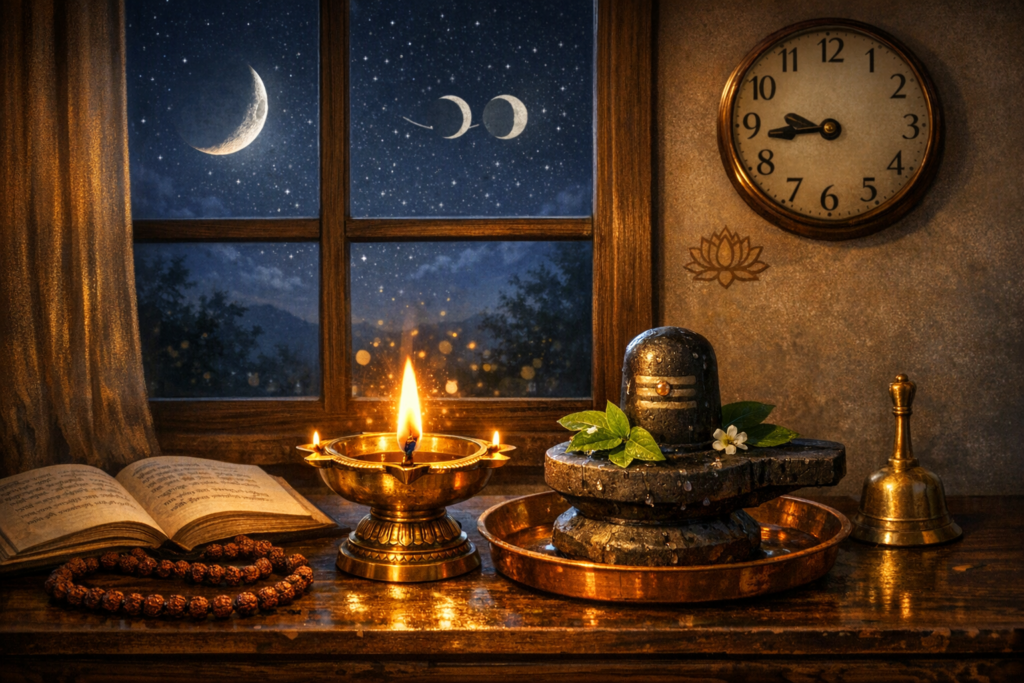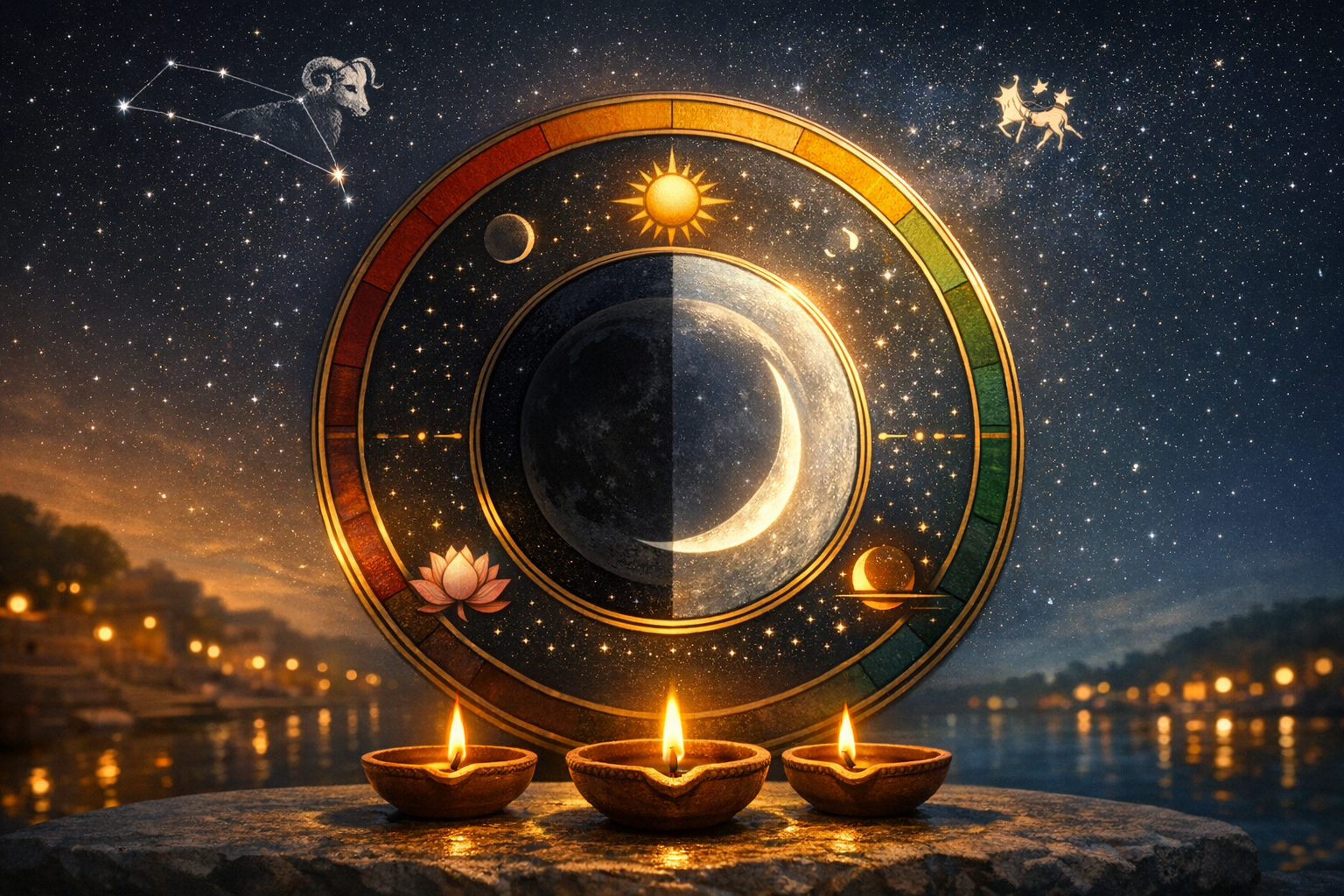
Friday, April 17, 2026 marks a significant lunar transition in the Panchang. Amavasya Tithi (no-moon day) prevails until 5:13 PM IST, after which Shukla Paksha Pratipada (the first day of the waxing phase) begins and continues until 3:13 PM IST on Saturday, April 18. These tithi boundaries apply across most regions of India on IST, with only minor city-wise variations due to longitude and local sunrise. In the Amanta tradition, this day is observed as Chaitra Amavasya, while the following Shukla Paksha begins the new lunar month. In the Purnimanta tradition followed widely in North India, this Amavasya immediately precedes Chaitra Shukla Paksha, the fortnight that inaugurates key observances such as Chaitra Navratri.
In technical terms, a tithi is a 12-degree elongation of the Moon from the Sun in geocentric longitude. Amavasya corresponds to a near-zero elongation (exact conjunction), and Shukla Paksha Pratipada commences the moment the Moon’s elongation surpasses 12 degrees. The shift at 5:13 PM IST on April 17 thus marks the precise astronomical threshold from the dark fortnight (Krishna Paksha) to the bright fortnight (Shukla Paksha). The subsequent end time of Pratipada at 3:13 PM IST on April 18 reflects the Moon’s motion through the next 12-degree arc.
Month naming differs by regional calendars. In the Amanta system (prevalent in much of western and southern India), months end on Amavasya, so April 17 is Chaitra Amavasya and the lunar month that begins at Shukla Paksha is Vaishakh. In the Purnimanta system (common in North India), months end on Purnima, which means the Shukla Paksha following this Amavasya is Chaitra Shukla. Because major festival names adhere to Purnimanta usage, the Shukla Paksha beginning on the evening of April 17 (and effectively from sunrise on April 18 for most household observances) is associated with Chaitra Navratri.
Rashi and Nakshatra align closely with this seasonal transition. Around mid-April, the Sun has just entered Mesha (Aries) at Mesha Sankranti. The Amavasya conjunction on April 17, 2026 therefore occurs with both luminaries in Mesha (Aries). Given the Sun’s position in early Mesha at this time of year, the operative Nakshatra at conjunction is within the early Aries sector, i.e., Ashwini. Some almanacs may reflect a late-Ashwini to early-Bharani boundary close to the tithi change depending on the ayanaṁśa adopted (e.g., Lahiri/Chitra Paksha) and the computational method (drik vs. vakya). For city-level precision on Nakshatra padas and any transitions near the tithi boundary, local Panchang consultation is recommended.
Beyond the tithi, practitioners often plan their day using Shubh Muhurat windows that are tied to the diurnal cycle. Brahma Muhurta—approximately 1 hour 36 minutes before local sunrise—is traditionally prized for japa, dhyana, and svadhyaya across dharmic traditions. Abhijit Muhurat—centered on local solar noon—is regarded as generally auspicious for undertakings that demand clarity and resolve; it spans roughly 24 minutes before to 24 minutes after true midday, which varies slightly from clock time by location and date. Because these muhurat windows depend on local sunrise and the equation of time, a city-specific Panchang remains the best reference for exact start and end points.
Rahu Kalam, Yamaganda, and Gulika are daily cautionary intervals computed by dividing local daytime (sunrise to sunset) into eight equal segments. On Fridays, Rahu Kalam falls during the fifth segment of daylight; for a notional 6:00 AM to 6:00 PM day this corresponds to about 10:30 AM to 12:00 PM. Yamaganda on Fridays occupies the seventh segment (approximately 3:00 PM to 4:30 PM for a 12-hour day), while Gulika is the second segment (about 7:30 AM to 9:00 AM under the same assumption). Replace the example sunrise and sunset with actual local times and recompute by eighths to derive accurate city-wise intervals.
Choghadiya, used widely across western India, offers another practical, high-resolution planning lens. Daytime Choghadiya cycles through segments such as Shubh, Labh, and Amrit (considered favorable), mixed/neutral periods (e.g., Char), and generally avoidable segments (Rog, Kaal, and Udveg). Because Choghadiya durations are derived from day and night lengths, they differ by season and latitude; referring to a location-calibrated Panchang yields precise segments for April 17, 2026.
Amavasya carries layered spiritual meanings. It is a day for inner stillness, closure, and intentional renewal just before the first light of the new lunar month. Many households observe snana-dana (sacred bath and charity), simple upavasa, diya-lighting at dusk, and vrata aligned to ishta-devata. Chaitra Amavasya in particular is considered suitable for Pitru Tarpana and Darśa Śrāddha where family customs permit, undertaken with humility and remembrance. Because this Amavasya falls on a Friday, some traditions favor gentle Lakshmi-oriented worship alongside acts of seva and gratitude; local parampara should guide whether any specific remedies or fasts are adopted.
With the onset of Shukla Paksha Pratipada after 5:13 PM IST on April 17 (and continuing until 3:13 PM IST on April 18), attention turns to beginnings—sowing intentions, initiating study, and preparing for Chaitra Navratri observances that typically commence from the next sunrise when Pratipada is operative for the daylight portion. This transition from darkness to light makes the period especially meaningful for sankalpa, community worship, and study of dharmic texts.
These rhythms harmonize across the broader dharmic family. In Buddhism, new-moon and full-moon Uposatha days emphasize intensified mindfulness, precepts, and sangha practice. In Jain traditions, upavāsa and pratikramana on key lunar dates nurture ahiṁsā, aparigraha, and inner vigilance; many communities observe fasts on Amavasya and Purnima according to local parampara. In Sikh practice, the spirit of simran, kirtan, and seva resonates with the introspective quiet of Amavasya and the resolve to serve that Shukla Paksha symbolizes. Honoring these shared values—truthfulness, compassion, discipline—deepens unity among Hindu, Buddhist, Jain, and Sikh traditions while respecting each path’s distinctive expressions.
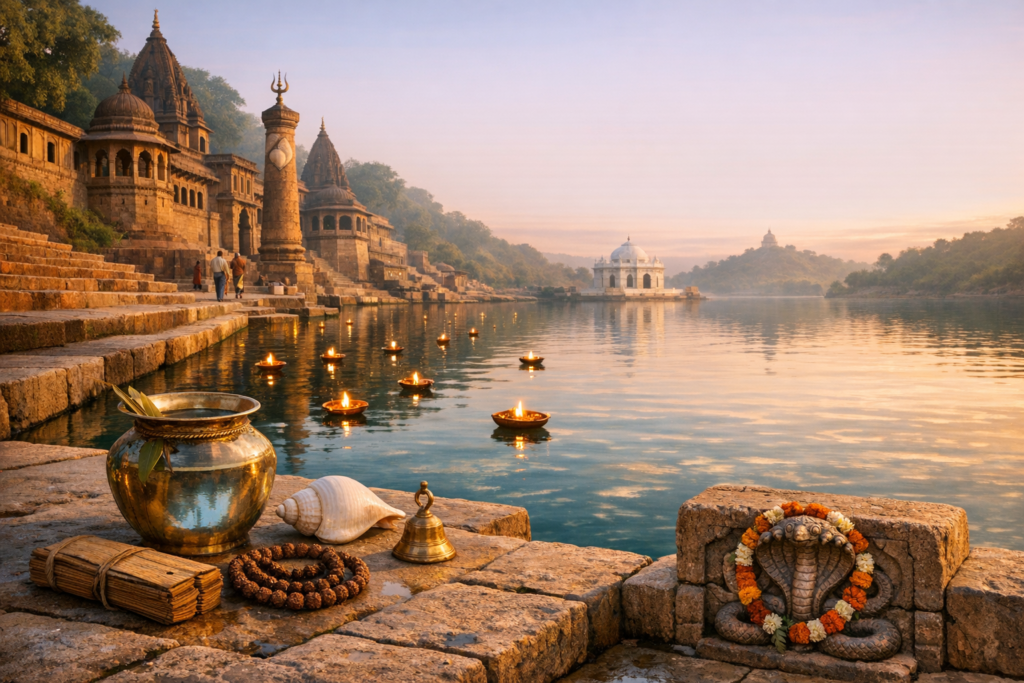
For those planning temple visits, riverbank snana, or collective sankalpa on April 17, 2026, mindful conduct safeguards ecological well-being and sacred spaces. Biodegradable offerings, minimal single-use materials, and attentive cleanliness at ghats and shrines preserve sanctity and align with dharma’s stewardship ethos.
Panchang data rests on precise astronomical calculations of the Sun–Moon longitude difference. Differences among published almanacs arise from inputs such as ephemeris source, ayanaṁśa (e.g., Lahiri/Chitra Paksha), and computational conventions (drik vs. vakya). The tithi change points given here—Amavasya until 5:13 PM IST on April 17 and Shukla Paksha Pratipada until 3:13 PM IST on April 18—are suitable for most regions of India on IST. For muhurat-sensitive rites (saṁskāras, marriage-related rituals, or graha-japa tied to specific lagnas), a city-calibrated Panchang or a competent jyotiṣa consultation remains essential.
Practical orientation for the day may be summarized as follows. Use Brahma Muhurta for contemplative practice, mantra, and breathwork. Undertake snana-dana and, where appropriate, Pitru Tarpana with sincerity and ecological care. Avoid Rahu Kalam, Yamaganda, and Gulika for new undertakings by deriving city-specific intervals from local sunrise and sunset. Prefer Abhijit Muhurat for concise, purpose-driven tasks that benefit from the day’s middling stability. As Shukla Paksha begins in the evening, set a thoughtful sankalpa for the coming fortnight and align preparations for Chaitra Navratri accordingly.
In sum, April 17, 2026 offers a clear arc: inward quiet and completion under Chaitra Amavasya through 5:13 PM IST, followed by the first spark of renewal with Shukla Paksha Pratipada. Recognizing the shared ethical center of India’s dharmic lineages—restraint, compassion, service, and remembrance—enriches the day’s observances and strengthens a culture of unity in diversity.
Inspired by this post on Hindu Blog.