On Monday, April 27, 2026, the Panchang for most regions records Shukla Paksha Ekadashi tithi (the eleventh lunar day of the waxing Moon) prevailing until 7:42 PM, after which it transitions to Shukla Paksha Dwadashi tithi (the twelfth lunar day). This daily Hindu calendar insight provides a precise anchor for observances, vrata discipline, and temple rituals aligned to the lunar day.
In many regional traditions, this Shukla Paksha Ekadashi of the Vaishakha month is commonly observed as Mohini Ekadashi, a vrata associated with sattvic restraint, clarity of mind, and devotion to Vishnu. While the devotional emphasis is Vaishnava in texture, related disciplines of non-violence, mindfulness, and self-restraint resonate across the dharmic spectrum, fostering unity in practice and intent among Hindu, Buddhist, Jain, and Sikh communities through shared values of compassion, remembrance, and service.
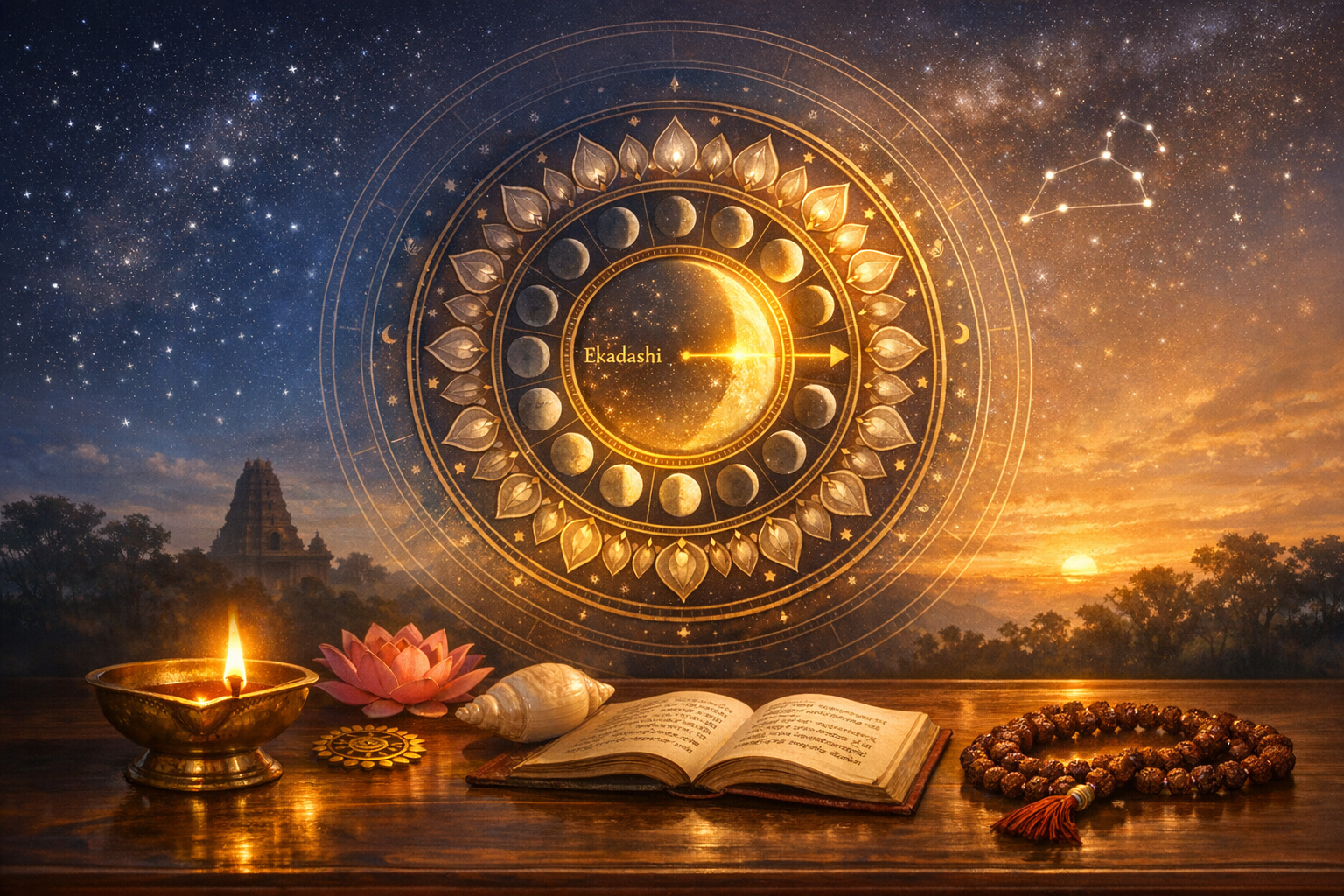
Technically, a tithi is defined by the increasing angular separation of the Moon from the Sun in the geocentric ecliptic frame. Each tithi spans 12 degrees of this separation; thus, Ekadashi maps the interval from 120° to 132°. Because the Moon’s speed varies and observance is sunrise-sensitive, a tithi can begin or end at any clock time, which explains why Ekadashi on April 27, 2026 concludes at 7:42 PM and Dwadashi begins thereafter.
For observance, Shukla Paksha Ekadashi is traditionally dedicated to upavāsa (fasting), japa (mantra repetition), and dhyāna (meditation), often accompanied by readings from Bhagavad-Gita and Vishnu Sahasranama. Householders and students frequently adopt a balanced approachmaintaining satvik meals or phalahar if full fasting is not feasiblewhile aligning the day with seva (service) and dana (charity). Such mindful restraint and reflective study harmonize readily with Buddhist Uposatha rhythms and Jain saamayika or posadha practices, as well as the contemplative remembrance and seva emphasized in Sikh tradition, underscoring shared civilizational ethics across dharmic paths.
Paranathe formal breaking of the Ekadashi fastshould be performed on Dwadashi. The general guidance is to break after sunrise on Dwadashi and avoid the first quarter of Dwadashi known as Hari Vāsara. Smarta and Vaishnava traditions follow specific refinements concerning mixed tithis and sunrise overlaps; therefore, local almanac guidance is prudent. Given that Dwadashi commences at 7:42 PM on April 27, 2026, parana will fall on the next morning, within the appropriate Dwadashi window for one’s location.
Regarding good time selection (Shubh Muhurat) for puja, sankalpa, and study, two daily anchors are widely noted. Brahma Muhurta occurs roughly 1 hour 36 minutes before local sunrise and is esteemed for meditation, scriptural recitation, and contemplative practice due to its quietude and mental luminance. Abhijit Muhurta centers on local midday and lasts approximately 48 minutes (roughly 24 minutes before and after local solar noon), often considered a strong all-purpose muhurta when other options are constrained.
Beyond these, regional traditions may consult Choghadiya for agile planning across the day. Daytime is divided into eight ghadi segments computed from local sunrise; segments named Amrit, Shubh, and Labh are preferred, while Rog and Udveg are generally avoided. Because each city’s sunrise shifts the segment boundaries, practitioners are advised to compute Choghadiya fresh for their locality on April 27, 2026 to align activities with auspicious segments.
Rahu Kaal, Yamaganda, and Gulika Kaal are commonly avoided for initiating new undertakings. Daytime is divided into eight equal parts from local sunrise to sunset; each weekday maps these sensitive intervals to specific parts. For Monday, Rahu Kaal typically falls in the second segment of the day; however, with changing sunrise and sunset, exact windows must be recalculated for the observer’s city. This method preserves both accuracy and the spirit of the Panchang.
The nakshatra and Chandra rashi (Moon sign) for April 27, 2026 depend on longitude, latitude, and time zone. As a general orientation, Shukla Paksha Ekadashi in the Vaishakha month often finds the Moon in Simha rashi across parts of the day, spanning the Magha–Purva Phalguni–Uttara Phalguni corridor of nakshatras; nevertheless, the precise nakshatra and transition timings should be confirmed from a location-specific Panchang or ephemeris. Nakshatra-based remedies and worshipsuch as honoring the presiding deity of the lunar mansioncan then be integrated with Ekadashi observances for a cohesive spiritual program.
Regional calendar conventions also shape naming and monthly alignment. Purnimanta calendars (common in North India) mark months from full moon to full moon, while Amanta calendars (common in many parts of South India) count from new moon to new moon. Despite naming differences, the operational coreShukla Paksha Ekadashi tithi prevailing until 7:42 PM on April 27, 2026 and Dwadashi thereafterremains the same, sustaining a unified rhythm of observance across regions.
For daily practice on this Panchang date, many households structure the day around three touchstones. Morning hours emphasize clean living, sankalpa, and quiet japa or patha during Brahma Muhurta. Midday Abhijit Muhurta is used for charitable intent, svadhyaya, or a concentrated period of dhyana. Evening satsang, bhajans, or readings consolidate the day’s momentum, carried forward into Dwadashi parana performed at the appropriate local time the next morning.
From a health perspective, Ekadashi’s dietary discipline can be adapted responsibly. Those observing nirjala (waterless) or phalahar fasts often transition with warm liquids or light satvik foods on Dwadashi to maintain digestive comfort. The vrata’s essence is inner clarity and compassionate conduct rather than austerity for its own sake; aligning with one’s capacity safeguards well-being while honoring the vrata’s spiritual intent.
In civilizational terms, this April 27, 2026 Panchang entry highlights an inclusive ethic: discipline without dogma, precision in timekeeping without sectarian rigidity, and devotion that coexists with inquiry. These hallmarksvisible in Hindu Panchang practice and mirrored in the mindful fasts and observances of Buddhism, Jainism, and Sikhismreflect a shared quest for self-mastery, ethical living, and universal goodwill. Observed in this spirit, Shukla Paksha Ekadashi on April 27, 2026 becomes a meeting point for dharmic unity, combining accurate calendar science with compassionate, cross-traditional wisdom.
Inspired by this post on Hindu Blog.