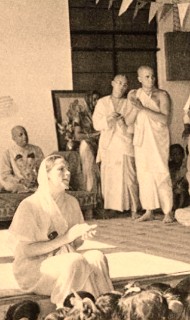
In an early morning gathering at Kailash Seksaria’s home, Srila Prabhupada introduced a new melody of Gurvastakam and invited several devotees to chant. After two lines from each, he stopped them and asked another to continue. When Yamuna Devi was asked to lead, he did not interrupt. Later, upon being asked why, he offered a concise directive that has become a guiding principle in the Bhakti Tradition: “Learn to listen. You cannot follow nicely unless you hear nicely, and you cannot lead nicely unless you have learned to follow nicely.”
This brief episode exemplifies a core pedagogical principle in Hindu spirituality and devotional chanting: attentive hearing (sravanam) precedes effective leadership. By repeatedly halting the chanting, Srila Prabhupada foregrounded the discipline of listening to rhythm, pitch, and the devotional mood before assuming the responsibility to guide others. The moment functions as a practical case study in the Role of Guru within the Guru-Shishya Relationship—training the senses and the heart so that kirtan becomes both aesthetically harmonious and spiritually elevating.
Many practitioners recognize the emotional clarity that follows such instruction. The quiet surprise of being asked to pause after only two lines can refine humility, sharpen concentration, and deepen responsiveness to the collective flow. In congregational kirtan, the capacity to hear the mrdanga, kartals, and the vocal assembly—before asserting one’s lead—transforms performance into communion, sustaining devotion rather than performance-driven intensity.
The listening-first principle resonates across dharmic traditions and underscores unity in spiritual diversity. In Sikh kirtan, attunement to Gurbani and sangati (synchrony) anchors leadership in seva and humility. In Buddhist practice, mindful chanting and breath awareness cultivate presence and receptivity before instruction. In Jain samayik, attentive hearing and restraint stabilize inner alignment. In Hindu bhajans and kirtan, the same ethic of careful listening nurtures collective devotion. This shared emphasis on humility, discipline, and service demonstrates a common foundation across Hinduism, Buddhism, Jainism, and Sikhism.
Applied practically, the teaching is straightforward: pause to hear the ensemble’s pitch and tempo; align breath and tone to the group’s center of gravity; allow the preceding voice to conclude before responding; and adjust volume and pace to preserve the sanctity of the mantra. Such habits of attentive listening stabilize kirtan dynamics, elevate congregational participation, and anchor the devotional mood in steadiness rather than haste.
Beyond music, the lesson articulates a universal leadership ethic: followership forms the foundation of trustworthy guidance. Whether in families, communities, or institutions, “hear nicely” enhances empathy, cooperation, and accountability. In the Guru-Shishya Tradition, this refinement of character is inseparable from technique—leadership in sacred arts matures only when rooted in disciplined listening and sincere devotion.
Srila Prabhupada’s concise instruction thus offers a complete framework for devotional practice: attentive hearing cultivates steady following; steady following matures into responsible leading; and responsible leading safeguards the collective spirit of kirtan. As practitioners of diverse dharmic paths honor this sequence, they discover a shared methodology that strengthens unity, deepens devotion, and sustains the living heritage of congregational chanting.
Inspired by this post on Dandavats.