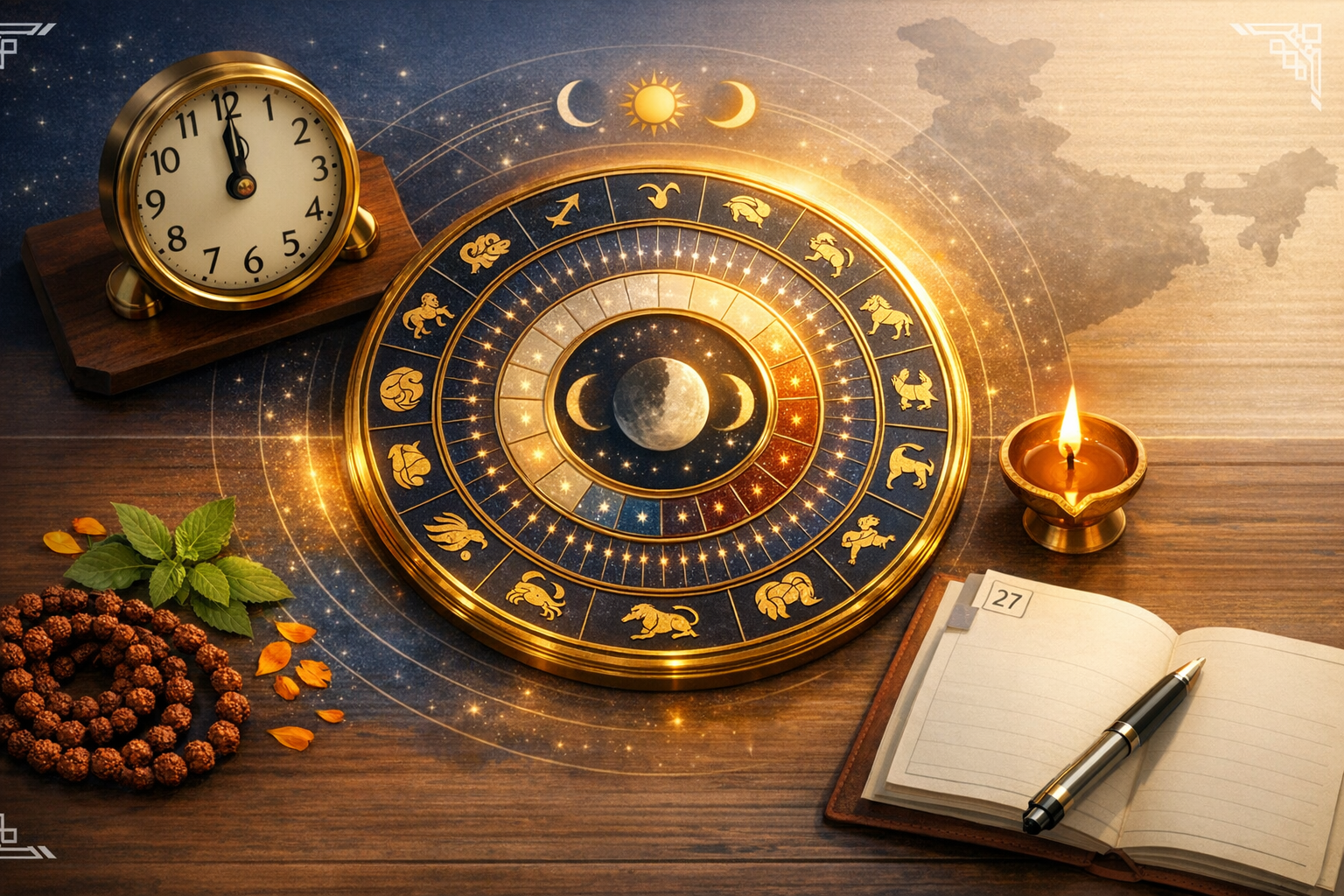
Friday, March 27, 2026, in the Hindu calendar (Panchang) observes Shukla Paksha Navami, the ninth lunar day of the waxing or light phase of the Moon, until 12:02 PM. From 12:02 PM onward, the day transitions to Shukla Paksha Dashami, the tenth lunar day, in most regions. This sequence is significant for daily puja, vrata planning, and muhurta selection across the Indian subcontinent.
Because Panchang elements depend on local sunrise, longitude, and latitude, exact observance windows can vary by location. The Navami-to-Dashami transition given here (12:02 PM) follows standard almanac reckoning for many regions; individuals should align ritual timing with their local Panchang if living far from standard time meridians or at higher latitudes.
Technical note on Tithi: In classical jyotisha, a tithi is defined by the longitudinal difference between the Moon and the Sun increasing in steps of 12 degrees. Shukla Paksha Navami commences the moment this difference crosses 96° and ends when it exceeds 108°, at which time Shukla Paksha Dashami begins. Because the Moon’s apparent motion is non-uniform, tithi durations vary day to day; hence calendar entries specify precise changeover times such as 12:02 PM for this date.
Calendar placement: In most Purnimanta (North Indian) and Amanta (South Indian) traditions, this date aligns with Chaitra Shukla Paksha. It also falls early in the traditional year counts used in many regions (e.g., close to the onset of the new Saka year), which lends added auspiciousness to intentional beginnings undertaken during the waxing fortnight.
Significance of Shukla Paksha Navami (before 12:02 PM): Navami during the bright fortnight is widely regarded as a sattvic and forward-moving phase that supports learning, disciplined sadhana, community service (seva), and steady project work. Devotees often offer worship to Sri Vishnu or Sri Rama, recite portions of the Ramayana, practice japa, or undertake light fasting consistent with health and local custom.
Significance of Shukla Paksha Dashami (from 12:02 PM onward): Dashami is traditionally favorable for progress-oriented tasks that require order, implementation, and consolidationfinalizing documents, organizing schedules, or advancing educational and professional milestones. Many households find that transitioning household chores and administrative work to Dashami hours provides a calm sense of completion by evening.
Placement of Sri Rama Navami (Madhyahna rule): The festival of Sri Rama Navami is determined by the tithi prevailing at Madhyahna (apparent midday). Because Shukla Paksha Navami ends at 12:02 PM on March 27, many regional Panchangs will place Sri Rama Navami on March 26, 2026, if Madhyahna locally occurs after the change to Dashami. Where Madhyahna still falls within Navami based on local calculations, observances may align on March 27. Devotional recitations and charitable acts on both days remain harmonious with dharmic intent and community unity.
Auspiciousness and general muhurta guidance: The waxing fortnight naturally favors constructive undertakings. Many almanacs regard Abhijit muhurta (centered on local solar noon) as broadly auspicious for initiating important actions when other muhurtas are unavailable. On this date, Abhijit muhurta may straddle the Navami–Dashami junction; those wishing to honor Navami-specific sankalpa commonly complete it before 12:02 PM, while tasks aligned with Dashami may commence after the transition.
Rahu Kalam, Yamaganda, and Gulika (Friday rule-of-thumb): On Fridays, Rahu Kalam typically falls in the late morning; for an approximate 6:00 AM sunrise, many regional almanacs list Rahu Kalam as 10:30 AM–12:00 noon, Yamaganda as 3:00–4:30 PM, and Gulika Kalam as 7:30–9:00 AM. These are location-dependent and scale with local sunrise times; planners should proportionally adjust to local conditions and avoid major undertakings during these intervals where tradition advises caution.
Nakshatra and Rashi considerations: Nakshatra (lunar mansion) and Chandra Rashi (Moon sign) shape the day’s psychological tone and task suitability. Fixed nakshatras (e.g., Rohini, Uttaraphalguni, Uttarashadha, Uttarabhadra) are classically preferred for stabilizing activities; movable nakshatras (e.g., Shatabhisha, Chitra, Swati, Punarvasu) better suit travel and outreach; mixed or tender nakshatras guide toward study, devotion, or healing. Because the nakshatra and Moon’s Rashi change with the Moon’s transit and local time, practitioners should reference their local Panchang for the exact lunar mansion and sign applicable to their city on March 27, 2026, and adapt activities accordingly.
Daily rhythm and practical planning: Many families complete Shukla Paksha Navami observances (light fasting, Vishnu/Rama archana, japa, or charity) before 12:02 PM, then use the Dashami period for implementation-focused tasks, budgeting, filing, or methodical study. Students often report steadier concentration for reading and revision in the Dashami window, while householders describe a felt sense of closure when chores and correspondence are finalized before dusk.
Shared dharmic resonance and unity: The Panchang’s lunar rhythm is part of a broader civilizational heritage that values mindful timekeeping and compassionate action. While Hindu communities observe the day as Shukla Paksha Navami to Dashami, related values are honored across dharmic traditionsBuddhist uposatha-inspired meditation, Jain ahiṁsā-centered sādhanā and pratikraman cycles, and Sikh seva and remembrance through kirtan and paath. Emphasizing shared ethicstruthfulness, non-violence, self-discipline, and servicestrengthens unity in diversity across Hinduism, Buddhism, Jainism, and Sikhism.
Health and vrata prudence: Those observing dietary restraint or fasting are encouraged to keep hydration and rest in view, adapting rigor to age, climate, and medical guidance. The spirit of vrata is inner clarity and compassion; the observance is best upheld when it enhances well-being and family harmony.
Key takeaways for March 27, 2026: Plan Navami-specific devotions in the forenoon before 12:02 PM; shift to Dashami-aligned work after the transition. Where major undertakings cannot be rescheduled, consider Abhijit muhurta while remaining mindful of Friday’s Rahu Kalam and related intervals. Let the day’s waxing light encourage balanced progresssustained sadhana in the morning and steady implementation in the afternoonsupporting both spiritual intent and practical success.
Inspired by this post on Hindu Blog.