Tuesday, March 10, 2026 aligns with Krishna Paksha Saptami tithi in the Hindu calendar (Panchang) across most regions. The tithi—being the seventh lunar day of the waning or dark fortnight—prevails throughout March 10 and continues until 12:11 AM on March 11. From that moment onward, the next lunar day (Ashtami) begins in the Krishna Paksha sequence. As always with Panchang computations, minor regional and time-zone variations may occur, so local almanacs should be consulted for precise timings.
In Panchang science, a tithi is defined by the relative angular separation between the Moon and the Sun. Each tithi spans a 12-degree elongation; Saptami corresponds to the interval when this elongation lies between 72° and 84°. Because the Moon’s apparent motion is not uniform, tithi boundaries rarely synchronize with civil midnights or sunrises. The recorded end time of 12:11 AM on March 11 (commonly referenced in Indian almanacs using IST as the basis) reflects this astronomical reality.
Krishna Paksha, the waning phase, is traditionally associated with inwardness, consolidation, and reflective practice. Within that arc, Saptami often encourages measured actions that balance pragmatism and devotion. The weekday context—Tuesday (Mangalvār)—is linked in many households with worship of Hanuman or Subrahmanya (Skanda), guiding disciplines of courage, service, and self-restraint. Families frequently report that the evening lamp-lighting, a brief japa, or recitation of a favorite stotra on Krishna Paksha Saptami fosters calm, continuity, and moral clarity.
Auspicious-time selection (muhurta) for activities on March 10, 2026 is best approached methodically. Abhijit Muhurta—centered around local solar noon—has a traditional reputation for balance and success, particularly for administrative decisions, correspondence, and modest initiations. While exact windows depend on sunrise, sunset, and latitude/longitude, the principle remains consistent: align key undertakings with supportive solar and lunar measures and avoid the inauspicious blocks that tradition highlights.
Day-to-day cautionary periods include Rahu Kaal, Gulika Kaal, and Yamaganda. Their placement rotates by weekday and is computed as fractional segments of the time from sunrise to sunset. On Tuesdays, Rahu Kaal typically falls in the afternoon; with a 12-hour day, a common approximation places it near 3:00–4:30 PM local time, though exact clocks vary with day length and latitude. Many practitioners therefore avoid initiating consequential ventures—financial signings, first medical doses, travel starts—during these spans, preferring to reserve them for neutral or auspicious intervals.
Regional systems like Choghadiya, especially prevalent in Gujarat, Rajasthan, and Mahārāṣṭra, divide daytime and nighttime into segments named Amrit, Shubh, Labh, Chara, Udveg, Kaal, and Rog. Broad guidance classifies Amrit, Shubh, and Labh as favorable; Chara as mobile/neutral; and Udveg, Kaal, and Rog as avoidable. When in doubt—especially for travel departures or contractual commitments—cross-checking Choghadiya with Abhijit Muhurta and the weekday doshas provides a practical, evidence-informed approach that harmonizes lived experience with almanac theory.
Nakshatra and Rashi for March 10, 2026 are determined by the Moon’s sidereal longitude at any given moment. The Moon’s placement against the 27 Nakshatras (each spanning 13°20′) and its sign (Rashi) frame the day’s qualitative fabric in Vedic astrology (Jyotiṣa). Because Moon transits can shift across a calendar day—and because almanacs may adopt different ayanāṁśa baselines (e.g., Lahiri/Chitrapaksha)—the operative Nakshatra and Rashi may vary by location and by the chosen Panchang tradition. Localized Panchang or observatory-grade ephemerides remain the gold standard for definitive identification.
The monthly designation of this Krishna Paksha Saptami likewise follows regional calendar conventions. In much of northern India (Purnimanta system), this tithi would ordinarily belong to the Krishna half of Phalguna, while in the southern Amanta system it typically aligns with Phalguna Krishna as well but month starts differ. Correlates across linguistic calendars include Maasi (Tamil), Kumbham (Malayalam), and Phagan/Fagun (Gujarati/Bengali colloquial usage). Such cross-mapping illustrates the unity-in-diversity of Hindu calendrical practice: differing labels, one coherent astronomical cadence.
These calendrical rhythms are shared across the wider dharmic world. Theravāda Buddhist communities observe Uposatha on lunar days for mindfulness and ethical renewal; Jain traditions align vrata, Sāmāyika, and Pratikraman with lunar markers to cultivate restraint and compassion; Sikh communities primarily follow the Nanakshahi (solar) calendar yet maintain cultural literacy of the Bikrami lunisolar reckoning for heritage observances. Seen together, the Panchang on a day like March 10, 2026 becomes a bridge: it invites meditation, service (seva), and inter-tradition respect grounded in a common sky.
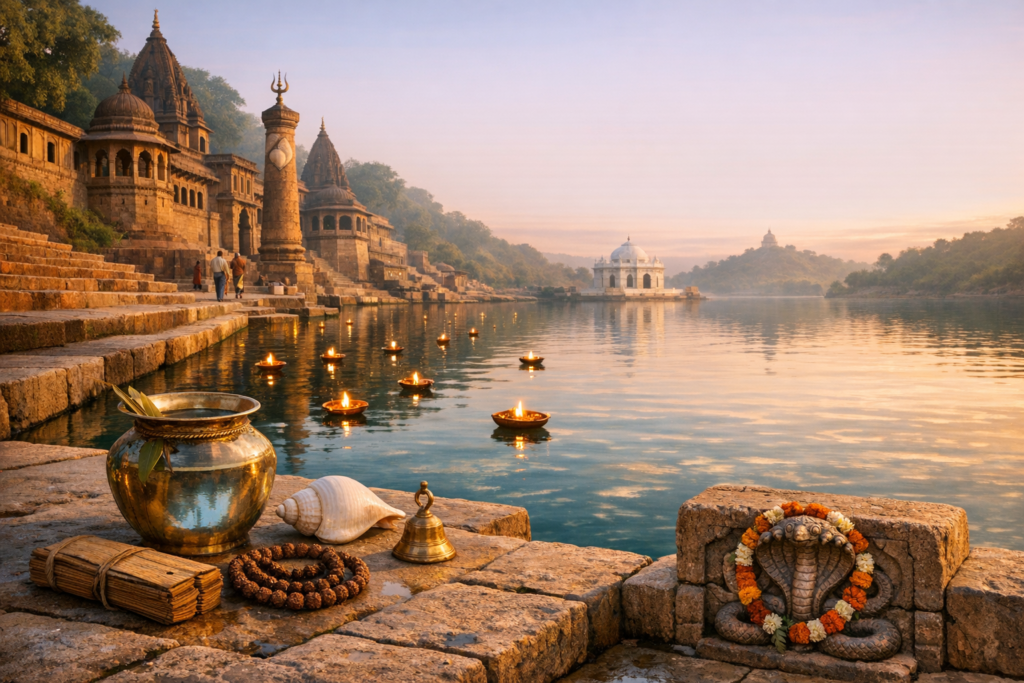
For household practice on Krishna Paksha Saptami, many families prefer steady, sustainable routines over grand undertakings. Lighting a diya at dusk, a brief recitation from core scriptures (for example, Bhagavad Gītā for reflection, Dhammapada verses for mindful ethics, Jain āgama excerpts on ahiṁsā, or Naam Simran passages known in Sikh tradition), and a small act of charity form a coherent triad: illumination, insight, and action. Such practices harmonize with the introspective tenor of the waning Moon while honoring the inclusive, dharmic ethos of Sanatana Dharma.
Those seeking to operationalize Panchang guidance can follow a simple protocol: identify local sunrise and sunset; note the tithi in force at intended start times; screen the afternoon for Tuesday’s Rahu Kaal; cross-check a favorable Choghadiya (Amrit/Shubh/Labh) that overlaps the planned window; and, if possible, converge on the vicinity of Abhijit Muhurta for balanced initiatives. This layered method respects astronomy (Sun and Moon positions), tradition (weekday doshas), and practical timing (work and family constraints).
Technical precision matters. Differences among Drik/Vākya Panchang computations, observatory sources, and ayanāṁśa choices can result in small yet meaningful variations in tithi end times, Nakshatra rollovers, and yoga/karana markers. For communities in the diaspora—especially where Daylight Saving Time shifts and higher latitudes alter day lengths—reliance on location-aware Panchang tools or local temple almanacs ensures the most faithful synchronization with the sky above.
In summary, March 10, 2026 (Tuesday) is governed by Krishna Paksha Saptami throughout the civil day and up to 12:11 AM on March 11, after which Ashtami commences. The day favors steady, reflective actions; careful muhurta selection can further enhance outcomes. By engaging Panchang thoughtfully—tithi, Nakshatra, Rashi, and weekday considerations—households and communities can connect astronomy with spirituality, and culture with conscience, reinforcing a lived unity across Hindu, Buddhist, Jain, and Sikh traditions.
Inspired by this post on Hindu Blog.