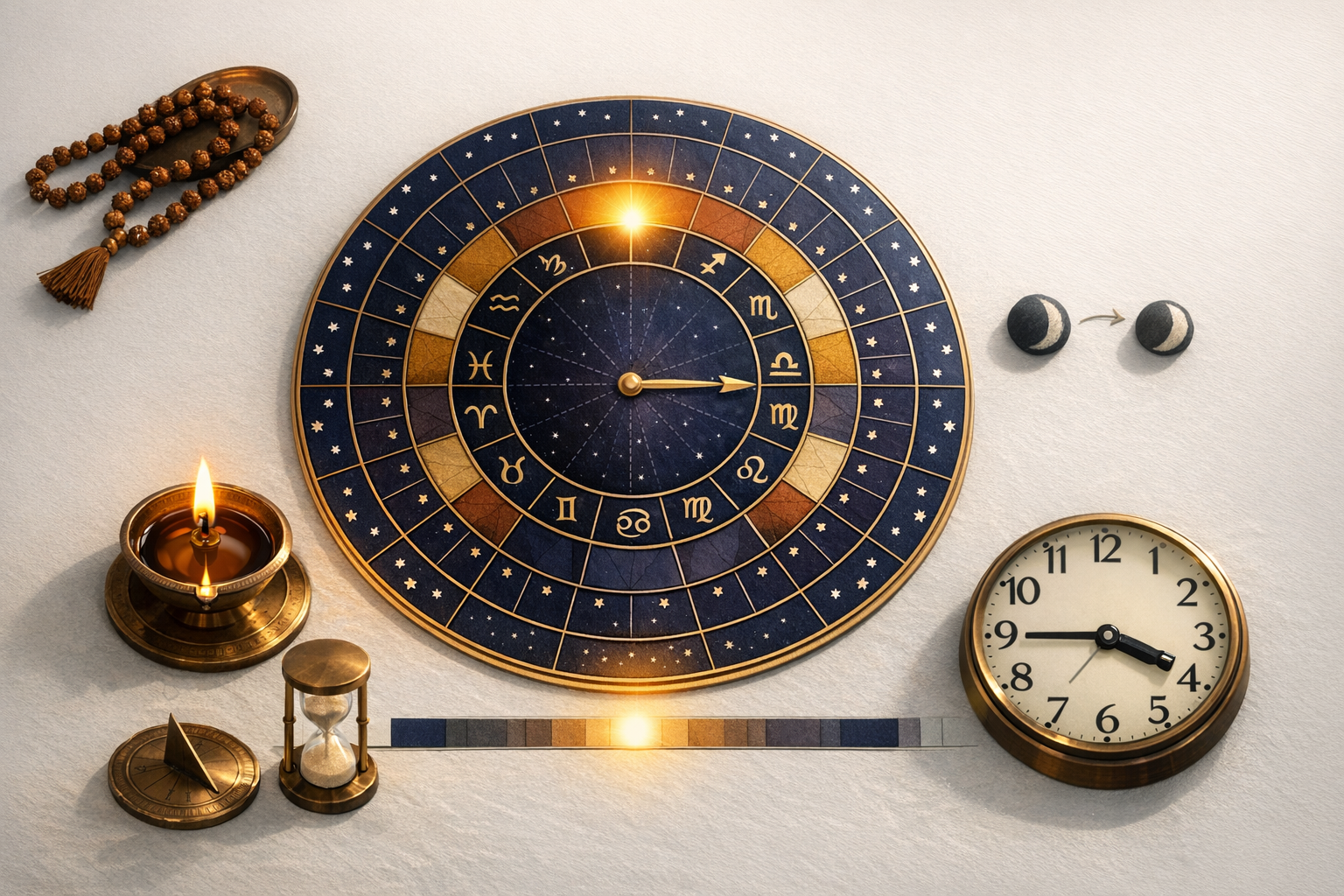
Monday, June 1, 2026, aligns with Krishna Paksha Pratipada in most regional Panchangs and Hindu calendars. The tithi remains Krishna Paksha Pratipada until approximately 3:04 PM (IST), after which it transitions to Krishna Paksha Dwitiya for the remainder of the day and night. This shift marks the opening movement of the waning half of the lunar month and is observed in household and temple routines across regions with minor local variations.
In the technical language of the Panchang, a tithi is defined by the angular distance between the Moon and the Sun, measured in segments of 12 degrees. When the lunar elongation crosses multiples of 12 degrees, the tithi changes. Krishna Paksha designates the dark fortnight following Purnima, during which the Moon’s illumination gradually decreases. Pratipada, the first tithi of this fortnight, inaugurates a contemplative arc that traditionally emphasizes restraint, inner alignment, and the steady organization of life’s essentials.
Krishna Paksha Pratipada carries an understated, organizing quality. Many households use this opening day of the waning phase to put affairs in orderclearing spaces, simplifying routines, and setting a tone of measured, mindful action. As the day progresses and Dwitiya begins at around 3:04 PM (IST), activities that require patient follow-through, careful communication, and steadiness of intent are generally favored.
When taking a sankalpa for puja, vrata, homa, or japa on this date, the correct tithi name should be included according to the time at one’s location. Before the transition, the sankalpa references Krishna Paksha Pratipada; afterward it should reference Krishna Paksha Dwitiya. This detail-oriented approach helps practitioners maintain fidelity to Vedic and Smarta procedural norms while honoring regional sampradayic customs.
Shubh Muhurat selection on June 1, 2026 benefits from standard Panchang principles. Abhijit Muhurat, the auspicious midpoint around local solar noon, is commonly employed for initiating non-mangalik, everyday undertakings when specialized muhurats are unavailable. Because Abhijit is calculated around exact local solar noon (not simply clock noon), practitioners are advised to verify it using a location-specific Panchang or muhurat calculator to account for longitude, equation of time, and the day’s sunrise–sunset span.
Equally important are inauspicious windows such as Rahu Kalam, Gulika Kalam, and Yamaganda. These are derived by dividing the interval between sunrise and sunset into eight equal parts and assigning each part according to the weekday scheme. For Mondays, the Rahu Kalam segment typically falls in the morning when computed from local sunrise; however, the exact clock time depends on the day length at one’s location. For reliable planningparticularly for travel, financial decisions, first-time initiations, and major signingsconsult a location-aware Panchang to avoid these intervals.
Nakshatra and Rashi for a given date are computed from the Moon’s geocentric ecliptic longitude at the place and time in question. Nakshatra demarcations are in 13°20′ segments, while Rashi spans are 30°. Because the Moon traverses roughly 12–13 degrees per day, nakshatra or even rashi can change within the same date, and sometimes within daylight hours. For June 1, 2026, observers should refer to a trusted regional almanac, noting that sunrise-based Panchang conventions may list the nakshatra prevailing at sunrise and will indicate any change during the day.
Yoga and Karanatwo further Panchang limbsrefine muhurat selection. Yoga is computed from the sum of the longitudes of the Sun and Moon and apportioned into 27 equal parts; Karana divides each tithi into two halves and cycles through a sequence that includes the moveable Karanas (Bava, Balava, Kaulava, Taitila, Garija, Vanija, Vishti/Bhadra) and a few fixed Karanas. Because Yoga and Karana may also change during the day, accurate muhurat decisions should reference a dynamic, location-specific Panchang rather than a static date-only listing.
Practical planning on a Pratipada→Dwitiya day often follows a simple rhythm. Before the tithi shift, activities that align with beginning the inward, restorative arc of Krishna Pakshaorganizing ledgers, resetting routines, and initiating sadhana with a reflective focusare well placed. After the shift to Dwitiya, undertakings that reward persistence and methodstudy, careful correspondence, or detailed craftare commonly emphasized.
In many regions, 2026 features an intercalary month, Adhik Jyeshta Maas 2026, to harmonize the lunar and solar calendars. Depending on whether a community follows the Amanta or Purnimanta reckoning, and local sunrise rules, dates around June 1 may be mapped into either Jyeshta or Adhik Jyeshta in published almanacs. This is normal and does not imply disagreement in principle; it reflects different traditional frameworks that lead to the same long-term astronomical alignment.
Across dharmic traditions, the early days of the dark fortnight offer a shared, unifying emphasis on inwardness, ethical clarity, and compassionate action. Many Hindu households choose simple upasanalighting a lamp, offering water, or chanting a chosen mantrawith care to the tithi in the sankalpa. Practitioners in Buddhist lineages may dedicate the day to mindfulness of breath and metta (loving-kindness), Jain communities often observe sāmāyika (periods of equanimity) or pratikraman (gentle self-review), and Sikhs may lean into Nitnem, kirtan, and seva. The common thread is intentionality and service: aligning daily conduct with truthfulness, ahimsa, dana, and remembrance of the Divine.
Those planning significant rites such as griha-pravesh, annaprashan, or engagements typically avoid Rahu Kalam and Vishti (Bhadra) Karana and prefer windows supported by the day’s nakshatra, yoga, and tara-bala. When specialized muhurats are not required, Abhijit Muhurat or Choghadiya-based selections can serve well for routine beginnings, provided local calculations are observed. For travel starts, beginning just after an inauspicious interval rather than just before it is a time-tested rule of thumb.
The academic foundations of the Panchang rest on the precise mapping of celestial longitudes and agreed-upon traditional rules for translating those longitudes into calendrical elements. Differences between Drik (modern observational/ephemeris-based) and Surya Siddhanta (classical siddhantic) computations can shift times by minutes and occasionally an hour or two. Hence, practitioners are encouraged to consistently follow one method and one reputable Panchang to avoid confusion arising from method-mixing.
For personal well-being, the Pratipada→Dwitiya span invites a quiet recalibration. Many find that a short period of breath awareness at sunrise, a commitment to simplified meals, and an act of sevasuch as annadanam or community assistanceset a compassionate trajectory for the fortnight. Aligning the day’s work with the Moon’s waning tone can be as simple as prioritizing completion, decluttering, and thoughtful dialogue over impulsive expansion.
Because the tithi transition on June 1, 2026 occurs in the afternoon, one practical approach is to segment the day: use the Pratipada window before 3:04 PM (IST) for initiating inward-facing or corrective tasks, and the Dwitiya window afterward for sustained study, correspondence, and detailed craft. Those who observe evening puja or sandhya should name the tithi in accordance with the time of worship, ensuring procedural accuracy in sankalpa.
For students of astrology and muhurta, this date is a good case study in cross-checking. One can compare Abhijit Muhurat, Rahu Kalam, and the nakshatra change (if any) across two or three reliable sources and note small but instructive differences arising from local sunrise, time zones, and computational baselines. Such comparative study deepens literacy in the Panchang and fosters confidence in daily application.
Finally, unity in diversityan enduring principle across Hinduism, Buddhism, Jainism, and Sikhismnaturally expresses itself in how communities relate to the calendar. There is no compulsion to homogenize practice; rather, the Panchang invites a shared reverence for time as sacred. Observing Krishna Paksha Pratipada and Dwitiya on June 1, 2026 with mindful conduct, truthful speech, and service to others honors that shared ideal, whatever the specific sampradaya.
Inspired by this post on Hindu Blog.