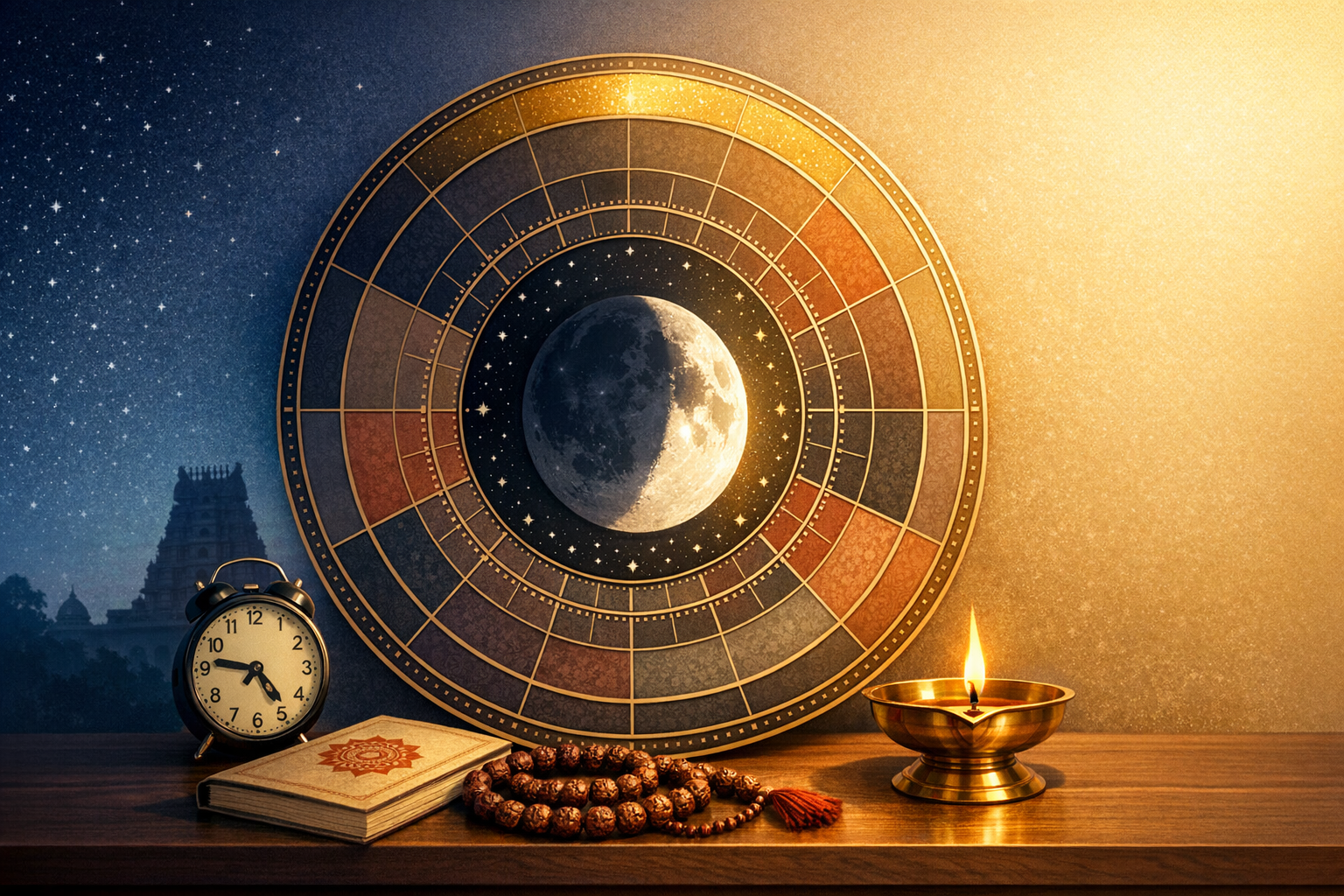
On Wednesday, February 25, 2026, according to the Hindu calendar (Panchang), the day begins with Shukla Paksha Ashtami (the eighth tithi of the waxing phase of the Moon) lasting until 4:47 AM. From 4:47 AM onward, it is Shukla Paksha Navami (the ninth tithi of the waxing phase) for the remainder of the civil day in most regions. The phrase “in most regions” reflects standard Panchang practice using Indian Standard Time (IST); local sunrise, longitude, and time zone may shift the clock reading of the transition.
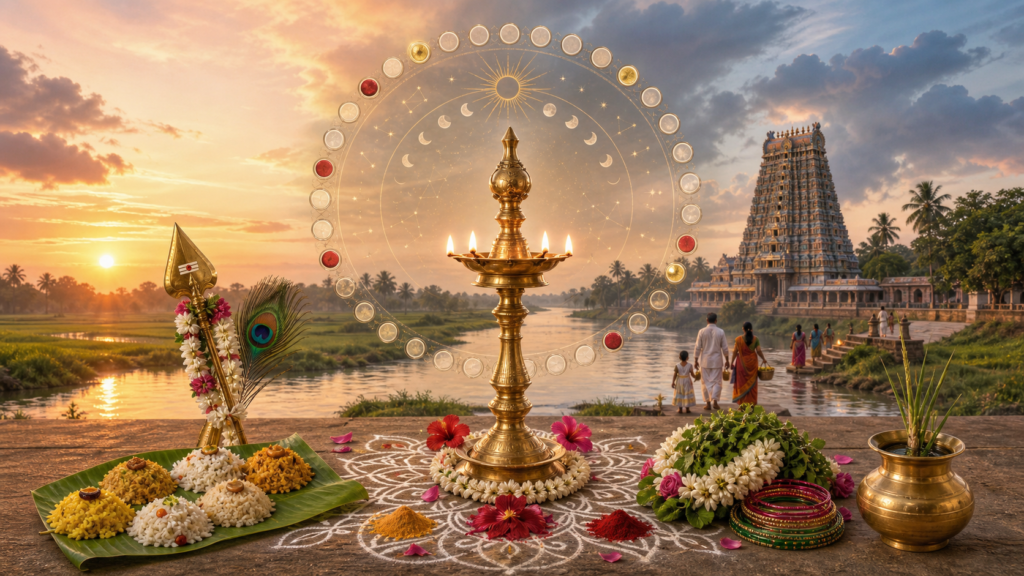
Tithi in the Panchang is defined by the angular separation between the Moon and the Sun. Each tithi spans 12 degrees of elongation: Ashtami corresponds to 84–96 degrees and Navami to 96–108 degrees. Because the Moon’s motion is non-uniform, a tithi rarely aligns with a civil day from midnight to midnight and can begin or end at any hour, which explains the pre-dawn handover from Ashtami to Navami on this Wednesday.
Computationally, the operative quantity is D = (Lunar longitude − Solar longitude) mod 360°. The tithi index is floor(D/12) + 1, and a change of tithi occurs whenever D crosses an integer multiple of 12°. Traditional Indian almanacs compute with sidereal longitudes (commonly using Lahiri ayanāṁśa), which should be used for high-fidelity results when deriving city-specific muhurta for February 25, 2026.
Within Shukla Paksha, Ashtami emphasizes purification and steadiness after the fortnight’s early acceleration, while Navami supports consolidation, clarity, and dharmic resolve. Monthly Shukla Navami is distinct from festival observances such as Chaitra Shukla Navami (Rama Navami), yet it is widely regarded as favorable for svādhyāya (scriptural study), seva (service), and sattvic vrata. Many households experience midweek Navami as a balanced interval for thoughtful planning and conscientious action.
Good Time windows (auspicious timings) are frequently anchored by Abhijit Muhurta, centered on local solar noon and lasting approximately 48 minutes (about 24 minutes on either side of local midday). Because Abhijit depends on actual sunrise and sunset at one’s location, the precise interval on February 25, 2026 should be derived from the local noon. This mid-day muhurta is traditionally sought for beginnings requiring fairness, clarity, and steadiness, while respecting family and sampradāya guidelines.
Conversely, Rahu Kalam, Yamagandam, and Gulika Kalam are typically avoided for initiating travel, contracts, or first-time ceremonies. These are computed by dividing the daylight interval (sunrise to sunset) into eight equal parts and assigning weekday-specific segments. For Wednesday, Rahu Kalam falls around the middle of the day; with near-equinox daylength in India as a rough illustration, it often appears close to the fifth eighth of daylight. Because these intervals shift with sunrise and sunset, exact clock times should always be recalculated from local daylength rather than assumed from a single nationwide schedule.
The day’s Nakshatra and the Moon’s Rashi (sidereal sign) refine the Panchang’s interpretive texture. Nakshatra divides the ecliptic into twenty-seven arcs of 13°20′ each, while Rashi indicates the Moon’s sign in the sidereal zodiac. On days with a pre-dawn tithi transition, the Moon may lie near a Nakshatra boundary, subtly influencing the day’s psychological tone and recommended activities. As these parameters are time- and location-sensitive and are not included in the original notice, a reliable local Panchang or astronomical tool (using Lahiri ayanāṁśa) should be consulted for the exact Nakshatra and Moon Rashi for one’s city on February 25, 2026.
Yoga (a function of the combined longitudes of the Sun and Moon) and Karana (half-tithis) further nuance auspiciousness. Eleven Karanas recur in a known sequence, and a Karana change near dawn can slightly adjust preferred windows for travel, learning, or household rites. In practical selection, many consult tithi first, then cross-check Yoga, Karana, and the Moon’s Nakshatra and Rashi before finalizing a muhurta.
Regions that employ Choghadiya, especially in western India, complement the Panchang with day and night cycles of roughly 96-minute segments whose lengths scale with local daylength. On a Wednesday, segments labeled Amrit, Shubh, and Labh are generally preferred for beginnings, while Kaal and Rog are commonly avoided; Udveg and Char are context-dependent. For February 25, 2026, the sequence and clock times should be drawn from a city-specific Choghadiya computed from that day’s sunrise and sunset.
Regional practice can vary with Amanta versus Purnimanta month systems, temple traditions, and, for communities outside India, daylight saving adjustments and longitude. Diaspora households often coordinate with a local temple’s Panchang or their ancestral sampradāya to maintain coherence while honoring local astronomical reality. This approach preserves cultural continuity and precision in muhurta.
Across the dharmic traditionsHinduism, Buddhism, Jainism, and Sikhismthe lunar rhythm echoes a shared ethos of mindfulness, ethical restraint, and compassionate service. While the vocabulary differsUposatha in Buddhism, Poshadha in Jainism, vrata and sankalpa in Hindu practicethe waxing and waning cycle invites introspection, study, remembrance of the Divine, and seva. The Nanakshahi calendar structures Sikh commemorations, and its emphasis on truthful living, remembrance (Naam), and community service resonates with the spirit in which many approach auspicious time on a Panchang day.
For practical planning, this Wednesday’s early-morning shift from Ashtami to Shukla Paksha Navami favors learning, thoughtful decision-making, and measured initiatives. Activities may be aligned to Abhijit Muhurta, while Rahu Kalam is typically avoided for first-time signatures or launches. Temple darshan, quiet japa, daan, and community service fit well across the day; final choices can be fine-tuned by retrieving Nakshatra, Rashi, Yoga, and Karana from a trusted local Panchang for one’s city.
In summary: Shukla Paksha Ashtami ends at 4:47 AM on February 25, 2026 (IST in most regions), and Shukla Paksha Navami prevails thereafter. All other auspicious windowsAbhijit Muhurta, Choghadiya segments, and weekday doshas (Rahu Kalam, Yamagandam, Gulika)should be computed from the local sunrise and sunset to ensure accuracy and alignment with tradition.
Inspired by this post on Hindu Blog.