The Mahabharata occupies a singular position in Indian epics for its rigorous, unsentimental examination of moral complexity. Rather than resolving ethical life into simple binaries of heroes and villains, the text frames human action as an ongoing negotiation between dharma and adharma under conditions of uncertainty, competing duties, and irreversible consequences. Its characters are luminous not because they are flawless, but because their struggles are recognizably human and their choices profoundly instructive for a shared dharmic conversation across Hinduism, Buddhism, Jainism, and Sikhism.
In constructive contrast to the Ramayana’s vision of Maryada Purushottama an ideal of rectitude that inspires aspirational ethics the Mahabharata functions as a laboratory of decision-making in the real world. The two epics are thus complementary: one provides a stable moral horizon, the other maps ethical navigation when horizons are clouded. Together they enrich Sanatana Dharma by illuminating both principled ideals and contextual judgments, reinforcing unity rather than inviting sectarian comparison.
Structurally, the Mahabharata is a polyphonic itihasa. It embeds law-like prescriptions within case studies, dialogues, and narrative reversals across parvas such as Sabha, Vana, Udyoga, Bhishma (which houses the Bhagavad Gita), Shanti, and Anushasana. This interweaving invites readers to test abstract principles against lived complexity, much as jurists reconcile śruti-smṛti norms with loka (custom) and vyavahāra (practice) in Dharmashastra reasoning.
Central to the epic’s moral architecture is the stratification of duty: sāmānya dharma (universal norms such as truthfulness and compassion), sva-dharma (role- and temperament-specific obligations), kula-dharma (family or community codes), rāja-dharma (duties of statecraft), and āpaddharma (exceptional measures in crisis). The friction among these layers generates what the text repeatedly stages as dharma-saṅkaṭa genuine dilemmas in which any choice bears moral cost.
This layered view anticipates sophisticated ethical debates: deontological adherence to rules versus consequentialist assessments of outcomes, integrity of means versus necessity, and the prudence required in governance. Shanti Parva and Anushasana Parva explicitly parse rāja-dharma and dāna-dharma, acknowledging that realpolitik (nīti) must remain answerable to higher dharma even when emergencies (ātayāyika conditions) permit otherwise prohibited measures.
A broader dharmic lens affirms this many-sidedness. Jain anekāntavāda counsels humility before complex truth; the Buddhist Madhyama Mārga offers a middle way that avoids moral absolutism and nihilism; Sikh miri-piri integrates temporal responsibility with spiritual discipline. Read together, these traditions reinforce the epic’s insight: grey shades are not moral relativism, but disciplined acknowledgment of partial perspectives within a larger ethical whole.
Consider the dice game in Sabha Parva. Yudhiṣṭhira, renowned as Dharmarāja, submits to a rigged invitation, exposing a fissure between private virtue and public prudence. His acceptance honors courtly duty and hospitality codes, yet it neglects the king’s responsibility to safeguard dependents from foreseeable harm. The humiliation of Draupadī that follows indicts not a single individual, but a failure of collective conscience and institutional restraint.
Draupadī’s juridical challenge asking whether a person who has staked and lost himself retains capacity to stake another dramatizes procedural justice versus raw power. Her argument enlists sāmānya dharma (human dignity) against predatory custom, making the sabhā a classroom for legal reasoning and moral courage. The text thereby honors agency and sharpens the distinction between ritual compliance and ethical legitimacy.
Bhīṣma embodies the burden of vows. His terrible pledge of celibacy safeguards a dynasty but binds him to a chain of consequences that repeatedly compromise compassionate judgment. His silence in the assembly and his fidelity to the throne, even when policy veers toward adharma, illustrate how a righteous intention tethered to rigid form can shade into complicity. His later expositions in Shanti Parva on rāja-dharma and ahiṃsā versus kṣātra-duty register a hard-earned evolution: principled flexibility.
Droṇa’s arc explores the duties of a teacher and the ethics of access. His exacting standards elevate Arjuna, yet episodes such as Ekalavya’s severed thumb expose structural constraints and anxieties about skill, status, and social order. The narrative does not sanctify exclusion; it displays the enduring tension between preserving standards and ensuring fairness, a tension recognizably addressed across dharmic traditions that prize both excellence and compassion.
Karna personifies tragic loyalty. His unmatched generosity and steadfast friendship with Duryodhana win admiration, yet his consent to Draupadī’s humiliation and his participation in conspiracies against the Pāṇḍavas entangle noble qualities in ignoble ends. The Mahabharata resists a reductive verdict: it invites readers to see how systemic injustice, wounded honor, and gratitude can shape allegiance, even as dharma demands that allegiance be tested against first principles.
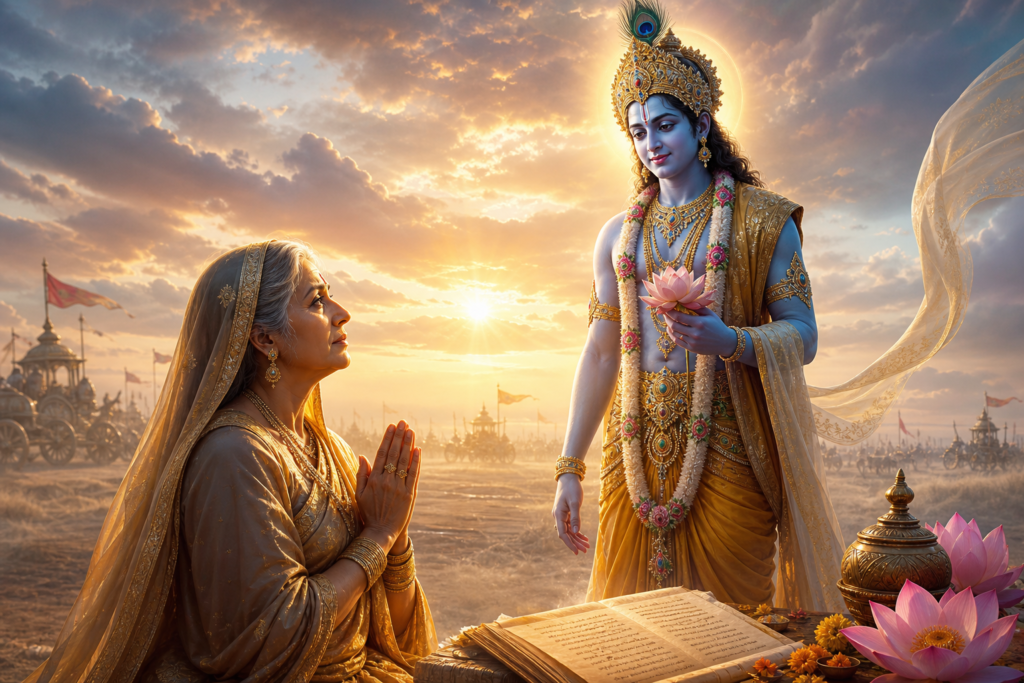
Śrī Krishna’s statecraft is often cited as the epic’s most debated ‘grey’ terrain. Deployed as a last-resort strategist under āpaddharma, he sanctions asymmetrical tactics placing Śikhaṇḍī before Bhīṣma, or prompting the announcement ‘Aśvatthāmā is slain’ to disarm Droṇa when adversaries have already violated Dharma-Yuddha norms. The text frames these as bounded exceptions under crisis, not as blank checks. Their moral force rests on two tests: exhaustion of peaceful options (Udyoga Parva’s failed diplomacy) and alignment with the restoration of justice, not private gain.
Arjuna’s hesitation before battle, set against the iconic line dharma-kshetre kuru-kshetre, culminates in the Bhagavad Gita’s synthesis of karma-yoga, jñāna, and bhakti. The instruction is not a license for violence; it is a pedagogy for action purified of ego, undertaken as sva-dharma with equanimity, in service of loka-saṅgraha (the sustaining of the social order). The Gita’s remedy for paralysis is discernment, not zeal.
Truthfulness provides another instructive edge case. Yudhiṣṭhira’s half-truth about Aśvatthāmā a moral compromise that collapses his chariot’s fabled levitation underscores that tactical speech in crisis carries karmic residue. Shanti Parva’s discussions of exception remind readers that permitted is not equivalent to costless; an ethically necessary act may still incur a burden to be acknowledged, atoned for, and educated from.
Bhīma’s strike on Duryodhana’s thigh fulfills a public vow and avenges Draupadī’s insult, yet violates gada-yuddha conventions. The scene lays bare the tragic symmetry of norm erosion in protracted conflict: as breaches accumulate from Abhimanyu’s unlawful killing to nocturnal ambushes the ideal of Dharma-Yuddha yields to survival logic. The epic neither excuses nor sensationalizes this slide; it records moral injury as a civic fact that later governance must heal.
Śikhaṇḍī’s role unsettles simplistic readings of identity and valor. Bhīṣma’s choice to refrain from combat against Śikhaṇḍī, and Krishna’s decision to position Śikhaṇḍī before Arjuna, foreground the ethics of proxy, vow, and recognition. Rather than marginalizing, the narrative integrates complexity into the fabric of dharma, a stance resonant with a dharmic ethos that honors lived realities without erasure.
Aśvatthāmā’s night raid and the unleashing of the brahmāstra supply an epic analogue to debates about catastrophic weapons and collective punishment. His subsequent remorse, renunciation of the jewel, and the containment of devastation by Krishna and the Pāṇḍavas reassert a core principle: strength devoid of restraint imperils the very dharma it claims to defend.
Vidura-nīti in Udyoga Parva articulates governance counsel grounded in prudence, fairness, and foresight. Advising Dhṛtarāṣṭra to prevent war through justice and timely concession, Vidura’s maxims parallel the later rāja-dharma expositions of Shanti Parva and, in spirit, the statecraft sobriety of Arthasastra. The point is not cynicism, but the ethical calibration of might to right.
Udyoga Parva also preserves the record of exhausting peace: Krishna’s embassy, the Pāṇḍavas’ reduced claim for five villages, and Duryodhana’s refusal. This meticulous documentation of due process matters. Dharma-Yuddha is framed as a last resort after diplomacy, mediation, and fair compromise have failed, a sequence that honors ahiṃsā as a governing aspiration within kṣātra-dharma.
Amid polarities, seemingly minor figures illuminate decisive integrity. Yuyutsu’s defection from the Kaurava camp to side with dharma exemplifies the priority of conscience over clan. The epic thereby democratizes virtue: moral clarity is not the preserve of the most famous names.
Postwar, Shanti Parva and Anushasana Parva undertake the arduous work of reknitting society: limits on royal power, protection of vulnerable groups, the ethics of taxation, justice tempered by mercy, and the pedagogy of reconciliation. The Mahabharata insists that victory is incomplete without just governance, social healing, and renewed attention to dāna, dayā, and satya.
Set alongside the Ramayana’s luminous portrait of duty upheld even at great personal cost, the Mahabharata’s pragmatism does not diminish idealism; it safeguards it under pressure. Together, the epics offer a full-spectrum ethical education: principles worth striving for and methods for choosing wisely when principles collide.
Across dharmic traditions, this education finds consonance. Anekāntavāda affirms that complex quarrels rarely admit single-axis judgments; the Buddhist Middle Way models balance without capitulation; Sikh commitments to seva and the miri-piri synthesis remind that spiritual depth and civic responsibility are mutually reinforcing. Such affinities underscore a shared civilizational capacity to engage grey zones with humility, courage, and compassion.
For contemporary leaders in governance, business, and community life, the epic’s decision-making grammar is strikingly relevant. It invites cultivation of four skills: diagnosing the layers of duty at stake, exhausting peaceful remedies, selecting means proportionate to just ends, and accepting moral residue with accountability and atonement. These disciplines transform ethical debate from culture-war slogans into dharmic practice.
Methodologically, the Mahabharata encourages an interpretive stance that avoids both hagiography and cynicism. Characters are not to be flattened into flawless icons or irredeemable villains; they are case studies in navigating competing goods and resisting compounding harms. The text’s authority lies not in simplification but in meticulously showing how choices are made, tested, and corrected.
The epic’s handling of Abhimanyu’s death within the cakravyūha, and the subsequent chain of retaliations, illustrates a key thesis: norm violation begets further violation unless bounded by renewed commitment to dharma. The narrative records this spiral without indulgence, then channels it toward institutional wisdom in Shanti Parva precisely the transition healthy societies must achieve after conflict.
Crucially, the Mahabharata embeds emotional truth. Readers recognize in its protagonists the tug-of-war familiar to family life, civic duty, and professional ethics: promises that bind, loyalties that divide, and responsibilities that cannot be outsourced. This resonance is the epic’s pedagogical power; it forms character by illuminating consequence.
In this light, the often-invoked ‘grey shades’ do not signal ethical drift; they mark a mature pedagogy. By aligning principled ideals with contextual intelligence, the Mahabharata offers a unitary dharmic conversation that welcomes Hindu, Buddhist, Jain, and Sikh insights into a shared endeavor: to act justly, love mercy, and walk humbly when duty grows difficult.
What endures is a demanding but hopeful invitation: to refine judgment without abandoning ideals, to wield power without forgetting compassion, and to remember that the measure of victory is not conquest, but the restoration of order, dignity, and mutual flourishing across the whole of society.
Inspired by this post on Hindu Blog.