
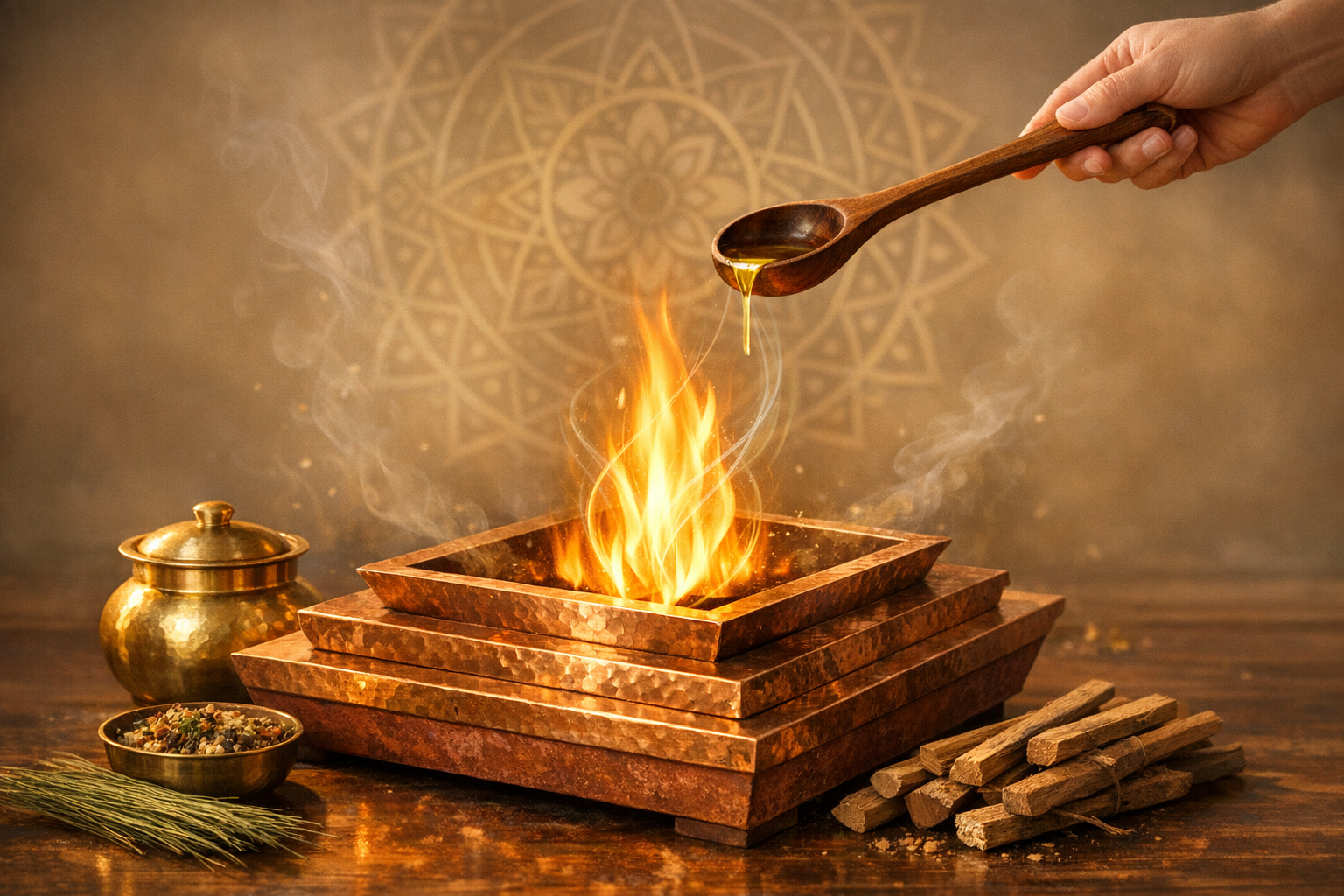
Across the Vedic tradition, a recurring question arises: why is gheethe clarified, refined essence of milkso central to yajna (yagna), homa, and havan? The preference is neither arbitrary nor merely conventional. Like a precisely engineered system that requires a specific fuel, the sacred fire of Agni is designedscripturally, symbolically, and materiallyto be nourished by ghṛta (ghee). Understanding this preference illuminates the inner logic of Vedic ritual, its philosophical depth, and its practical wisdom.
In the Vedic worldview, Agni is the messenger who carries offerings (āhutis) to the devas. The śruti and smṛti literature consistently identify ghee as the principal oblationājya or ājya-bhāgareserved for Agni. Rigvedic praise hymns repeatedly describe Agni as “ghṛtānu” and “ghṛtapṛṣṭha,” evoking a flame bathed and brightened by ghee. Brāhmaṇa texts expand this rationale: ghee is the concentrated, purified essence (sāra) of a long chain of transformationplants to cow, milk to butter, butter to gheemirroring the ritual’s very aim of refining the gross into the subtle and returning the essence to its cosmic source.
Scriptural injunctions (vidhis) across the Śrauta and Gṛhya Sutras are unambiguous: the default liquid oblation into Agni is ghee. While ritual sequences may also include grains, herbs, wood (samidha), and resins, ghee functions as the canonical liquid medium that completes an āhuti with the utterance “svāhā.” In Agnihotra and other domestic rites, small, measured ghee offerings align breath, mantra, and flame into a single act of consecrated integration.
Beyond scriptural mandate, ghee exhibits material and combustion properties that make it uniquely suited for sacred fire. Clarified butter has a high smoke point relative to many unrefined oils, burns with a steady luminous flame, and produces comparatively less sticky residue. Its combustion profile reliably sustains the clean, upward draft inside the havan kuṇḍaan aerodynamic chamber whose sloped walls and geometry are designed to shape convection, enhance oxygenation, and raise the flame’s brightness without excessive soot.
Ghee also solves a subtle but important ritual-technical need: it is a lipid solvent that readily dissolves and transports the hydrophobic aromatic compounds in havan samagri (the herbal blend of woods, resins, leaves, and seeds). Upon contact with the flame, these compounds volatilize efficiently, creating a fragrant plume in which terpenes, phenolics, and other volatiles disperse rapidly. This amplifies the ritual’s sensory presence and, according to the Vedic conception, assists Agni in “carrying” the offering. In effect, ghee does double dutyan energy-rich fuel for the flame and a carrier medium that releases the samagri’s subtle qualities into the sacrificial atmosphere.
By contrast, many plant oils (depending on refinement, degree of unsaturation, and thermal stability) can polymerize or char more readily, generating heavier soot and less predictable combustion in an open ritual setting. This is why lamps (dīpas) may accept varied oils according to regional custom, but the sacrificial fire of yajna, with its precise sequence of āhutis and mantras, traditionally favors ghee. The choice protects the clarity of the flame, the cadence of offerings, and the sanctity of the air within the ritual space.
The symbolic grammar is equally compelling. In Ayurvedic and yogic discourse, ghee is associated with “sattva”clarity, harmony, and nourishment. It supports “ojas,” the subtle vitality that sustains immunity and equanimity, and kindles “tejas,” the inner radiance of discernment. Offering ghee thus becomes a profound enactment: clarity is given to the clarifying fire; nourishment is returned to the cosmic nourisher. As gross desire is offered into the luminous principle of Agni, it is transmuted into insight, resolve, and sanctified intentionprecisely the inner alchemy that yajna is meant to awaken.
There is also a civilizational ethic woven into this preference. Ghee is one of the pañcagavya elements revered in many ritual contexts and points to a broader ecology of gratitudetoward the cow, the land, the rain, and the community. When conscientiously sourced, it ties the sacrificial act to a lived ethic of care and reciprocity. Contemporary practitioners increasingly align this with principles of ahiṁsā by seeking ethical dairying or, where conscience directs, minimizing quantities and emphasizing bhāva (intent) within domestic (gṛhya) rites.
From a public-health lens, early laboratory and field observations suggest that fragrant plumes produced by homaespecially when ghee aerosolizes herbal samagrimay exhibit antimicrobial effects in confined environments. The proposed mechanism involves the dispersal of bioactive volatiles and heat-driven convection that alter the local microenvironment. While these findings are intriguing, they remain an emerging area of inquiry and deserve rigorous, controlled study before firm conclusions are drawn. The Vedic paradigm has long claimed purificatory effects; modern research is beginning to ask how and under what conditions such effects can be measured.
The ritual architecture is also noteworthy. The havan kuṇḍa is not a mere container; it is a calibrated form that optimizes combustion and airflow. The sequencing of āhutissmall, well-timed spoonfuls of ghee paired to mantra and breathstabilizes flame dynamics and keeps the fire in a responsive state. Practitioners observe that when offerings remain small and rhythmic, the flame speaks backrising at “svāhā,” staying bright with minimal smoke, and subsiding gently between mantras. This is the hallmark of a well-tended yajna: clarity without agitation.
The oft-heard analogydifferent engines need different fuelscaptures the point succinctly. A temple lamp, a kitchen stove, and a Vedic sacrificial fire are distinct “engines” optimized for different outputs: steady illumination, cooking heat, or consecrated transformation. Ghee is the precise fuel for the third, not only by scriptural decree but by combustion behavior, volatilization synergy with herbs, and the symbolic semantics of sattva and nourishment. That is why, in the vast literature of ritual practice, one rarely encounters oil as the principal oblation in yajna, even if oil may be used for lamps or region-specific customs outside the sacrificial altar.
Across dharmic traditions, the sanctity of fire and light forms a shared thread. In Hinduism, yajna centers on Agni as messenger and transformer; in Buddhism (especially Vajrayāna and East Asian lineages), sacred fire rites and butter lamps sustain the symbolism of illumination; in Jain practice, dīpas and fragrant offerings signify purity and inner awakening; Sikh tradition, rooted in the Shabad (Divine Word), emphasizes the flame of wisdom as the true purifier. The mediums and emphases differ, yet the intention converges: to transform ignorance into insight, and separateness into solidarity. Recognizing this continuity honors the unity of dharmic spirituality while appreciating each path’s unique discipline.
In contemporary settingsurban apartments, shared spaces, or regions with air-quality sensitivitiespractitioners adapt responsibly. Domestic homas keep ghee āhutis small and evenly spaced, use well-dried wood (mango, peepal, or palāśa where traditional), select samagri without synthetic perfumes, and ensure ventilation that respects neighbors and environment. The guiding principle is simple: maintain a clean flame, prioritize sattvic ingredients, and let intention and care govern quantity and frequency.
For those organizing a home havan, a few practical touchstones help. Prepare the kuṇḍa and space to promote airflow and safety. Warm the ghee gently so it pours smoothly without smoking. Offer small spoonfuls aligned with mantras, allowing the flame to respond at each “svāhā.” Alternate ghee with dry samidha and samagri to keep the burn balanced. Conclude with a modest pūrṇāhuti and distribute prasāda mindfully, letting the atmosphere settle into silence. In this cadence, the ritual reveals its original engineering: clarity becomes audible, visible, and palpable.
In sum, saying “yajna needs ghee” is not a mere slogan. It is a compact statement of ritual design, scriptural authority, symbolic wisdom, and practical science. When the right fuel meets the right flame, the result is more than fireit is transformation. That is why ghee, above all other mediums, remains the time-tested catalyst that turns a pile of sticks and herbs into the luminous grammar of Vedic worship.
Inspired by this post on Hindu Pad.
