
Across the Dharmic traditions of Hinduism, Buddhism, Jainism, and Sikhism, the ultimate aim of yoga and meditation is described as direct contact with the Supreme Reality—known variously as Paramātmā, Brahman, or the transcendent ground of being. Within that shared horizon, Hari Kirtana—congregational chanting of the divine names of Hari—has emerged as a time-tested, accessible, and unifying path that integrates devotion (bhakti), focus (dhyāna), knowledge (jñāna), and ethical action (karma) into a single embodied practice.
Classical sources of Hindu philosophy affirm convergent goals across disciplines: the Bhagavad Gita presents devotion as the culmination of yoga, jñāna schools articulate realization of Brahman as the highest truth, and Patanjali’s Yoga Sutras aim at the cessation of mental fluctuations to reveal pure awareness. Complementing these, the bhakti tradition emphasizes Hari Kirtana as a particularly potent means in the present age: a sonic yoga through which divine remembrance is made effortless, communal, and deeply transformative. This perspective does not invalidate other paths; rather, it highlights kirtana as an integrative catalyst that harmonizes with asana, pranayama, japa, and contemplative study.
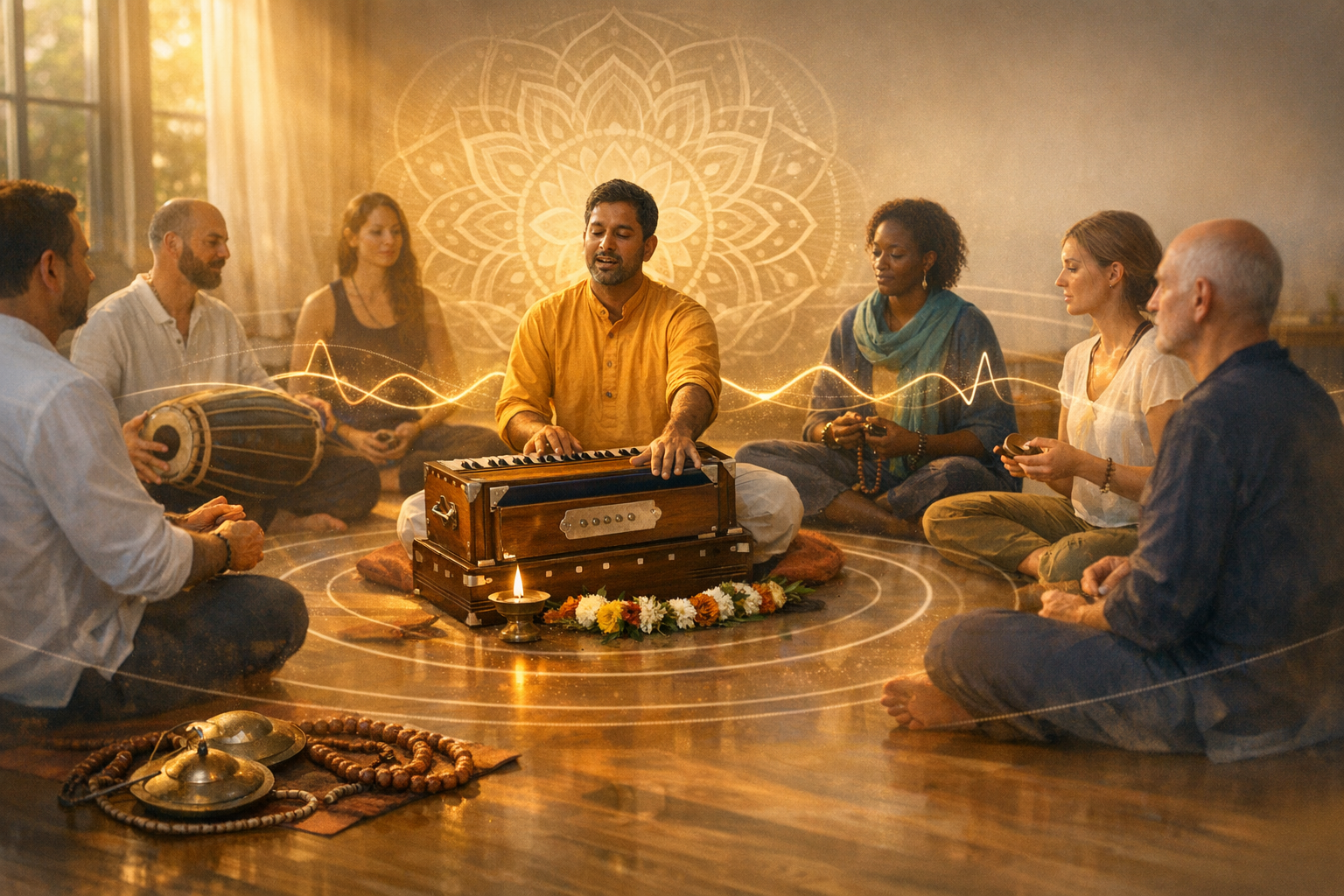
Hari Kirtana is best understood as sound-based meditation (nada yoga) organized around sacred mantras—most famously the Hare Krishna mahā-mantra—sung with rhythm, melody, and collective intention. The practice typically involves call-and-response singing, hand cymbals (kartals), drums (mṛdaṅga), and harmonium, producing an immersive auditory field that entrains breath, attention, and emotion. Within the Gaudiya Vaishnava lineage and the broader Hare Krishna Movement, this practice is termed hari-nāma-saṅkīrtana; it also resonates with the wider mantra culture of India, where sacred sound is both prayer and precise method.
Scriptural and philosophical anchors for Hari Kirtana are well established. The Bhagavad Gita (e.g., 9.14; 10.25; 6.47) extols constant remembrance and loving devotion as the heart of yoga. The Srimad Bhagavatham and allied Puranic literature repeatedly identify collective chanting as especially efficacious for cultivating sattva (clarity), dissolving attachment, and stabilizing meditative absorption. The Upanishadic intuition of “nada brahma” (sound as a doorway to the Absolute) provides a metaphysical frame: mantra is not mere word, but a vibrational template that orients consciousness toward its source.
This sonic focus naturally supports unity among Dharmic traditions. Sikhism emphasizes Naam Simran (remembrance of the Name), Jainism venerates the Navkar Mantra as a path of purification, and Buddhist lineages engage in mantra and sutra recitation (e.g., Om Mani Padme Hum) as compassion-training. In all cases, sacred sound disciplines attention, softens the heart, and cultivates nonviolence (ahimsa), humility, and service (seva). Rather than asserting a singular route, Hari Kirtana is presented here as a shared bridge—an expression of Vasudhaiva Kutumbakam—that honors diverse Ishta (chosen ideals) while inviting collective uplift.
The theoretical core of Hari Kirtana rests on nada yoga: the insight that structured vibration can reorganize cognition and emotion. Mantra syllables carry phonetic “seeds” (bīja) whose consonant-vowel architecture shapes airflow, resonance, and neural feedback. Sustained toning, especially with light nasalization and gentle chest resonance, promotes coherent breathing, aligns posture, and stabilizes attention. When mantra, melody (rāga), and rhythm (tāla) are coordinated, the entire sensorimotor system participates, transforming singing into full-spectrum meditation.
Contemporary research on sound and breath lends empirical support. Studies on “Om” chanting suggest modulation of the limbic system, reductions in autonomic arousal, and increases in vagal tone—physiological signatures associated with calm focus, emotional regulation, and improved heart-rate variability (HRV). Humming and lengthened exhalation may increase nasal nitric oxide and parasympathetic activity, while group singing has been associated with synchronized heart rhythms, elevated positive affect, and markers of social bonding. Though methodologies vary and more research is warranted, cumulative findings align with long-standing yogic claims: mantra-synchronized breathing refines awareness and steadies the mind.
Pranayama principles enhance kirtana’s effects. Breathing in a relaxed 5–6 breaths per minute range (with a soft 1:1 or 1:1:2 inhale:pause:exhale ratio) stabilizes the baroreflex and supports vagal pathways implicated in resilience. Gentle ujjayi toning or humming on the exhale can be integrated unobtrusively while singing. Practitioners often report that these subtle breath cues reduce performance anxiety, deepen bhāva (devotional mood), and prolong sustained attention without strain.
Group dynamics amplify transformation. Call-and-response patterns naturally entrain attention cycles, while percussion aligns motor timing and fosters “we-intentionality.” Synchrony increases predictability, decreases cognitive load, and frees attentional bandwidth for contemplative absorption. Many communities—temples, satsangs, and ISKCON (International Society For Krishna Consciousness) gatherings—observe that shared kirtana reduces loneliness, encourages seva, and creates durable bonds across background, language, and age.
An inclusive ethic is essential. Hari Kirtana invites remembrance of the Divine through many Names—Krishna, Govinda, Hari, Rāma, Nārāyaṇa—while respecting other sacred invocations such as Waheguru, Om Mani Padme Hum, and the Navkar Mantra. The intent is not proselytizing but deep listening, humility, and mutual recognition. When framed as a shared contemplative art aligned with Dharma—truthfulness, compassion, restraint, and service—kirtana becomes a civic practice of harmony as much as a personal sādhana.
Preparation supports depth. A short Hatha Yoga warm-up (5–10 minutes of gentle spinal waves, hip openers, and thoracic expansion) optimizes posture and breath mechanics. Brief breathwork (two to three minutes of coherent breathing) lowers arousal. Hydration and modest vocal hygiene—light humming, lip trills, and soft scales—reduce strain. These simple steps allow longer, steadier sessions with cleaner intonation and less fatigue.
Mantra selection can honor individual Ishta while keeping a shared center. Common Vaishnava invocations—Hare Krishna, Om Namo Bhagavate Vāsudevāya, Om Namo Nārāyaṇāya—sit comfortably alongside inter-Dharmic refrains in multi-tradition settings. A practical approach is to anchor the session with a primary mantra and respectfully offer space for parallel invocations, allowing participants to connect from their own tradition without fragmentation of the collective rhythm.
A 30-minute Hari Kirtana blueprint might proceed as follows: 3 minutes of breath coherence and soft humming; 5 minutes of a slow-tempo mantra to settle attention; 15 minutes of progressive call-and-response with moderate percussion and hand claps; 5 minutes of quiet japa (mālā or mental repetition) to consolidate the state; and 2 minutes of silent absorption and gratitude. This structure integrates movement, breath, sound, and stillness in a single arc.
For a deeper 60–90 minute session: open with 10 minutes of gentle asana and pranayama; establish a tonal center with tampura or harmonium; cycle through two to three rāgas to match energetic phases; keep percussion below conversational intensity to protect hearing; taper toward a lullaby-like cadence; close with śānti mantras or quiet japa. Alternating leaders refresh attention while maintaining a coherent thematic thread (e.g., names of Hari). Intervals of near-silence between chants allow the nervous system to integrate.
Environment matters. Natural reverberation (wood floors, soft walls) supports blended sound without harsh reflections. Moderate lighting reduces self-consciousness and supports pratyāhāra (sense withdrawal). For urban settings, microphones should be used sparingly to avoid excessive decibels; safe exposure guidelines (ideally below ~85 dB over extended periods) protect hearing. Where possible, outdoor community kirtans can integrate walking (nagara-saṅkīrtana) with mindful pace and breath.
Progress can be gently quantified without reducing devotion to data. Simple measures—resting HRV (e.g., RMSSD), breath rate, perceived stress scales, and short mood inventories—help tailor session length and tempo. Many practitioners keep a short journal of state-shifts, insights, and post-session sleep quality. Over weeks, patterns often emerge: steadier breath, quicker recovery from stressors, and deepened compassion in daily interactions.
Hari Kirtana pairs naturally with japa. Loud kirtana (saṅkīrtana) recruits energy and shared intention; soft personal repetition (japa) concentrates attention inward. Alternating them refines both extroversion and introversion in practice. Mantra contemplation between sessions—study of meanings and scriptural contexts (Bhagavad Gita, Srimad Bhagavatham)—strengthens resolve and clarifies philosophical ground, ensuring bhakti rests on insight rather than sentiment alone.
Common questions arise. Is kirtana merely music? In this context, music is the vehicle, not the destination; the method is explicitly yogic, organizing attention, breath, and emotion toward Dharma. Does kirtana replace meditation? It complements it: rhythmic sound regulates the nervous system, making subsequent silent meditation more stable. Is it sectarian? When framed around shared ethical commitments and respect for diverse Names, kirtana becomes a platform for inter-tradition friendship rather than division.
Care and inclusivity are paramount. Vocal pacing, breaks for silence, and availability of quiet spaces support those with sensory sensitivity or trauma histories. Leaders should avoid coercive enthusiasm; consent-based participation and clear facilitation cues make the practice welcoming. Modest amplification and mindful percussion protect the throat and ears. The underlying principle is ahimsa—gentleness to oneself and others—expressed through sound.
Ethically, Hari Kirtana blossoms alongside seva. Community service before or after sessions—food distribution, environmental cleanup, or compassionate visits—grounds devotion in action. The synergy is classical: sound refines intention; service embodies love; study clarifies direction; and silence consolidates realization. Over time, the cycle reduces self-centeredness, broadens empathy, and deepens commitment to societal well-being.
In sum, Hari Kirtana offers a rigorous yet welcoming path for the modern age: scripturally rooted, physiologically attuned, emotionally resonant, and socially unifying. By honoring multiple Ishta, integrating Hatha Yoga, pranayama, japa, and study, and grounding expression in ahimsa and seva, the practice becomes a comprehensive bhakti-yoga for contemporary life. Approached with humility and care, Hari Kirtana not only steadies the mind and opens the heart; it also affirms the deepest Dharmic truth—that spiritual diversity, lived with integrity, is a strength to be celebrated.
Inspired by this post on Hindu Pad.






Leave a Reply
You must be logged in to post a comment.