The offering of 21 durva (dūrvā) blades to Ganesha endures across regions and lineages because it unites mythic memory, ritual science, and lived devotion into a single, elegant act. Devotees of Vinayaka and scholars of Sanatana Dharma alike point to this practice as a model of how Puranic narrative, Vedic symbolism, and Ayurvedic knowledge reinforce one another to cultivate cooling clarity, mindful restraint, and auspicious beginnings in daily life and during Ganesha Chaturthi or Sankashti Chaturthi.
Classical narratives recount that a fire-born demon named Analasura unleashed scorching heat that threatened the worlds. Ganesha, invoked as Vighnaharta, subdued the asura by containing him, after which an unbearable inner heat blazed through Ganesha’s own form. Sages, seers, and householders are said to have offered durva—fresh, tender grass renowned for its cooling potency—fashioned as a garland or in counted blades. The heat subsided. Since then, offering 21 durva blades became an archetypal gesture recognizing Ganesha’s role as remover of obstacles and restorer of inner equilibrium.
The number 21 (ekaviṁśati) is not arbitrary. In many traditional explanations preserved in oral teaching and ritual manuals, 21 symbolizes the integration of the 10 organs of perception and action (pañca jñānendriyas and pañca karmendriyas), the 10 vital energies (pañca prāṇas and pañca upa-prāṇas), and the sovereign mind (manas) as the twenty-first. In effect, the offering represents a vow to harmonize senses, breath, and mind under Ganesha’s guardianship. This yogic reading aligns closely with the broader Vedic and Upanishadic project of self-mastery, making the ritual an embodied declaration of inner governance.
Durva itself carries layered symbolism. Botanically identified as Cynodon dactylon (often called doob or Bermuda grass), it thrives in sun and stress, re-roots easily, and rebounds from cutting. Its tri-forked leaflet evokes triads common to Hindu thought—sattva, rajas, tamas; past, present, future; creation, preservation, dissolution. To place this resilient, humble, ever-renewing grass at Ganesha’s feet is to present the best of one’s grounded, regenerative nature, asking that resilience be refined into wisdom and steadiness.
Ayurveda gives the practice additional depth. Durva is traditionally described as sheeta (cooling) in virya, astringent and slightly sweet in rasa, with stambhana (hemostatic) qualities. Classical formulations use durva swarasa (expressed juice) to soothe pitta aggravations and support wound healing. This pharmacological coolness mirrors the ritual purpose in the Analasura episode: durva pacifies the blaze of unregulated heat—mythically in the deity’s body, psychologically in human passions like krodha (anger) and asuya (envy), and physically in heat-related imbalances. The alignment of Puranic motif and Ayurvedic property is a striking example of Sanatana Dharma’s integrative knowledge systems.
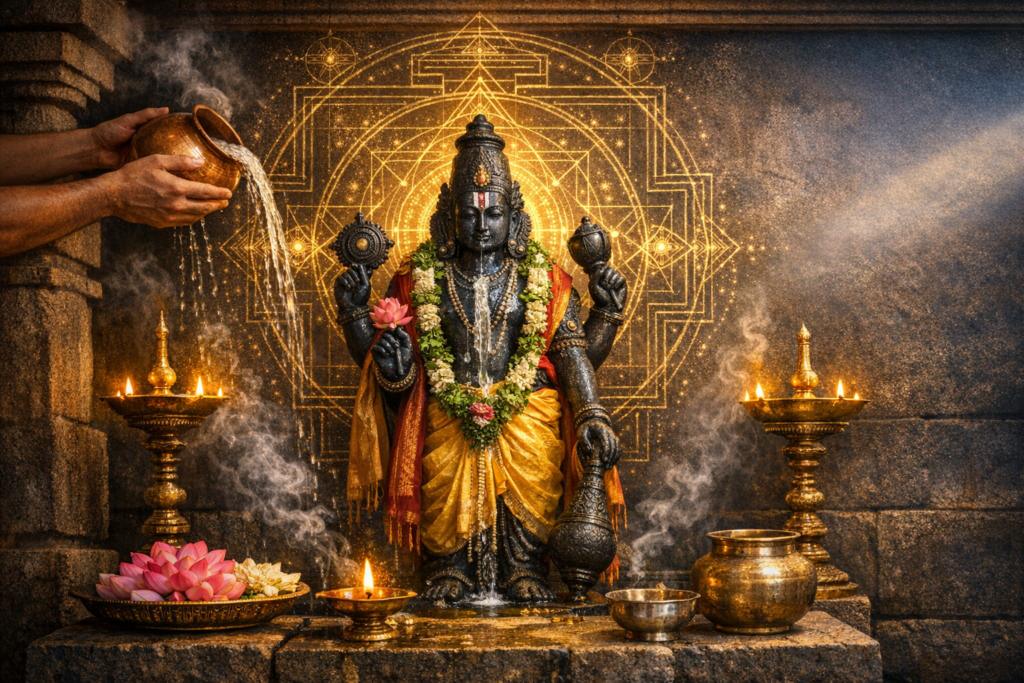
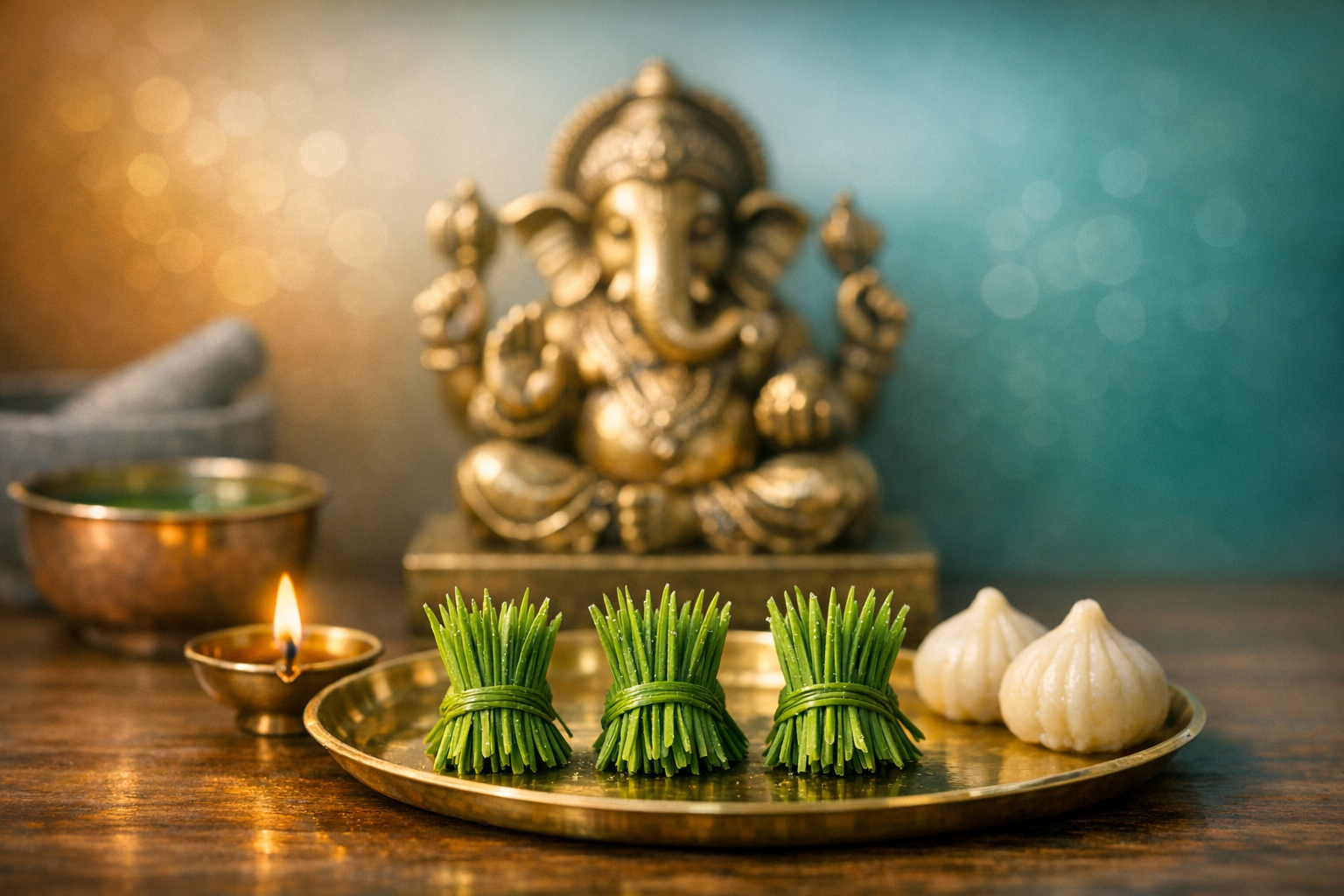
Ritual practice varies by region and family parampara, but common principles are clear. Devotees gather fresh, tender shoots—preferably green and unblemished—wash them with clean water, and count exactly 21 blades. Some lineages fashion three small bundles of seven, while others offer 21 single blades or a small wreath of 21 loops. The offering is made with mantra—often Om Gam Ganapataye Namah or the Ganapati Atharvashirsha—touching the blades to Ganesha’s trunk or head and placing them at the murti’s base or atop the crown. The sequence typically follows simple upacharas (offerings), and may be accompanied by naivedya such as modaka or fruits, depending on local custom.
Counting disciplines are part of the upasana. Three bundles of seven reflect cosmological sevens (rishis, lokas) refined by the triadic gunas, while a straight count to 21 keeps the focus on the senses-pranas-mind mapping. Either way, the ekaviṁśati measure serves as a mental metronome for attention. Many households teach children to count the blades carefully at dawn, developing numeracy, mindfulness, and reverence in a single ritual act—a pedagogical pattern that blends affection, precision, and cultural memory.
Texts and liturgy also reinforce Ganesha’s bond with durva. Devotional namavalis frequently address him as Dūrvā-priya—“the One who delights in durva.” Later Puranic and regional katha traditions, including those associated with the Ganesha Purana and Mudgala Purana, circulate the Analasura motif and related episodes to highlight how Ganesha’s grace cools the world’s fevers, removes impediments to dharma, and safeguards the welfare of beings. While versions differ across regions, the throughline is consistent: simple, sattvic offerings made with sincere intent secure protection and clarity.
Devotees often ask whether durva should include roots (mūla-yukta) or be trimmed shoots. Both prescriptions exist in different traditions. Some temples specify mūla-yukta durva as especially auspicious; many householders, prioritizing ecological care, gently harvest tender tips without uprooting, ensuring the grass continues to thrive. The shared dharmic principle is satya and ahimsa in practice: offer what is pure, sustainable, and non-injurious. As a practical guideline, choose fresh, tri-shoot blades, avoid yellowed or withered segments, and follow the local shastra and temple maryada.
Because the offering is both symbol and sadhana, substitutes are handled thoughtfully. If fresh durva is unavailable, practitioners may perform manasika-puja (mental offering) or place akshata (unbroken, sanctified rice) while vowing to offer durva at the earliest opportunity. This preserves the sankalpa (intent), which is the ritual’s inner engine, while respecting ecological and seasonal realities.
The distinction between durva and darbha (kusa) is also instructive. Both are sacred grasses in the Poaceae family but serve different primary purposes. Durva (Cynodon dactylon) is especially dear to Ganesha and used in cooling, auspicious offerings. Darbha or kusa (Desmostachya bipinnata) is the canonical Vedic ritual grass used in homa, asana, and kalasha rites for purification and containment. The two are complementary in the dharmic ecosystem: one cools and delights, the other consecrates and protects. Recognizing their distinct roles reduces confusion and strengthens practice fidelity.
Numbers carry liturgical weight throughout Hindu rituals, and 21 recurs as a particularly auspicious count. Ekaviṁśati offerings appear in homa, lamp lightings, and kalasha setups, signaling completion without closure—an open-ended odd number that invites continuation. In Ganesha puja, 21 durva blades conjoin numerology with ethics: the senses are to be disciplined, pranas regulated, and mind steadied. This ethical arithmetic frames bhakti as methodical and transformative rather than merely emotional.
Across dharmic traditions, the reverence for sacred grasses and simple, non-violent offerings communicates a shared civilizational ethos. Buddhism remembers the kusa seat beneath the Bodhi tree as the ground of awakening. Jain and Hindu rites employ sacred plants as symbols of restraint, purity, and mindful living. Sikh teachings elevate seva (selfless service), humility, and ecological responsibility, values that converge with the spirit of offering humble, living earth to the Divine. Such convergences strengthen unity in spiritual diversity: diverse practices, one ethic of compassion, simplicity, and inner cooling of destructive fires.
Community memory deepens this continuity. Many recount dew-bright mornings gathering durva in fields and courtyards, learning from elders to wash, count, and offer with care. The gestures are small, but their emotional weight is lasting: steadiness before new beginnings, gratitude after resolved difficulties, and an unspoken assurance that obstacles yield to clarity when discipline, devotion, and discernment meet. These everyday remembrances keep the ritual alive as a living pedagogy transmitted through affection rather than decree.
In contemporary households and temples, the practice also aligns with wellbeing disciplines. Breath regulation (pranayama), attention training (dharana), and restraint (yama-niyama) are harmonized with the act of offering. By explicitly connecting the 21 blades to the senses, pranas, and mind, practitioners center the puja in the body-mind continuum, reinforcing that ritual is not separate from inner cultivation. The Analasura legend—read psychologically—warns that when passions flare, containment and cooling are paramount; durva is the ritual analog of that ethical medicine.
Festival contexts offer natural cadences for the observance. On Ganesha Chaturthi, Sankashti Chaturthi, or personal sankalpa days before interviews, journeys, or new ventures, devotees perform simple Ganesha puja with 21 durva blades, a clean lamp, and straightforward naivedya. The act requires no opulence—its power lies in precise intention, purity, and constancy. In this, it reflects a hallmark of Sanatana Dharma: gifts of nature turned into bridges between the finite and the infinite.
Practiced with understanding, offering 21 durva blades to Ganesha becomes more than a custom. It crystallizes a civilizational insight: that myth guards ethical truths; that Ayurveda and ritual both cool inner heat; that numbers can train attention; and that simplicity, resilience, and gratitude remain the strongest technologies of the heart. By placing the green, living thread of durva at the feet of the remover of obstacles, devotees align senses, breath, and mind to walk steadily—together with all dharmic kin—toward clarity, compassion, and auspicious beginnings.
Inspired by this post on Hindu Blog.