Shravana Kumara, celebrated across the Ramayana tradition, stands as a luminous emblem of Matru Pitru Bhaktidevotion to parentswithin the broader ethical and spiritual landscape of dharma. His story, brief yet profound, has shaped cultural memory in South Asia by linking filial duty, pilgrimage, and the moral responsibilities of rulers into a single, unforgettable episode.
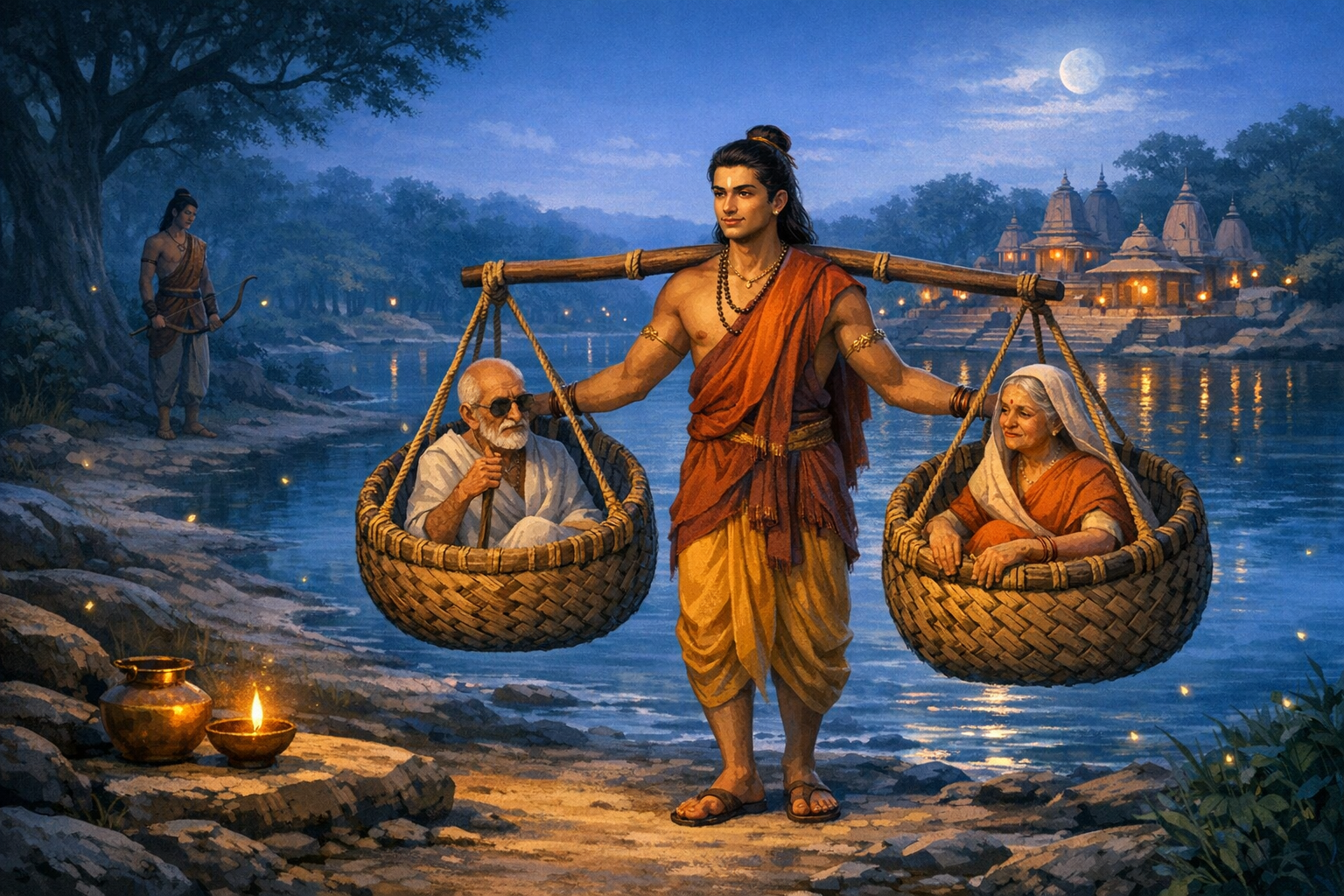
According to the epic’s narrative arc, Shravana lived with his elderly, blind parents and dedicated his youth to their care. Determined to fulfill their longing for a sacred journey, he carried them on a balanced yoketwo panniers slung across his shouldersmoving from one tīrtha to another. In this austere commitment, the image of a son bearing the weight of both parents becomes a living metaphor for the human obligation to repay the parental debt (pitṛ-ṛṇa) recognized across dharmic traditions.
The tragedy unfolds near a water source at night. King Daśarathathen a prince famed for the Kshatriya skill of shabdavedhī archery (shooting by sound)heard the ripple of water and loosed an arrow, imagining a deer had come to drink. The shaft struck Shravana instead, who had approached the river to fetch water for his parents. Recognizing the grievous error, Daśaratha brought water to the blind couple and confessed what had transpired.
In many retellings, the bereaved parents, stricken by grief, pronounce a solemn curse: Daśaratha would one day die in agony of separation from a beloved son. The epic later fulfills this moral causality when the king passes away, shattered by the exile of Rāma. Thus, the episode operates not only as a portrait of exemplary Bhakti but also as a structural keystone explaining Daśaratha’s fate within the Ramayana’s karmic and ethical logic.
Textually, the core incident appears in Vālmīki’s Ramayana (in the Ayodhyā Kāṇḍa’s account of Daśaratha’s lament). While the earliest version emphasizes an ascetic boy and his blind parents without an explicit personal name, later Sanskrit and vernacular traditions widely remember him as Shravana or Shravana Kumara. Medieval and regional Ramayana adaptations, along with katha and puranic storytelling streams, helped standardize this name and magnify the tale’s moral significance for audiences across geographies.
At the heart of the narrative is the dharma of reverence: Mātṛ devo bhava, Pitṛ devo bhava“revere the mother as divine, revere the father as divine.” This dictum, echoed in the śruti and elaborated in dharmaśāstra literature, frames parental care as a sacred obligation. The broader paradigm of the three debtsowed to the gods (deva-ṛṇa), sages (ṛṣi-ṛṇa), and ancestors (pitṛ-ṛṇa)places filial service at the center of a life oriented to duty, gratitude, and continuity.
Shravana’s choice of a pilgrimage (tīrtha-yātra) for his parents is equally instructive. In the dharmic imagination, tīrthas are spiritual fordsthresholds that connect temporal life to transcendent meaning. By undertaking a yātra on their behalf, Shravana transforms personal duty into shared merit (puṇya), affirming that Bhakti and seva (selfless service) can converge in one sustained act of care.
The episode also critiques untempered prowess. Shabdavedhī archery, celebrated in heroic lore, here becomes a cautionary device: power without discernment imperils innocence. Daśaratha’s remorse and accountability align with normative Kshatriya dharma, which binds martial skill to ethical restraint and responsibility for unintended harm. In this sense, the story encodes a royal ethics of consequence long before formal legal frameworks are articulated.
Karmic continuity gives the tale its narrative force. The parents’ curse is not mere retribution; it dramatizes a cosmos in which action and consequence, duty and lapse, are woven into a just moral fabric. By linking Daśaratha’s tragic end to an earlier error, the Ramayana underscores that dharma is as much about attentiveness and compassion as it is about valor and vow-keeping.
Shravana Kumara’s Matru Pitru Bhakti resonates across the dharmic familyHinduism, Buddhism, Jainism, and Sikhismwhere filial gratitude and seva are bedrock values. Buddhist teachings, such as the Sigālovāda Sutta, outline children’s duties to parents with remarkable clarity; Jain traditions extol ahimsa and compassionate care within the household; Sikh teachings elevate seva as a pathway to the Divine, embracing respect for parents as part of righteous living. The tale’s core ethiclove rendered as responsibilitythus strengthens unity across these traditions.
Culturally, Shravana’s imageyoke upon shoulders, parents seated patientlyhas fed temple sculpture, folk theatre, and regional katha. Many communities maintain local place-lore that situates the mishap near rivers and sacred ghats in North India, often along the Sarayu’s mythic landscape around Ayodhya. While precise historical geography varies by tradition, the mnemonic power of these sites keeps the ethic of care active in community memory.
For contemporary readers, the story speaks to lived realities: elders requiring assistance, caregivers balancing livelihood with duty, and families seeking meaning through shared spiritual practices. It offers a vocabularyBhakti, seva, ṛṇafor articulating why care matters not only emotionally but existentially. In a modern context, this can translate into tangible commitments: elder-friendly homes, community support networks, and intergenerational dialogues anchored in dignity and gratitude.
Thematically, Shravana Kumara illuminates three intertwined strands of the Ramayana’s wisdom. First, the primacy of Matru Pitru Bhakti as a lived discipline, not mere sentiment. Second, the ethical accountability of rulers, whose strength must submit to compassion and circumspection. Third, the integrative power of pilgrimage, which turns individual aspiration into relational virtue, knitting persons, families, and sacred geographies into a single moral tapestry.
In sum, the remembrance of Shravana Kumara is not simply a moving anecdote; it is a compact moral treatise. It fuses filial duty, Bhakti, and kingship ethics into an enduring lesson: dharma matures where devotion becomes responsibility, and where power consents to conscience. Read this way, the episode strengthens a shared dharmic ethosacross Hinduism, Buddhism, Jainism, and Sikhismin which reverence for parents and compassion for the vulnerable remain guiding lights for personal and public life.
Inspired by this post on Hindu Pad.