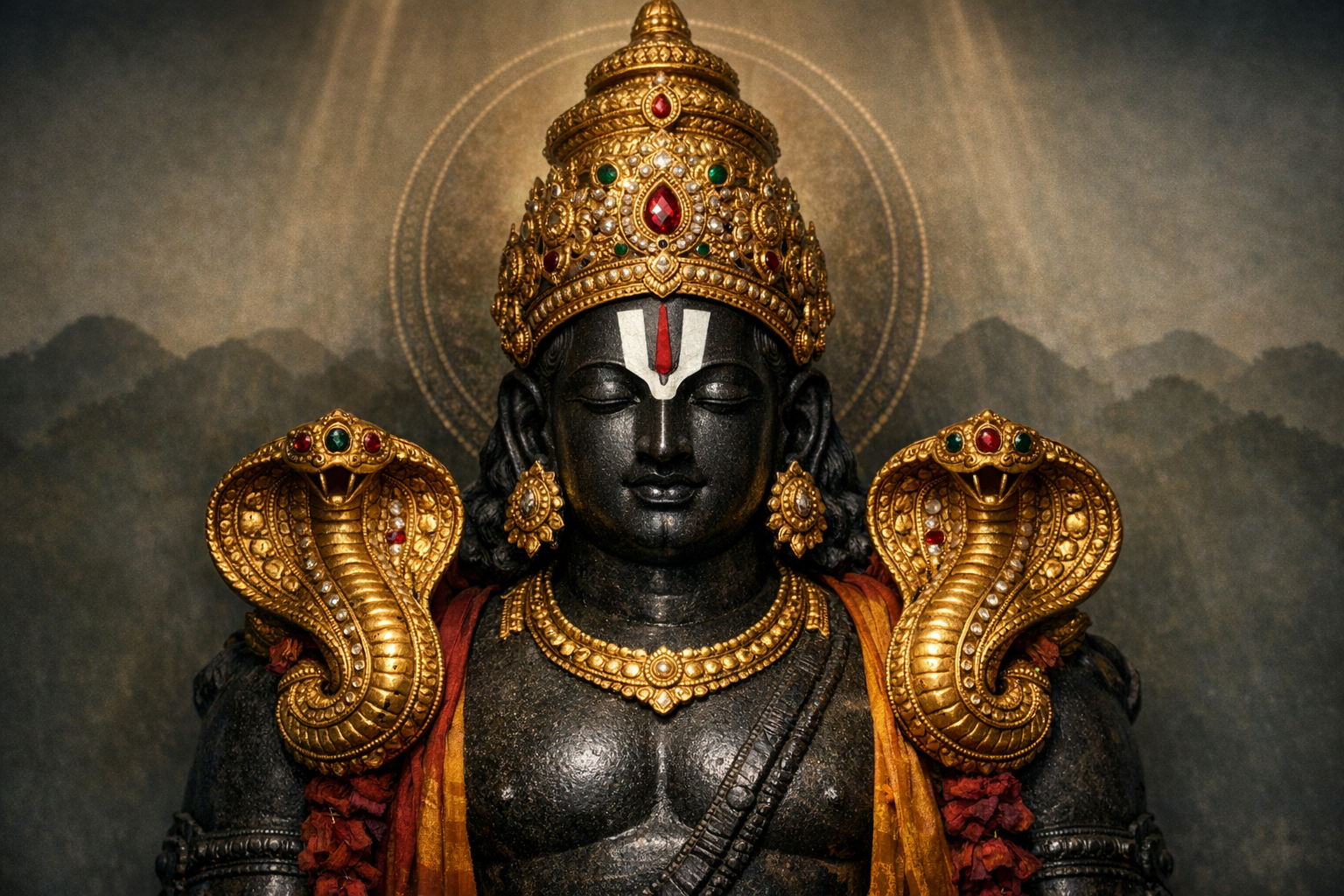
Close observation of the moola murti of Lord Venkateswara at Tirumala reveals two finely wrought golden serpent emblems poised upon the deity’s shoulders. Known collectively as the Nagabharana (nāga + bharaṇa, “serpent ornaments”), these paired images evoke Adisesha, the eternal serpent who serves as Vishnu’s divine couch and guardian. Far from being merely decorative, the Nagabharana synthesize theology, iconography, and ritual practice within the Tirumala Tirupati Devasthanam (TTD) tradition, and they form a distinctive feature in the visual profile of the deity at the Tirumala Tirupati Temple.
Etymologically, the term links the serpent (nāga) with embellishment (bharaṇa), but in the Vaishnava context the semantic field extends to protection, infinity, and cosmic steadinessattributes inseparable from Adisesha. Within Vaishnava theology, Adisesha (also called Ananta) symbolizes endless time and steadfast service (śeṣatva) to the Supreme. Placing serpent emblems on the shoulders foregrounds this doctrinal core: the Lord’s sovereignty is enveloped by protective grace, and creation itself rests upon the stability that Adisesha signifies.
Puranic literature, especially the Venkatachala Mahatmya of the Skanda Purana, frames Tirumala’s sacred geography through the figure of Adisesha. According to this tradition, Adisesha manifests as the SeshachalamTirumala’s “Seven Hills”to accompany and serve the Lord on earth. The Nagabharana resonate with this narration: even as the hills encircle the kshetra as a colossal serpentine presence, the shoulder emblems express the same guardianship in miniature upon the icon, binding land, lore, and liturgy into a coherent whole.
Agamically, Tirumala follows the Vaikhanasa Agama, whose prescriptions for murti-lakshana (iconic features) and bhūṣaṇa-vidhi (ornamentation protocol) integrate meaning with form. While individual ornaments and their exact placement can vary across temples and periods, the logic remains constant: each bhūṣaṇa reinforces a specific theological attribute while maintaining iconometric harmony. In this schema, serpent motifs at the skandha (shoulders) operate as skandha-bhūṣaṇastabilizing the composition visually and invoking protective symbolism ritually. The Nagabharana, therefore, are not incidental; they are structurally and doctrinally integral.
Visually, the two serpents are rendered in high relief, often with flared hoods and stylized bodies that taper into elegant curves. In several exemplars of South Indian goldwork, such motifs are accomplished through repoussé and chasing, with selective gem-setting to accentuate the eyes or hood contour. Their symmetryone serpent on each shouldercreates a compositional bracket around the central chest area, drawing devotional attention upward toward the face and crown while quieting the profusion of other jewels. In the context of TTD ornaments, the Nagabharana’s golden sheen and measured scale enable them to be legible even during brief darshan, where clarity of form is crucial.
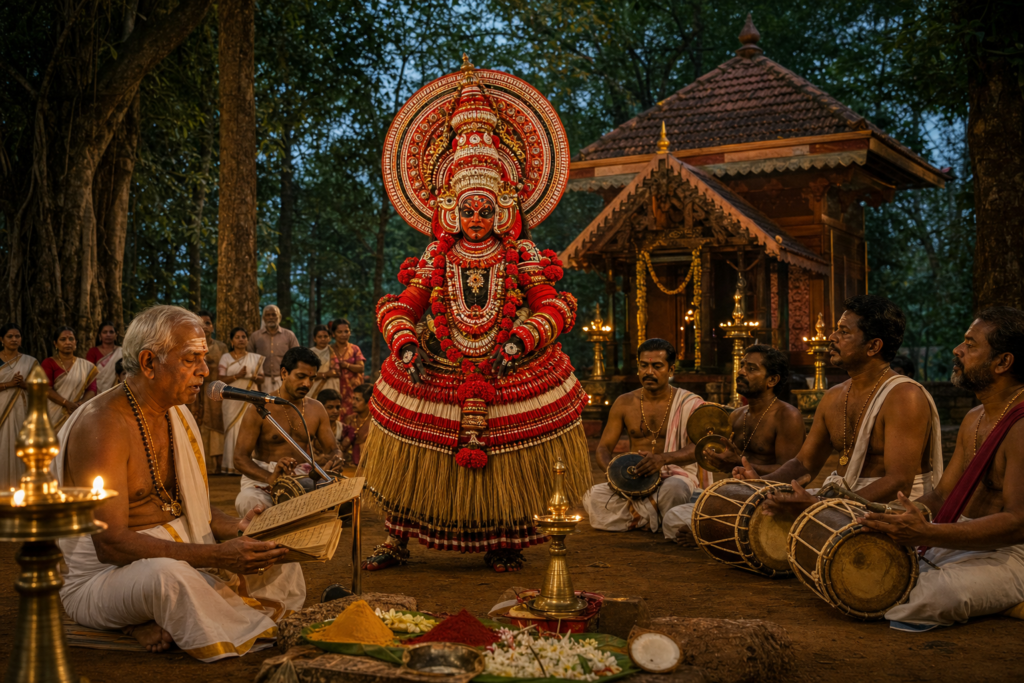
Ritually, ornaments on the moola murti are periodically removed for abhisheka and inspection according to temple protocols, then re-adorned in keeping with the day’s alankara. Within this cycle, the Nagabharana serve an instructive role: their placement reminds devotees that adornment in Vaishnava worship is neither luxury nor mere aesthetics, but a scriptural mode of affirming the Lord’s auspicious attributes (kalyāṇa-guṇa). The serpents, in particular, evoke the sheltering canopy and the vigilant watch that Adisesha provides, making the act of darshan an encounter with protection as much as with beauty.
Historically, the jewelry tradition at Tirumala matured through continuous patronagefrom early South Indian dynasties to the Vijayanagara period and beyond. Inscriptions from the sixteenth century attest to extensive donations of jewels and gold to the deity, and later records speak to careful custodianship by TTD. While specific donor attributions for the Nagabharana are not always singled out in surviving epigraphs, the continuity of the serpent emblems in the temple’s alankara repertoire attests to their entrenched ritual and iconographic status. In short, the Nagabharana belong to a living heritage of TTD ornaments that bridges centuries of devotion, craftsmanship, and service.
Theologically, the serpent imagery communicates at least three interlinked ideas. First, Adisesha personifies the infinite (ananta), suggesting that the Lord’s sustaining power extends beyond measure. Second, the posture and gaze of the serpents signify vigilance, aligning with the protective and guardian functions (raksha) celebrated in South Asian serpent lore. Third, by recalling the bed and canopy of Vishnu, the Nagabharana internalize cosmic architecture within the icon itselfcompressing oceanic vastness (kshira-sagara), time, and space into a shoulder-bound emblem of poised serenity.
From a comparative perspective, serpent motifs are a pan-dharmic language across the subcontinent and beyond. In Buddhism, naga figures protect the Tathagatafamously, Muchalinda shelters the Buddha during a stormencapsulating compassion as refuge. In Jain tradition, the iconography of Parshvanatha with a multi-hooded serpent canopy conveys spiritual protection and ascetic resolve. While Sikh practice centers on the sovereignty of the Shabad rather than iconic forms, the serpentine symbol of shelter maps onto a shared dharmic ethic of seeking divine refuge and protection. Read together, these strands affirm unity within diversity: the Nagabharana at Tirumala converse silently with allied motifs in related dharmic traditions.
Devotionally, pilgrims often describe the two golden serpents as the points where the gaze briefly rests before rising to the Lord’s eyes and crown. In crowded queues and fleeting moments of darshan, the Nagabharana function almost like visual handrailssteadying attention and instilling a felt sense of being watched over. For many, that brief glint of gold on the shoulders becomes inseparable from the inner experience of śaraṇāgati (surrender), translating abstract theology into an immediate, protective embrace.
Art-historically, the Nagabharana also differentiate the Tirumala icon from related Vishnu images. At Srirangam, for instance, the Lord reclines upon Adisesha in the expansive ananta-śayana posture, the serpent rendered architectonically as bed and canopy. At Tirumala, by contrast, the standing form retains the serpent in concentrated emblems at the shoulders, thereby preserving the theological presence of Adisesha without altering the upright stance. This condensation of meaning into skandha-level ornaments exemplifies the South Indian genius for combining doctrinal depth with sculptural economy.
Conservation practice at major temples such as those under TTD emphasizes secure custody, periodic condition assessments, and controlled handling of metalwork in accord with ritual requirements. Gold’s resistance to corrosion makes it an ideal substrate, yet its softness demands careful storage and expert workmanship in re-fastening. In this sense, the continued clarity and integrity of the Nagabharana testify not only to the skill of historical goldsmiths but also to the discipline of contemporary temple administration and archakas who maintain alignment with Agamic canons.
Taken together, the Nagabharana of Venkateswara Swamy concentrate Tirumala’s sacred narrative, Vaishnava theology, and South Indian ornamental craft into two luminous forms. They announce the presence of Adisesha as protector, recall the Seshachalam as living geography, and engage devotees in a felt experience of safety and surrender. At a time when the unity of dharmic traditions is both precious and necessary, these serpent emblems offer an elegant, shared visual languageaffirming that the quest for refuge in the Divine, and the guardianship of dharma, are common treasures across Hinduism, Buddhism, Jainism, and Sikhism.
Inspired by this post on Hindu Pad.