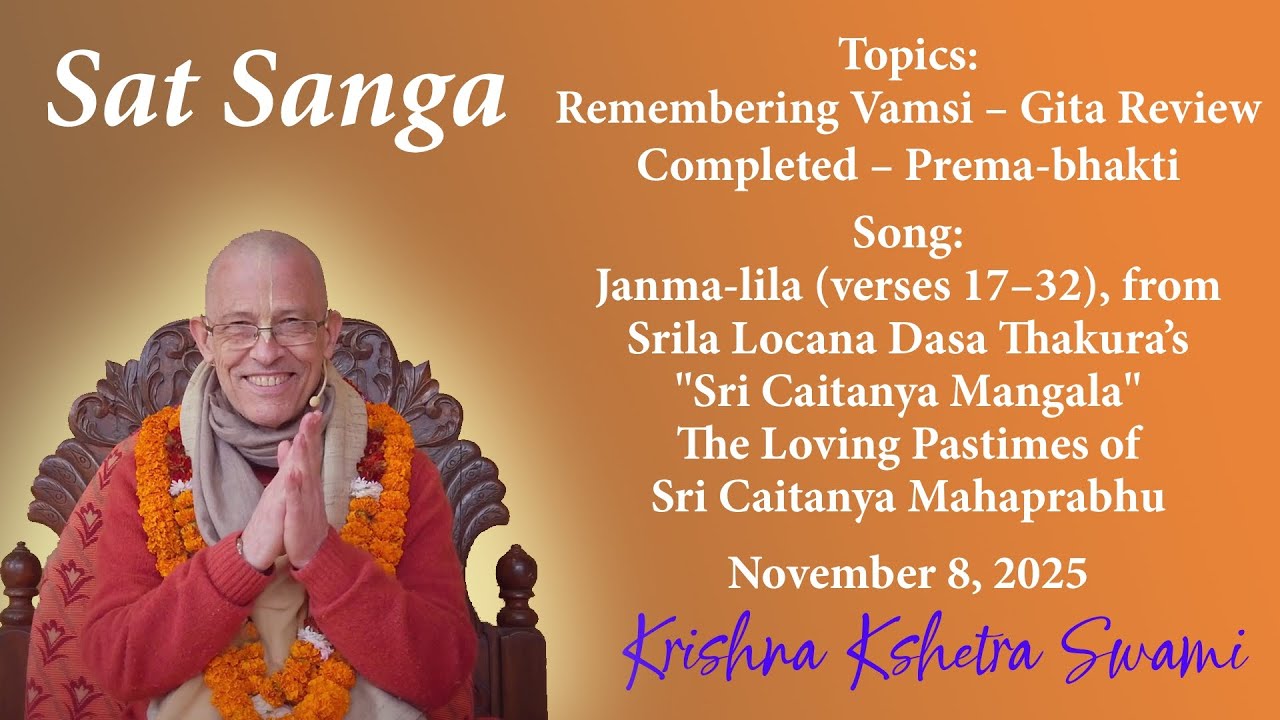
In a recent sat-sanga on 08.11.2025 with HH Krishna Kshetra Swami, a contemplative review of the Bhagavad Gita reached completion, and the group turned to the resonant theme of prema-bhakti while remembering the vamsi, Sri Krishna’s flute. The session combined rigorous scriptural study with lived devotion, offering participants a clear pathway from disciplined sadhana to love-centered practice.
Drawing on Srimad-Bhagavatam, the discussion outlined how advanced devotion manifests as spontaneous expressionstears, laughter, ecstatic singing, dancing, direct address to the infallible Lord, and, at times, reverent re-enactment of līlā. Such states indicate a consciousness no longer circumscribed by conditioned life, oriented instead toward the unborn Supreme. The emphasis remained on authenticity: these symptoms arise naturally from deep absorption rather than deliberate performance.
Remembering the vamsi served as a potent symbol. The flute’s empty reed becomes eloquent only when animated by divine breathan image that illumines the inner work of becoming receptive through humility, aparigraha, and attentive breath awareness. Participants reflected on analogous practices across dharmic traditions: kirtan and nama-smarana in Hinduism, simran and shabad-kirtan in Sikhism, devotional chanting and mindfulness in Buddhism, and reverential stavan of the Tirthankaras in Jainism. The shared thread is a heart educated toward compassion and surrender.
With the Bhagavad Gita review concluded, key syntheses were highlighted: karma-yoga cleanses intention, jnana-yoga clarifies vision, and bhakti-yoga personalizes realization in loving relation with Sri Krishna. The arc culminates in surrender (Bhagavad Gita 18.66), understood not as passivity but as courageous alignment with dharma and service (seva). Within the Gaudiya and ISKCON traditions, this alignment matures through sravana, kirtana, smarana, and sevapractices accessible to contemporary seekers.
Prema-bhakti was presented as the ripened fruit of steady practice. Classical markerssoftness of heart, unmotivated service, and unwavering remembrancecoexist with sobriety and ethical clarity. The gathering cautioned against superficial imitation of advanced states, underscoring steadiness in japa, study, and sat-sanga as the reliable means to cultivate genuine transformation.
Practical encouragement closed the session: establish a daily rhythm of japa, kirtan, or simran; study a passage of the Bhagavad Gita with attention to application; participate in sat-sanga; and extend compassion through tangible seva. Such integrative steps foster unity in spiritual diversity across Hinduism, Buddhism, Jainism, and Sikhism, affirming that multiple dharmic pathways can converge in the shared aspiration for wisdom, peace, and love.
Inspired by this post on Dandavats.