
Śrīmad-Bhāgavatam 8.18.13 presents a compact but deeply layered scene from the appearance of Lord Vāmanadeva, the dwarf incarnation of Lord Vishnu. The verse describes the great sages beholding the Lord in the form of a young brahmacārī, rejoicing in His presence, and arranging the proper Vedic ceremonies under the guidance of Kaśyapa Muni, the Prajāpati. In a few words, the text brings together devotion, ritual discipline, family responsibility, guru-guided culture, and the sacred meaning of human birth.
The original verse reads: taṁ vaṭuṁ vāmanaṁ dṛṣṭvā modamānā maharṣayaḥ karmāṇi kārayām āsuḥ puraskṛtya prajāpatim. Its theological force lies in the way it identifies Vāmana not merely as a child, nor only as an extraordinary divine manifestation, but as a vaṭu, a brahmacārī prepared for discipline, learning, austerity, and sacred responsibility. The sages do not respond with passive admiration. They respond with action. Their joy becomes ceremony, and their reverence becomes properly ordered dharma.
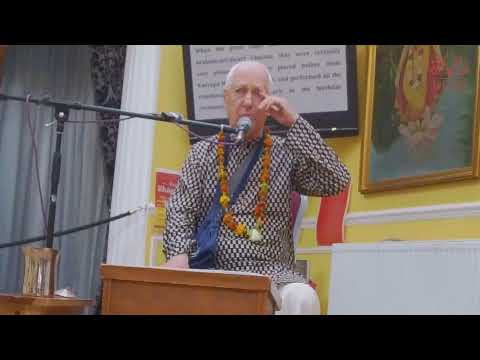
The class associated with this verse, titled “Srimad Bhagavatam class I 8.18.13I HG Vaiyasaki dasa,” points toward an important feature of the Bhagavata Purana: its stories are never only stories. They are vehicles of spiritual education. The appearance of Vāmanadeva is not presented as mythology in the casual sense of invented narrative, but as sacred history carrying philosophical, ethical, and devotional instruction. The video may be viewed here: https://www.youtube.com/watch?v=lciIzdExRpg.
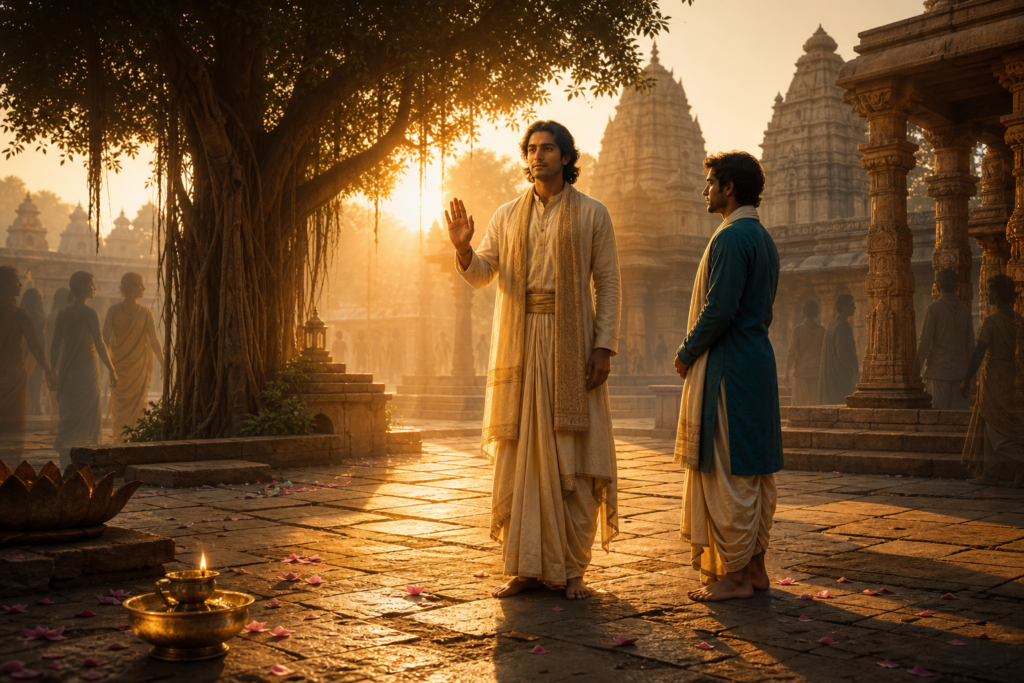
In the broader context of the Eighth Canto, Lord Vāmana appears as the son of Aditi and Kaśyapa Muni at a moment of cosmic imbalance. Bali Mahārāja, though a powerful and generous ruler, has gained dominion in a way that requires divine intervention. The Lord does not appear with overwhelming military force. He appears as a small brahmacārī, carrying the quiet authority of truth, restraint, and sacred learning. This is one of the most striking theological lessons of the Vāmana avatāra: divine power often reveals itself through humility rather than spectacle.
The word vāmanam, meaning dwarf, should not be read as a sign of weakness. In the Bhagavata tradition, Vāmana’s smallness is pedagogical. It disarms pride, exposes superficial judgment, and prepares the ground for the revelation of Trivikrama, the cosmic form that spans the worlds. The Lord first approaches as one who asks only for three steps of land. Yet those three steps become a profound statement about ownership, surrender, and the limits of worldly power.
Śrīmad-Bhāgavatam 8.18.13 focuses especially on the sages’ response to Vāmana’s appearance. They are described as pleased, not because they have encountered novelty, but because they recognize divine purpose. Their happiness is disciplined by Vedic culture. They organize the proper rites, placing Kaśyapa Muni at the forefront. This detail is important because dharma is not treated as private enthusiasm alone. It is transmitted through lineage, order, responsibility, and qualified guidance.
Kaśyapa Muni’s role as Prajāpati gives the scene social and cosmic significance. A Prajāpati is not merely a biological progenitor; he is a guardian of continuity, order, and sacred responsibility. By placing Kaśyapa Muni before them, the sages affirm that spiritual life is not detached from family, society, or the disciplined transmission of culture. Birth, initiation, learning, and worship are all connected through samskara, the system of sacraments that refines human life from its earliest stages.
The purport to this verse emphasizes jāta-karma, the birth ceremony traditionally performed when a child is born in a brāhmaṇa family. It also notes that because Vāmana appeared as a vaṭu, His sacred thread ceremony was performed immediately. This detail opens a broader discussion of samskaras in Vedic culture. These rites are not empty formalities. They are educational markers that remind the individual and the community that life is meant for refinement, self-control, service, and God-realisation.
In a technical sense, samskara means purification, refinement, or impression. The traditional Vedic system recognizes that human life is shaped by repeated impressions: speech, food, conduct, memory, ritual, learning, and association. A samskara places a person within a moral and spiritual framework. It says that life is not random, and the body is not merely biological. Birth carries obligation. Education carries sanctity. Family carries duty. Community carries responsibility.
Jāta-karma, as a birth rite, acknowledges the arrival of embodied life as sacred. Upanayana, the sacred thread ceremony, marks entry into disciplined learning and brahmacarya. In Vāmana’s case, the narrative compresses these stages because the Lord appears already in the form of a brahmacārī. The theological point is clear: the Supreme enters the world not to reject dharma, but to honor it, demonstrate it, and elevate it.
Brahmacarya is often misunderstood as merely celibacy. In the Vedic and Bhagavata framework, it is more comprehensive. It refers to a disciplined orientation of life toward Brahman, sacred knowledge, purity of conduct, restraint of the senses, service to the guru, and concentration of the mind. Vāmana’s form as a brahmacārī therefore carries an entire philosophy of education. Knowledge is not a commodity. It is a sacred discipline that reshapes character.
This verse is also significant for understanding Vaishnava theology. Lord Vishnu’s avatāras do not appear randomly. They appear to restore balance, protect dharma, uplift devotees, and teach by example. Vāmana’s appearance shows that the Lord may choose gentleness as the instrument of correction. Instead of humiliating Bali Mahārāja through brute force, Vāmana invites him into an act of surrender. The drama becomes moral rather than merely political.
For readers engaged in Hindu philosophy, this episode offers a refined view of power. True authority is not always loud, expansive, or coercive. Sometimes it arrives in the form of simplicity, humility, and a sacred request. The young Vāmana asks for little, yet reveals everything. This inversion is central to many Dharmic traditions, where the subtle often governs the gross and the inner intention determines the spiritual value of outer action.
The sages’ joy also deserves careful attention. Their happiness is not sentimental. It is rooted in recognition. They see the Lord, understand the sacredness of the moment, and act in harmony with śāstra. This is a model for spiritual maturity. Genuine devotion does not discard structure; it gives structure life. Ritual without devotion can become mechanical, but devotion without discipline can become unstable. The Bhagavata Purana repeatedly brings these two dimensions together.
The unity of Dharmic traditions can be thoughtfully understood through this lens. Hinduism, Buddhism, Jainism, and Sikhism each preserve distinctive teachings, practices, and histories, yet all place deep value on disciplined life, ethical conduct, humility, reverence for teachers, and transformation of the self. A verse such as Śrīmad-Bhāgavatam 8.18.13 speaks from a Vaishnava Hindu context, but its concern for sacred learning, restraint, and reverential conduct resonates broadly across Dharmic civilization.
The Vāmana narrative also speaks to modern readers who live in an age of haste, performance, and constant self-display. The image of the divine child-brahmacārī challenges the assumption that greatness must announce itself aggressively. It invites a quieter and more demanding question: what kind of inner formation makes a person worthy of trust? In that sense, Vāmana is not only an avatāra to be worshipped, but also a mirror for examining humility, discipline, and the use of power.
From an academic perspective, the verse reflects the Bhagavata Purana’s integration of theology and social ritual. The birth of a divine being is framed through the recognizable institutions of Vedic civilization: sages, Prajāpati, ceremony, brahmacarya, and initiation. This gives the narrative a layered texture. The cosmic enters the domestic. The divine enters the ritual order. The household becomes a site of sacred history.
At the same time, the verse should not be reduced to ritual sociology. Its devotional center remains the presence of the Lord. The ceremonies matter because of whom they honor. The sages matter because of what they recognize. Kaśyapa Muni matters because he stands within a lineage of responsibility. The verse is therefore both technical and tender: technical in its references to Vedic rites, tender in its depiction of joyful sages gathering around the newly appeared Lord.
HG Vaiyasaki dasa’s class on this passage belongs to the living tradition of Bhagavata hearing, in which scripture is not only read privately but received through oral explanation, kirtan culture, and devotional reflection. This is consistent with the long history of Hindu scriptural transmission, where śravaṇam, hearing, is itself a spiritual practice. The Bhagavata is meant to be heard, contemplated, discussed, and applied.
The verse also raises an important question about culture: how is sacred knowledge preserved across generations? The answer offered here is not abstract. It is preserved by families who honor birth as sacred, by teachers who initiate students into disciplined learning, by sages who recognize divine presence, and by communities that maintain rites with understanding rather than mere habit. Cultural heritage survives when meaning accompanies practice.
For contemporary Hindu society and the wider Dharmic world, the lesson is practical. Rituals such as jāta-karma and upanayana should not be treated as social display. Their deeper purpose is to connect the individual to dharma, humility, learning, and responsibility. When performed with clarity, they can strengthen family life, spiritual identity, and intergenerational continuity. When reduced to appearance, their transformative power is weakened.
Śrīmad-Bhāgavatam 8.18.13 therefore offers more than a brief note in the Vāmana avatāra narrative. It provides a window into Vedic culture, Vaishnava devotion, the sanctity of samskaras, and the power of humility. The sages rejoice because they see the divine in a form that invites reverence, learning, and service. Their response remains instructive: when sacred presence is recognized, the proper response is joy disciplined by dharma.
The enduring value of this passage lies in its ability to connect metaphysical truth with lived practice. Lord Vāmana’s appearance reminds readers that the highest reality can enter the world through the smallest form, that humility can carry cosmic authority, and that sacred ceremonies can become vessels of profound spiritual remembrance. In this way, the verse continues to guide readers toward a life shaped by devotion, knowledge, restraint, and reverence.
Inspired by this post on Dandavats.







Leave a Reply
You must be logged in to post a comment.