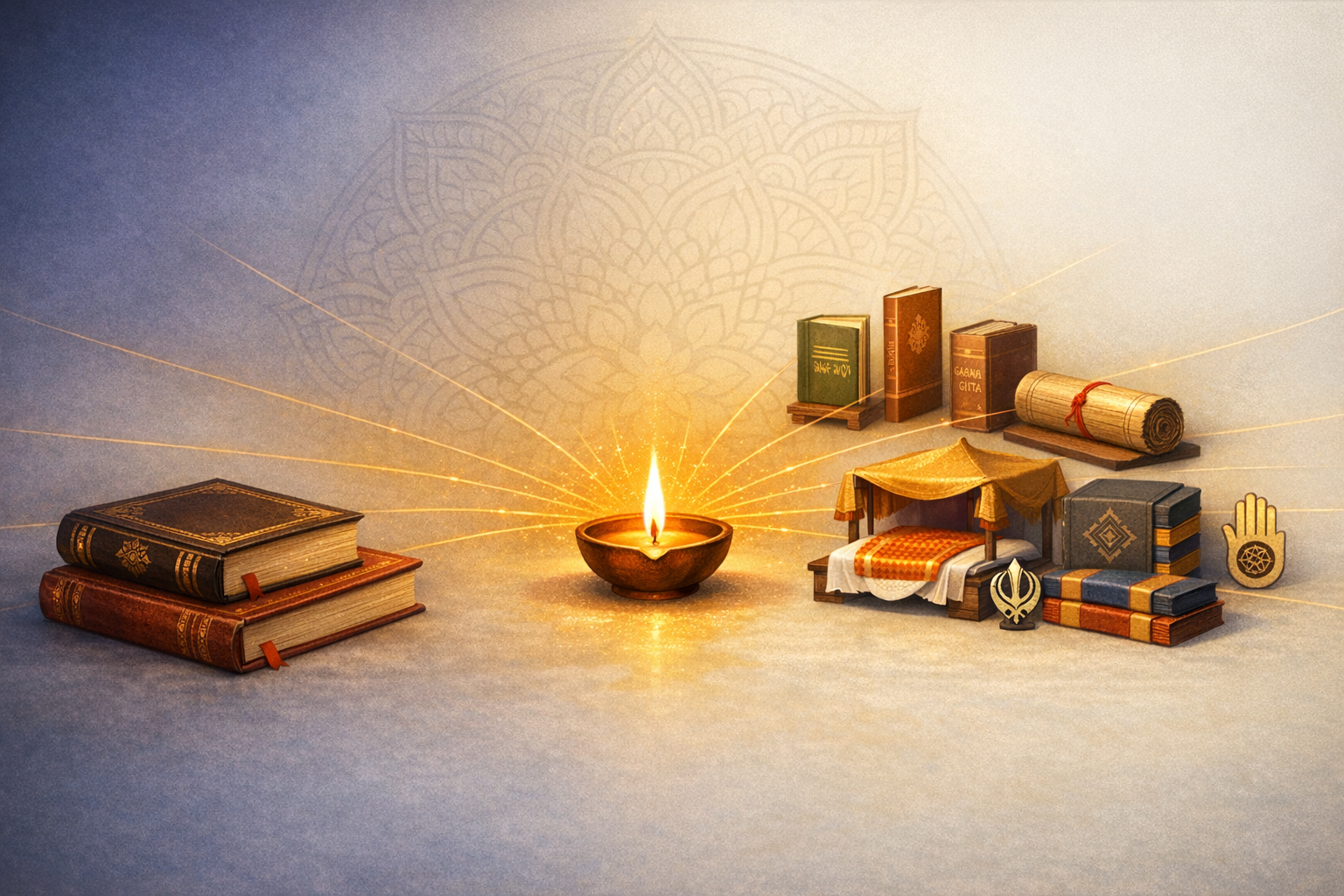
Is any Indian scripture equal to the Quran or Bible? The most accurate answer is that within the dharmic traditions of Hinduism, Buddhism, Jainism, and Sikhism, there is no single text that functions as an exclusive and universally binding canon for the entire civilizational family. Hinduism in particular is polycentric and textually plural, where authority flows through families of texts, teacher–disciple lineages, and lived practice (sādhanā) rather than through a formally closed canon. This plural framework preserves unity in philosophical aimsethical living, self-realization, and liberationwhile accommodating diversity in paths, practices, and scriptures.
Comparisons with the Quran or the Bible can therefore be misleading if they assume that religious authority must be centralized in one book. In much of the Indian context, scriptural authority is distributed and contextual: multiple texts are authoritative, and their use is guided by hermeneutical traditions, monastic orders, and community practices. What looks like “fragmentation” from an exclusively canonical viewpoint is better understood as a library-of-wisdom model in which convergence emerges through shared concepts such as dharma, karma, ahiṁsā, yoga, and liberation (mokṣa/nirvāṇa/kevalajñāna).
Within Hinduism, the classical architecture of authority is mapped through the distinction between Sruti and Smriti. Sruti“that which is heard”comprises the Vedas and is traditionally regarded as apauruṣeya (not authored by any individual), making it the highest textual authority. Smriti“that which is remembered”includes a vast corpus of literature (Itihāsa, Purāṇa, Dharmashastras, and Agamas) that elaborates and applies Sruti to society, ritual life, ethics, and devotion. This framework does not establish a single book for all Hindus; rather, it establishes an apex (Sruti) and a structured interpretive ecosystem (Smriti).
The VedasṚg, Yajur, Sāma, and Atharvaare expansive and internally diverse. Each contains layers: Samhita (hymns and mantras), Brāhmaṇa (ritual expositions), Āraṇyaka (meditative and transitional discussions), and Upaniṣad (philosophical teachings). Their scope ranges from cosmic hymns and sacrificial injunctions to profound metaphysical inquiry. For technical completeness, one must note that Vedic study unfolds through precise recensional traditions (śākhās) and specialized disciplines (Vedāṅgas) that govern phonetics, meter, etymology, grammar, astronomy, and ritual geometry.
The Upanishads, often described as the Vedānta (culmination of the Veda), distill the philosophical heart of the Sruti. Texts such as the Īśa, Kena, Kaṭha, Muṇḍaka, Māṇḍūkya, and Chāndogya probe the nature of reality (Brahman), the self (ātman), consciousness, and liberation. Their terse aphorisms generated centuries of commentary and debate, culminating in major Vedānta schools (Advaita, Viśiṣṭādvaita, and Dvaita) that agree on the sanctity of the Sruti while offering different non-contradictory lenses on the same ultimate truth.
Smriti literature translates foundational insights into lived ethics and memory. The ItihāsasRāmāyaṇa and Mahābhārataintegrate narrative, jurisprudence, ethics, and devotion; the latter includes the Bhagavad Gita, a compact synthesis of karma, jñāna, and bhakti. The Purāṇas systematize cosmology, sacred geography, temple lore, and theologies of deities such as Viṣṇu, Śiva, and Devī. Dharmashastras and Dharmasutras articulate jurisprudence and social ethics, while regional vernacular literatures transpose these ideals into the rhythms of everyday life.
Agamas and Tantras provide the ritual, liturgical, and architectural blueprints of Hindu temple life. Shaiva, Shakta, and Vaishnava Agamas (including Pañcarātra and Vaikhānasa) regulate consecration (prāṇa-pratiṣṭhā), iconography, festival calendars, daily worship, and home rituals. Their authority is practical and prescriptive, anchoring sacred art and communal devotion to an unbroken ritual science consistent with Sruti and elaborated by Smriti.
In practical terms, if a single, accessible Hindu text is sought for study, the Bhagavad Gita frequently serves as a concise and widely-read gateway. It is part of the Prasthāna-trayī (Upanishads, Bhagavad Gita, and Brahma Sutras), the triad that most Vedānta schools treat as the core philosophical canon. The Gita’s dialogical format unites ethics (dharma), contemplation (jñāna), devotion (bhakti), disciplined action (karma-yoga), and meditation (dhyāna) in 700 verses. Its universal tone explains why many readers informally treat it as the “closest equivalent” to a single handbookwhile remaining mindful that Hindu authority is fundamentally multi-textual.
That said, the Bhagavad Gita does not annul the primacy of the Vedas as Sruti nor supplant the living role of the Upanishads, Purāṇas, Agamas, and Dharmashastras. Rather, it acts as a portable canon, gathering and harmonizing essential strands for seekers across lineages. Its commentarial traditionfrom Śaṅkara to Rāmānuja and Madhva, and onward into modern expositionsdemonstrates how interpretive diversity can deepen, rather than dilute, a shared quest for truth.
Across the wider dharmic family, cohesion emerges through shared ethical and spiritual principles. Hinduism, Buddhism, Jainism, and Sikhism emphasize moral responsibility, non-violence (in varying degrees), self-discipline, meditation or remembrance, and liberation from suffering or bondage. This unity in ethical aspiration ensures that scriptural plurality does not fragment meaning; instead, it enriches the pathways by which individuals and communities cultivate wisdom and compassion.
In Sikhism, the Guru Granth Sahib occupies a central, definitive role analogous to what the Quran or Bible represent in their respective traditions. Compiled and authenticated by the Sikh Gurus, the Guru Granth Sahib is installed as the eternal Guru in gurdwārās and in Sikh homes, offering authoritative spiritual guidance through the revealed hymns (śabads) of the Gurus and other bhaktas. Its authority is simultaneously devotional, liturgical, ethical, and doctrinal, guiding the community through a living practice of remembrance (simran), service (seva), and upright living.
Buddhist canons are tradition-specific but functionally comprehensive. The Theravāda tradition preserves the Pāli Tipiṭaka (Sutta, Vinaya, and Abhidhamma); East Asian Mahāyāna communities preserve the Chinese Canon; Tibetan Buddhism preserves the Kangyur (words of the Buddha) and Tengyur (commentaries). Accessible gateways such as the Dhammapada communicate core ethical and contemplative teachings. While there is no single pan-Buddhist book, these canons and sub-canons provide cohesive spiritual, philosophical, and monastic guidance within each lineage.
Jainism preserves scriptural authority in the Āgamas (with textual histories and acceptance varying between Śvetāmbara and Digambara traditions) and in revered treatises such as the Tattvārtha Sūtra. Core principles such as ahiṁsā, aparigraha, and anekāntavāda are elaborated through sutra literature and rich commentarial streams. As in other dharmic streams, interpretive communities, ascetic orders, and scholastic traditions ensure cohesion without positing a single, exclusive book for all Jains across time and space.
With this landscape in view, the comparative question can be reframed responsibly. For Hinduism, the Vedas (Sruti) occupy the highest formal authority, while the Bhagavad Gita is the most widely read and pedagogically effective synthesis for general seekers. For Sikhism, the Guru Granth Sahib provides a singular and authoritative scripture. For Buddhism and Jainism, multiple core texts function as comprehensive guides within each living tradition. Thus, “equivalence” depends on which dharmic path is under discussion and must be stated with precision.
Indian traditions also articulate sophisticated theories of knowledge and interpretation that stabilize scriptural use across diversity. Mīmāṁsā develops rigorous hermeneutics for Vedic injunctions; Vedānta applies careful exegesis to the Upanishads, Bhagavad Gita, and Brahma Sutras; and classical epistemology (pramāṇa theory) affirms śabda-pramāṇa (reliable testimony) alongside perception and inference. Far from being ad hoc, the Indian scriptural universe is governed by logical, linguistic, and philosophical disciplines that ensure coherence.
In everyday practice, regional cultures and family lineages often privilege particular texts. Vaishnavas may favor the Bhāgavata Purāṇa and Pañcarātra Agamas; Shaivas draw on Śaiva Agamas and the Tēvāram; Shaktas treasure the Devī-Bhāgavata and Tantric manuals; Smārtas balance Vedic and Purāṇic sources. Sikh households revolve around the Guru Granth Sahib and daily nitnem; Buddhist communities recite suttas or sutras aligned with their tradition; Jain households observe canonical recitations and ethical vows articulated in their śāstras. Diversity of text is matched by unity of purpose.
For readers seeking an entry point, a balanced roadmap can be practical and unifying. In the Hindu stream, begin with the Bhagavad Gita (for synthesis) and select Upanishads (for metaphysics), complementing them with a dharma-oriented Purāṇa such as the Bhāgavata Purāṇa for devotional context. In the Buddhist stream, explore the Dhammapada and representative suttas (Theravāda) or a concise Mahāyāna sutra alongside a practice manual. In the Jain stream, the Tattvārtha Sūtra provides an authoritative overview of doctrine. In the Sikh stream, selections from the Guru Granth Sahib (guided by established commentaries and community practice) open a direct path to remembrance, ethics, and devotion. Such a cross-traditional reading honors unity-in-diversity without flattening distinctive voices.
Translations and commentaries matter. Reliable editions, rooted in the original languages (Sanskrit, Pāli, Prākrit, and Gurmukhi), and grounded in traditional commentaries, provide doctrinal fidelity and interpretive depth. Where possible, readers should consult works recognized by living traditions, as these carry the communal wisdom of practice and interpretationan essential hallmark of dharmic scriptural life.
In conclusion, asking “Which Indian scripture is equal to the Koran or Bible?” invites a deeper appreciation of how Indian, dharmic traditions conceive authority and unity. Hinduism does not centralize a single book for all adherents; the Vedas serve as the apex of Sruti, while the Bhagavad Gita often functions as the most accessible, widely read synthesis. Sikhism does center on a single supreme scripture, the Guru Granth Sahib. Buddhism and Jainism steward comprehensive, tradition-specific canons. Together, they sustain a civilizational model where many scriptures, one ethical arc, and a shared quest for liberation harmonize into a coherent, living whole.
Inspired by this post on Hindu Pad.