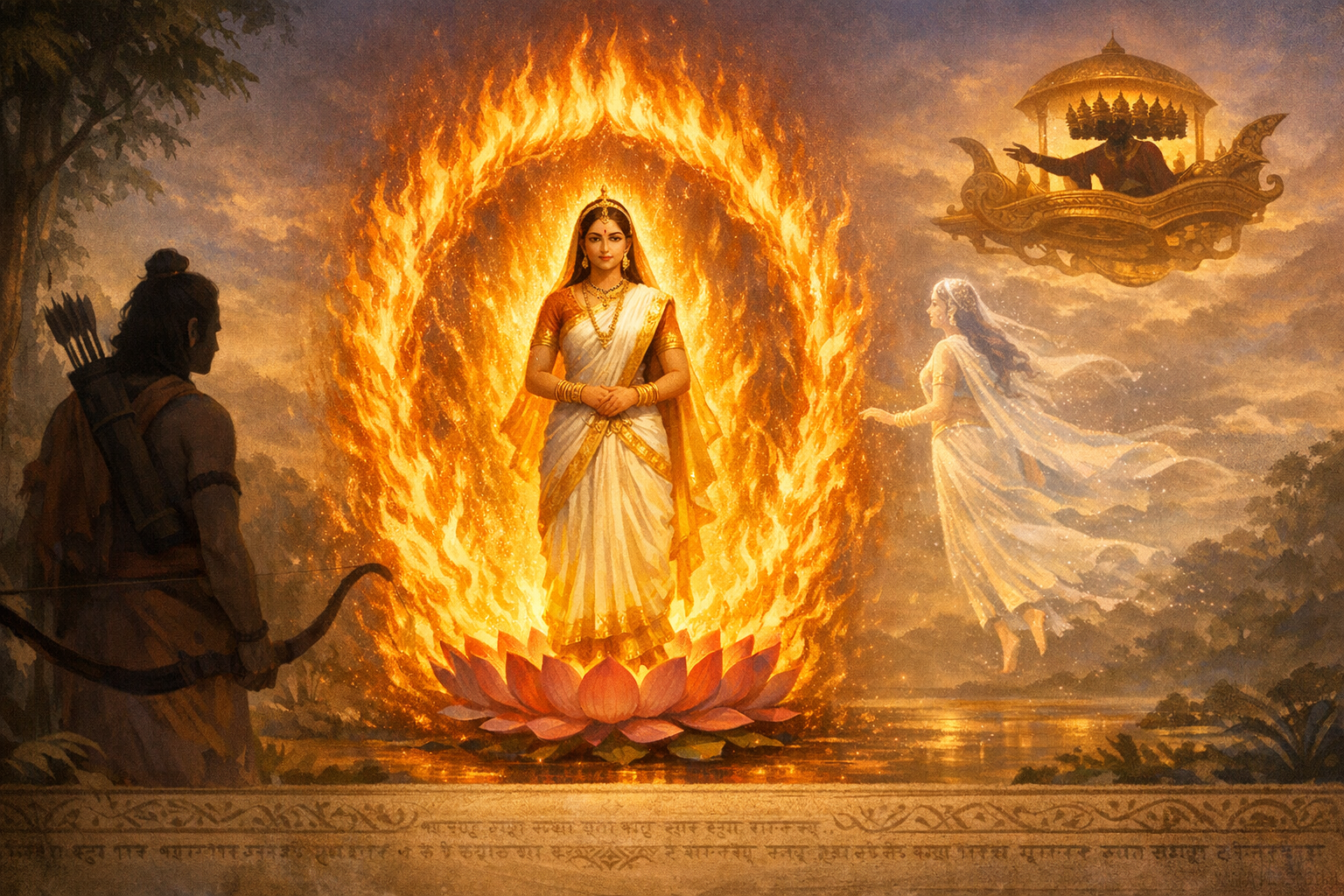
The Ramayana lives across languages, centuries, and communities, and each retelling adds a new layer to its ethical and philosophical resonance. Beyond the Valmiki Ramayana, Puranic literature preserves interpretive variations that illuminate the epic’s theological depth and its enduring place in the shared dharmic imagination of Hindus, Buddhists, Jains, and Sikhs. One influential variationattested in recensions attributed to the Narasimha Purana and echoed in allied sourcesrecasts the episode of Ravana kidnapping Sita by proposing that the demon-king carried away not the historical Sita, but a divinely fashioned double, commonly called “Maya Sita” or “Chāyā Sita.”
In this Puranic frame, “Maya Sita” functions as a theological safeguard. The narrative arc remains familiarRavana’s deceit, the journey to Lanka, the great war, and the fire-ordealyet its inner logic shifts. Agni is said to shelter the true Sita while an illusory counterpart endures abduction, ensuring that Sita’s inviolability remains intact even as the world witnesses Rama’s struggle against adharma. The culmination in the Agni-pariksha thus becomes less a social test and more a dramatic revelation: the return of the real Sita from Agni’s protection and the withdrawal of the Maya Sita who had fulfilled a sacrificial, protective role.
Although details vary between manuscripts and commentarial traditions, the thematic structure is strikingly consistent across several Puranic conversations, including passages ascribed to the Padma Purana and the Skanda Purana. The Narasimha Purana’s alternate account thereby participates in a broader Puranic habit of theological amplification: when a crucial ethical or spiritual lesson is at stake, the narrative introduces divine concealment (maya) or substitution (chāyā) to protect dharma’s exemplars while preserving the epic’s moral clarity.
This Maya Sita reading transforms the semantics of the Agni-pariksha. Rather than reducing the episode to a narrow social ritual, it repositions Agni as a cosmic guardian and revealer of truth. Agni, who is both purifier and witness in Vedic and Smriti traditions, becomes the stage on which the epic reasserts that Sitaunderstood as Sri, the Shakti of Vishnuremains untouched by Ravana. In this light, the ordeal resolves a metaphysical question publicly, not a moral doubt privately, and restores narrative harmony between Rama’s maryada and Sita’s inherent sanctity.
Doctrinally, the motif turns on a nuanced understanding of maya. Here, maya is not a negation of reality but the divine power of veiling and strategic manifestation (yogamaya). As “Maya Sita,” it serves as an upayaa compassionate expedientto achieve multiple ends simultaneously: protecting the dignity of Sita, exposing Ravana’s hubris, and creating the karmic and ethical conditions for Lanka’s downfall. This is liladivine playwith moral purpose.
Philosophically, the Narasimha Purana’s variation clarifies three related concerns. First, it maintains the integrity of Sita’s personhood by preventing interpretive space for violation. Second, it preserves Rama’s status as Maryada Purushottamaupholder of norm and exemplar of right actionwhose conduct is transparent, above reproach, and pedagogically legible to society. Third, it elevates Agni from ritual implement to cosmic witness, reinforcing the Puranic axiom that ethical truth must be both metaphysically real and publicly manifest.
The ethical implications are significant for contemporary readers. Many find the Maya Sita account emotionally resonant because it safeguards Sita’s agency and dignity while sustaining the epic’s karmic economy. The narrative also reframes the Agni-pariksha as an unveiling of a divine arrangement rather than a punitive ordeal, aligning the episode with broader dharmic commitments to compassion, truth, and righteous leadership. In doing so, it provides an interpretive bridge between tradition and modern ethical sensitivities without compromising the epic’s spiritual grammar.
Intertextually, the theme of a protected Sita and an illusory double appears across multiple retellings. Commentarial traditions in parts of the Ramayana receptionparticularly in Vaishnava theological discourseembrace this motif to emphasize Sita as Lakshmi, inherently beyond defilement. The Padma Purana and Skanda Purana are often cited in this conversation, indicating that the Narasimha Purana’s telling occupies a recognizable Puranic constellation rather than an isolated innovation.
From a textual-critical perspective, Puranas are living libraries: layered, regionalized, and often interpolated over long periods. Scholars therefore speak carefully about chapter divisions and attributions, since manuscript families can diverge. The value of the Narasimha Purana’s variant lies not merely in establishing priority over the Valmiki Ramayana, but in showing how Puranic hermeneutics work: the epic’s ethical telos remains stable, while expository scenes are reconfigured to protect dharma’s exemplars and ensure a didactic outcome for the community.
Placed within a broader dharmic context, such plurality is a strength, not a contradiction. Jain tellings like the Paumacariya reimagine characters and causalities to highlight non-violence and self-restraint; Buddhist Jataka traditions recast the narrative to teach universal compassion and right conduct; Sikh teachings honor the ethical ideal of righteous sovereignty (raj dharma) and truthfulness while using names like “Ram” devotionally to indicate the One. The Maya Sita motif converses with these traditions by modeling how multiple angles (anekānta-like perspectives) can illuminate a single moral horizondharma as truth, responsibility, and compassion.
Symbolically, Ravana’s seizure of the illusory Sita dramatizes adharma’s fundamental error: grasping at appearances. His apparent triumph is only over maya, not over reality; thus the war becomes a cosmic correction of vision. When truth is finally revealed through Agni, the community witnesses the distinction between seeming and being, reminding listeners that dharma’s protection may sometimes be hidden but never absent.
Liturgically and pedagogically, the variant enriches katha (sacred storytelling) in temples and homes. It allows teachers to highlight the roles of Agni as witness, Sita as Sri, and Rama as Maryada Purushottama in a way that preserves reverence while engaging contemporary ethical concerns. For communities that value the Ramayana’s guidance in personal and social life, the Narasimha Purana’s alternative episode offers a powerful lens to discuss integrity, restraint, and justice without resorting to reductive readings.
For students of epic literature, the Narasimha Purana’s Maya Sita narrative also demonstrates how Itihasa and Purana interrelate. Itihasa provides the narrative backbone of civilizational memory; Purana supplies theological exegesis and ritual symbolism that help communities internalize those memories as living dharma. Their dialoguerather than competitionhas sustained the Ramayana’s relevance from ancient courts and hermitages to contemporary classrooms and diasporic assemblies.
Ultimately, the Narasimha Purana’s portrayal of Ravana kidnapping an illusory Sita does not fracture the tradition; it deepens it. By reinterpreting a crucial episode through the lens of divine protection and cosmic witness, it preserves Sita’s inviolability, clarifies Rama’s exemplary conduct, and upholds the epic’s ethical arc. In a plural, dharmic world where multiple paths seek the same truth, such Puranic variations work as bridgesaffirming unity in diversity and guiding seekers toward a shared commitment to dharma, compassion, and wisdom.
Inspired by this post on Hindu Blog.