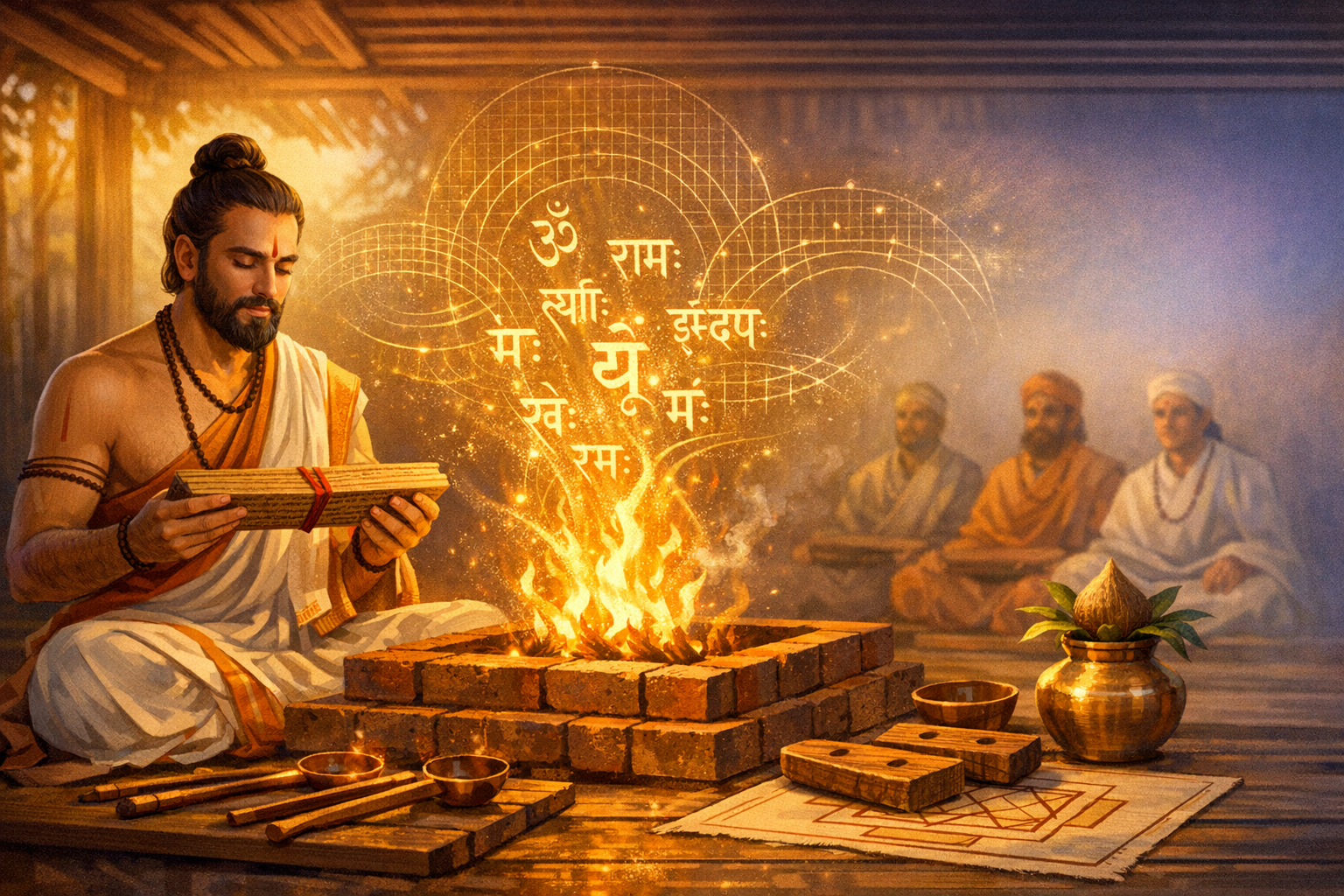
In the liturgical architecture of Vedic yajña, the Hotṛ (pronounced Ho-tri) emerges as the Rigvedic voice that animates ritual action through sacred sound. Serving as one of the four principal ritvij (priests) in solemn Vedic sacrifices, the Hotṛ recites hymns from the Ṛg Veda with calibrated precision, invoking deities and aligning the rite with ṛta, the cosmic order. The role is simultaneously technical and contemplative: technique safeguards textual fidelity, while contemplative presence imbues the rite with meaning that participants often describe as palpable stillness and uplift.
Etymologically, Hotṛ derives from the Sanskrit root hu, “to invoke or call,” with the agentive suffix -tṛ denoting “the invoker.” This etymology encapsulates the office: the Hotṛ is the summoner of deities through ṛcas (Ṛgvedic verses), transforming metrical speech and tonal accent into a precise instrument of ritual efficacy. Within the disciplined universe of śruti (revealed sound), invocation is not ornamental; it is causal, ordered, and exacting.
Classical śrauta practice distinguishes four chief priestsHotṛ (Ṛg Veda), Adhvaryu (Yajur Veda), Udgātṛ (Sāma Veda), and Brahman (Atharva Veda)whose synergy sustains the yajña. The Adhvaryu manages the physical and procedural aspects with Yajurvedic formulas; the Udgātṛ sings stotras (melodic chants) from the Sāma Veda; the Brahman supervises and remedies errors through Atharvavedic knowledge; and the Hotṛ, as Rigvedic specialist, gives the rite its articulate praise and invocation through śāstra recitation.
The Hotṛ’s primary responsibility is the śāstraextended Rigvedic recitations at key junctures of the soma and fire rituals. These recitations are not random selections; they are carefully curated sequences that match deity, meter (chandas), and ritual moment. Through this alignment, the Hotṛ ensures that the invoked deities are addressed with thematic coherence and metrical authority, reinforcing both the sanctity and the intended outcomes of the rite.
A useful technical contrast clarifies the liturgical division of labor: the Hotṛ’s śāstra (spoken praise) differs from the Udgātṛ’s stotra (sung praise) and the Adhvaryu’s yajus (prose formulas accompanying action). Together, these streamsrecited ṛcas, sung sāman melodies, and operative yajuscreate a multi-layered ritual soundscape in which praise, melody, and action interlock. This orchestration is especially prominent in soma sacrifices such as Agniṣṭoma, Ukthya, Atirātra, Vājapeya, and Aśvamedha.
Precision in chandas is central to the Hotṛ’s craft. Hymns selected in Gāyatrī, Anuṣṭubh, Triṣṭubh, or Jagatī meters each carry distinctive rhythmic and semantic force. A Triṣṭubh recitation, for instance, bears a martial, expansive cadence suited to certain deities and intentions, while Gāyatrī’s brisk symmetry can evoke clarity and luminosity. Listeners frequently report that correct metrical cadence heightens focus and collective resonance, making the rite experientially coherent.
Tonal accent (svara) is equally exacting. The classical tripartite systemudātta (raised), anudātta (unraised), and svarita (circumflex)structures how syllables are pitched, with additional attention to pluta (lengthened) vowels where required. The Hotṛ’s training includes mastery of these accents so that semantic meaning, ritual force, and oral continuity remain intact. In this tradition, a misplaced accent is not a minor flaw; it can constitute a ritual doṣa (error) requiring remedy.
The training pipeline that produces a Hotṛ is rigorous. Disciples internalize multiple pāṭha techniquessaṃhitā-pāṭha (continuous recitation), pada-pāṭha (word-by-word), krama, jaṭā, and ghanaeach designed as a redundancy system for error correction and accurate transmission. Foundational phonetic sciences (śikṣā) and recension-specific treatises such as the Ṛgveda Prātiśākhya codify rules for articulation, sandhi, and accent. Over time, this pedagogy cultivates unwavering concentration, breath control, and memory that often inspire deep respect among both practitioners and observers.
Textual authorities illuminate this role in detail. The Aitareya Brāhmaṇa and the Kauṣītaki (Śāṅkhāyana) Brāhmaṇa analyze how, why, and when specific Rigvedic hymns are employed within śrauta liturgies, while the Āśvalāyana and Śāṅkhāyana Śrauta Sūtras lay down procedural rules that guide the Hotṛ’s deployment of śāstra. These sources highlight an abiding principle: ritual action without well-formed speech risks becoming inert; well-formed speech without correct action risks disconnection; only their integration attains ritual plenitude.
The Hotṛ functions with three assistants, forming a quartet that refines performance and oversight. The Maitrāvaruṇa coordinates and supports the timing and integrity of recitations, the Acchāvāka renders responsive repetitions and confirmations that maintain the rite’s dialogic rhythm, and the Grāvastut praises the pressing stones (grāvan) during the soma ritual, embedding even the implements within a sacralized web of sound. This fourfold team exemplifies how Vedic liturgy ritualizes collaboration as much as content.
Error management underscores the Hotṛ’s professionalism. Should a syllable, accent, or selection deviate from prescribed norms, the Brahman priest identifies the lapse and prescribes Atharvavedic śānti or prāyaścitta measures. This institutionalized humilityaccepting oversight and remediationsafeguards the rite’s integrity and models a broader dharmic ethic in which precision and correction coexist without rivalry.
The social and ethical horizon of the Hotṛ’s work extends beyond technical mastery. By invoking deities with textual fidelity and contemplative intent, the Hotṛ reaffirms shared valuestruthfulness in speech, steadiness of mind, and service to community. Many participants experience the recitations as a sonic ethic: the discipline of sound becomes a discipline of self, and the collective cadence nurtures belonging, gratitude, and inner composure.
The distinction between Hotṛ and purohita is instructive. A purohita often serves as a household or court chaplain, advising on rites across the calendar, whereas the Hotṛ is a specialist for śrauta sacrifices whose authority rests in Rigvedic śāstra. In historical and royal contexts the same person could sometimes perform both functions, yet the liturgical identity of the Hotṛ remains anchored in the science of sacred recitation.
Contemporary practice, though rare and community-specific, preserves this lineage with remarkable dedication. In certain regions, śrauta rituals continue under the guidance of learned lineages that maintain recension fidelity (for example, the Śākala tradition of the Ṛg Veda) alongside the phonetic and metrical disciplines outlined in the prātiśākhya literature. Observers frequently note that even brief exposure to a well-executed Triṣṭubh or Jagatī śāstra can evoke a sense of spaciousness and quiet resolve.
From a ritual-systems perspective, the Hotṛ’s art demonstrates how sound engineers meaning. Selection (devatā, chandas, ṛṣi), sequencing (anuvāka and hymn placement), and delivery (svara, pace, and breath) converge into a tightly coupled process model. This modelcomparable in rigor to formal grammars or algorithmic pipelinesshows why the Vedic tradition views correct recitation as both an epistemic and a soteriological discipline.
Comparative insights across dharmic traditions underscore a shared civilizational esteem for sacred sound. In Buddhist practice, disciplined paritta and sutta recitation organizes community attention and compassion; in Jain tradition, sūtra recitation within sāmayika cultivates steadiness and nonviolence; in Sikh tradition, kīrtan and the continuous recitation of the Guru Granth Sāhib deepen devotion and ethical clarity. While forms and theologies differ, all affirm the transformative power of precise, intentional utterancean ethos that resonates with the Hotṛ’s vocation.
This shared emphasis on sound and discipline advances unity among Hinduism, Buddhism, Jainism, and Sikhism without collapsing their distinct identities. The Hotṛ’s example offers a constructive template: honor textual accuracy, cultivate inner attentiveness, and align speech with purpose. Such principles strengthen mutual respect, making space for plural ritual ecologies to thrive in dignity and harmony.
In sum, the Hotṛ is not only a guardian of Rigvedic memory but also a systems-architect of liturgical meaning. By integrating metrical science, tonal exactness, and contemplative presence, the Hotṛ ensures that yajña remains a living dialogue between human intention and cosmic order. The legacy is both technical and tender: technical in its uncompromising standards, tender in the way a measured voice can steady hearts, unify communities, and illuminate the ethical horizon of dharmic life.
Inspired by this post on Hindu Blog.