At a pivotal moment in the Yuddha Kanda of the Ramayana, the coalition assembled by Sri Rama to confront Ravana reached a dangerous inflection point. Sugriva, the Vanara king whose courage and earlier loyalty were indispensable to the Lanka campaign, allowed a surge of pride to draw him into a reckless confrontation. That decision, while born of valor, exposed a critical vulnerability in the coalition’s chain of commandand, paradoxically, catalyzed one of the most important leadership transitions of the war: Angada’s ascent to operational command of the Vanara battle formations.
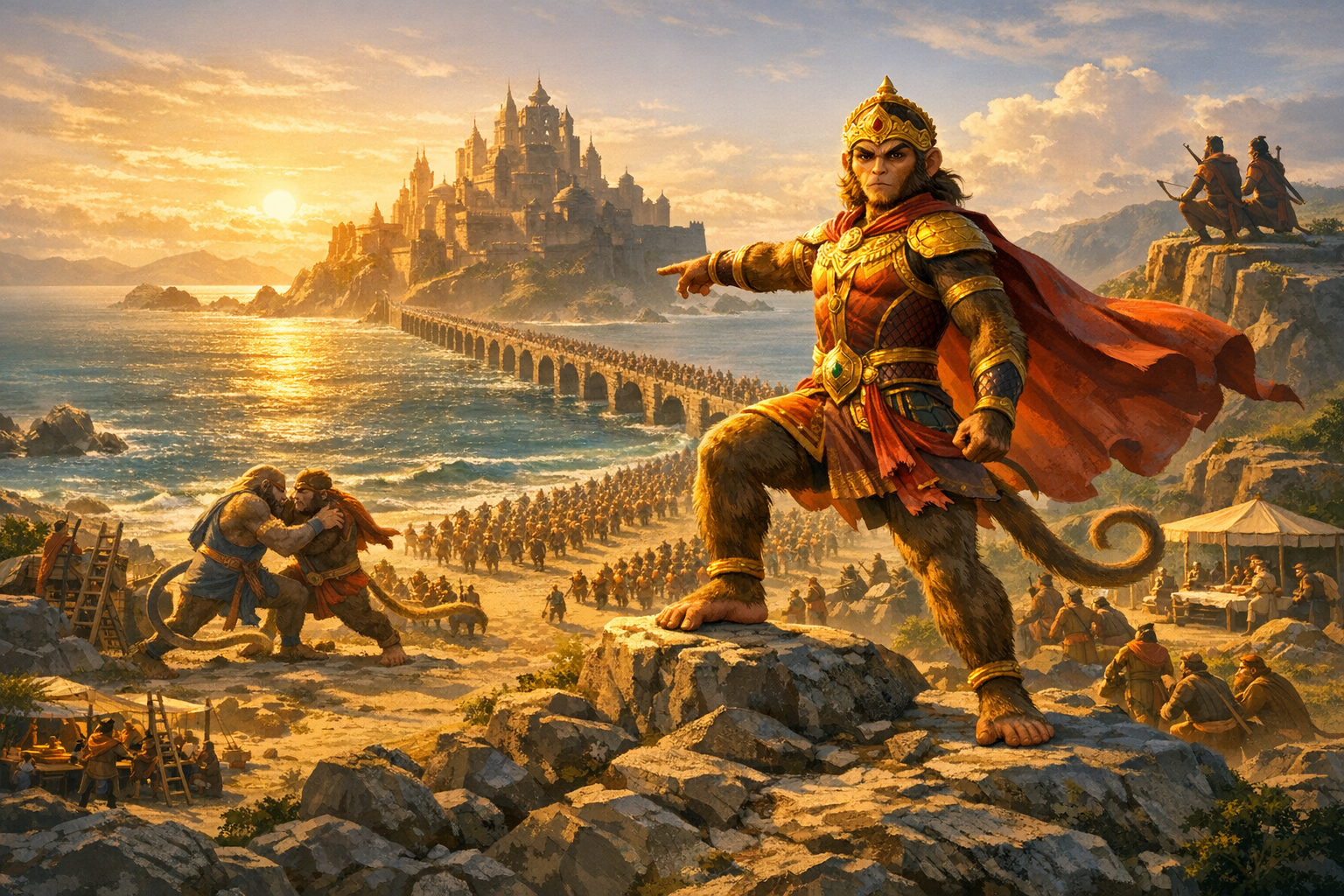
The strategic situation around Lanka was unforgiving. The Vanara army had executed an extraordinary amphibious approach, enabled by the engineering genius of Nala and Nila in constructing the Setu across the sea. With forward elements probing the island’s coastal defenses and Ravana’s elite commandersIndrajit, Kumbhakarna, and the foremost rakshasa captainsarrayed behind high ramparts, the campaign called for disciplined coordination, robust logistics, and unbroken unity of purpose. It was precisely under such pressure that lone acts, however heroic, could jeopardize the whole.
Sugriva’s martial reputation was never in doubt. He had stood by his vow to Sri Rama, unified disparate Vanara clans, and marshaled a vast force under a common cause. Yet traditions of the Ramayana also caution that leadership demands restraint equal to courage. In an episode widely recounted across retellings, Sugriva surged forward to challenge Ravana directlyeschewing the protective geometry of the allied lines. Accounts vary in detail, but the throughline is consistent: Sugriva’s impulse to force a decision through single combat exposed him and, by extension, the coalition, to unnecessary risk.
Classical statecraft would deem such a move perilous. In a Dharma-Yuddha, where the cause is just and the means must remain measured, the sovereign’s foremost duty is to preserve command continuity. A commander who is also a head of state cannot be made a casualty to impetuous zeal. As the duel with Ravana escalated, veteran Vanara captains were compelled to improvise a rescue under firean operation remembered in many tellings as one in which Hanuman’s timely intervention proved decisive in extracting Sugriva from grave danger.
The incident had two immediate consequences. First, it underscored the price of pride in war, where even a heartbeat of rashness can fracture formation integrity. Second, it forced an accelerated maturation of the Vanara high command. Sugriva, still the king and indispensable political fulcrum of the alliance, stepped back from impulsive frontline duels. In the space created by that humilityand under Sri Rama’s wise counselAngada was elevated to direct major Vanara battle formations, functionally serving as commander of the core strike elements while the overall sovereign and allied leadership set strategic direction.
Angada’s suitability was grounded in both lineage and merit. As the son of Vali and the crown prince (yuvraja), he bridged historic rivalries within the Vanara polity, transforming a potential fault line into a strength. More importantly, his performance during the southern search for Sitamanaging exhaustion, doubt, and the near-collapse of morale before the turning point at the ocean’s edgemarked him as a leader with emotional steadiness and operational clarity. When the moment demanded vision, he supported Hanuman’s decisive leap, and when diplomacy called, he later entered Ravana’s court as envoy with fearless composure.
That diplomatic mission, preserved in numerous Ramayana traditions, reveals Angada’s understanding of psychological warfare. He delivered a sharp admonition to Ravana, planting his foot as a visible symbol of the Vanaras’ irrepressible will, and invited the ruler of Lanka to choose prudence over ruin. The act was no mere bravado; it sought to create cognitive dissonance in the enemy command, weakening resolve without needless bloodshedan approach squarely within the ethics of Dharma-Yuddha.
Following Sugriva’s misstep and Angada’s demonstrated maturity, the Vanara high command consolidated around a distributed model. Angada took on principal field command for the main Vanara shock formations; Jambavan provided elder counsel and reserve management; Hanuman handled special operations, deep reconnaissance, and strategic raids; Nala and Nila oversaw engineering and mobility; and Sushena coordinated battlefield medicine and recovery. Vibhishana, the dharmic defector from Lanka, brought critical intelligence and an inside view of Ravana’s habits of command.
Operationally, Angada’s leadership style emphasized tempo, cohesion, and disciplined aggression. The battlefront was organized into mutually supporting sectors, with rotating Vanara spearheads to prevent attrition from eroding momentum. Light and fast-moving detachments executed harrying actions against Lanka’s gates to draw out select rakshasa units into disadvantageous engagements. When confronted with massed counterattacks, Angada prioritized elastic defenseabsorbing the blow, disengaging at speed, and surging back once ranged support from Sri Rama and Lakshmana had thinned enemy ranks.
Siegecraftalways a challenge for a primarily light-infantry force like the Vanaraswas reframed as a problem of redundancy and reach. Palm-trunk ladders, corded creepers, and ad hoc ramps enabled localized escalades, while controlled fires and stone volleys disrupted Lanka’s wall-top concentrations. Nala and Nila’s teams continuously adapted to countermeasures, demonstrating that engineering in the Ramayana is not mythic flourish alone but a disciplined military craft tied to movement, protection, and sustainment.
Within this matrix, the integration of human and Vanara capabilities became a defining advantage. Sri Rama and Lakshmana provided precise ranged lethality and command presence; the Vanara corps supplied reach, maneuver, and resilience. Angada’s role was to make the whole greater than the sum of its parts: ensure that Hanuman’s audacity never outpaced mutual support, that Jambavan’s reserves arrived at the exact moment of decision, and that Nala–Nila’s ingenuity kept the battlefield fluid rather than fixed.
As Ravana’s commanders shifted tacticsexploiting illusions, ambushes, and terrorthe Vanara high command institutionalized rapid reconstitution. When powerful missiles or deceitful stratagems caused sudden losses, Sushena’s medical command, supported by Hanuman’s legendary logistics, restored combat power with astonishing speed. The celebrated Sanjeevani episode is remembered not merely as miracle but as a parable in strategic sustainment: a fighting force that can swiftly revive its strength denies the enemy the strategic payoff of tactical success.
Angada’s ascent also carried deep civilizational meaning. It signaled that dharmic leadership is not defined by seniority alone but by the capacity to integrate courage with discernment, and lineage with legitimacy forged in service. Sugriva’s willingness to recalibrateto accept counsel, curb impetuosity, and empower the next generationdemonstrated a rare humility under the crushing weight of war. That humility preserved unity, the single greatest strategic asset of Rama’s coalition.
In the ethical vocabulary of the Ramayana, this transition exemplifies kshatra channeled by dharma: strength marshaled toward the just, managed through self-discipline, and measured by responsibility for the collective. Comparable ideals resonate across the wider dharmic family. Buddhist teachings caution against the intoxications of pride and victory; Jain thought elevates vigilance (apramāda) over carelessness in conduct; Sikh tradition valorizes fearless service aligned with righteousness. The Ramayana’s reconfiguration of command after Sugriva’s rash duel embodies these shared principlesvalor steadied by wisdom, zeal balanced by accountability, and leadership exercised as seva.
Strategically, the episode clarifies several timeless lessons. First, continuity of command is a center of gravity; leaders must protect it. Second, distributed leadershipwhen roles are clear and trust is highproduces agility in complex battlescapes. Third, psychological operations and diplomacy (as with Angada’s envoy mission) are not ornaments to warfighting but integral means to reduce violence and shorten conflict. Fourth, engineering and sustainment are decisive: without the Setu, without reliable battlefield medicine, no amount of courage would have sufficed.
It is equally important to note how the tradition frames victory. The goal is not annihilation but restorationthe re-centering of righteousness through the rescue of Sita and the reconstitution of legitimate order. Vibhishana’s acceptance as an ally underscores that even in conflict, doors remain open to repentance and reintegration. The Vanara command under Angada executed hard missions while honoring this ethical horizon, ensuring that means and ends remained aligned.
Modern readers often find this turning point emotionally resonant because it mirrors challenges faced in families, communities, and institutions. A gifted leader overreaches; a system momentarily falters; then, through honest counsel and shared purpose, the team resets. There is no triumphalism hereonly the sober recognition that great causes demand great character, from sovereigns to soldiers.
In organizational terms, the reformed Vanara high command functioned like a well-designed network: redundant nodes, clear pathways of authority, and adaptive feedback loops. Angada’s command approach emphasized cross-support between sectors, resilience under shock, and decisive exploitation when the enemy revealed a seam. Such qualities describe successful civil organizations as much as ancient armies.
The result, in narrative and moral terms, vindicated the recalibration. Sugriva’s stature did not diminish; it deepened. By restraining his impulse for single combat and enabling Angada’s operational leadership, he fulfilled the higher calling of kingship: to place the success of the righteous cause above the allure of personal glory. Angada, for his part, validated that trust by delivering disciplined energy where it mattered most, from the breaches at Lanka’s walls to the poised tempos between advance and consolidation.
Across retellingsValmiki, Kamba, Tulsidas, and regional traditionsthe particulars of command titles and formation names may vary. Yet the core insight holds steady: a moment of rashness forced a reckoning that made the Rama coalition stronger. The Vanara army moved from charismatic surge to institutional steadiness; the ambassador who shamed Ravana in his court also proved the field commander who could harmonize courage with control.
Placing this within the broader tapestry of dharmic narratives brings its unifying power into focus. The story is not of one tradition over another, but of shared ethical architecturediscipline, humility, and serviceexpressed through the epic art of the Ramayana. As such, it invites readers from Hindu, Buddhist, Jain, and Sikh paths to find convergences in leadership ideals that transcend sectarian lines.
Ultimately, the Lanka campaign’s turning point recasts both recklessness and redemption in practical terms. Pride can disrupt even the noblest alliance. Wisdom, however, can turn missteps into institutional learning. Angada’s rise, framed by Sugriva’s self-correction and Sri Rama’s steady counsel, demonstrates how dharma renews itself through responsible leadership, shared strength, and unity of purpose.
For those who lean into the Ramayana as scripture, history, or literature, this episode offers an unusually technical window into ancient statecraftcomplete with amphibious logistics, multi-domain tactics, psychological operations, and ethical constraints on force. Its enduring relevance lies not only in how the Vanara command won battles, but in how it preserved its soul while doing so.
In the end, the coalition’s victory over Ravana was secured not by solitary heroics but by a disciplined system of leadership where every role mattered. The courage of Sugriva, the composure of Angada, the ingenuity of Nala and Nila, the resolve of Hanuman, the counsel of Jambavan, the healing of Sushena, and the insight of Vibhishana converged under Sri Rama’s unwavering moral compass. From that convergence flowed both tactical success and the civilizational lesson that true power is power restrained by dharma.
Inspired by this post on Hindu Blog.