
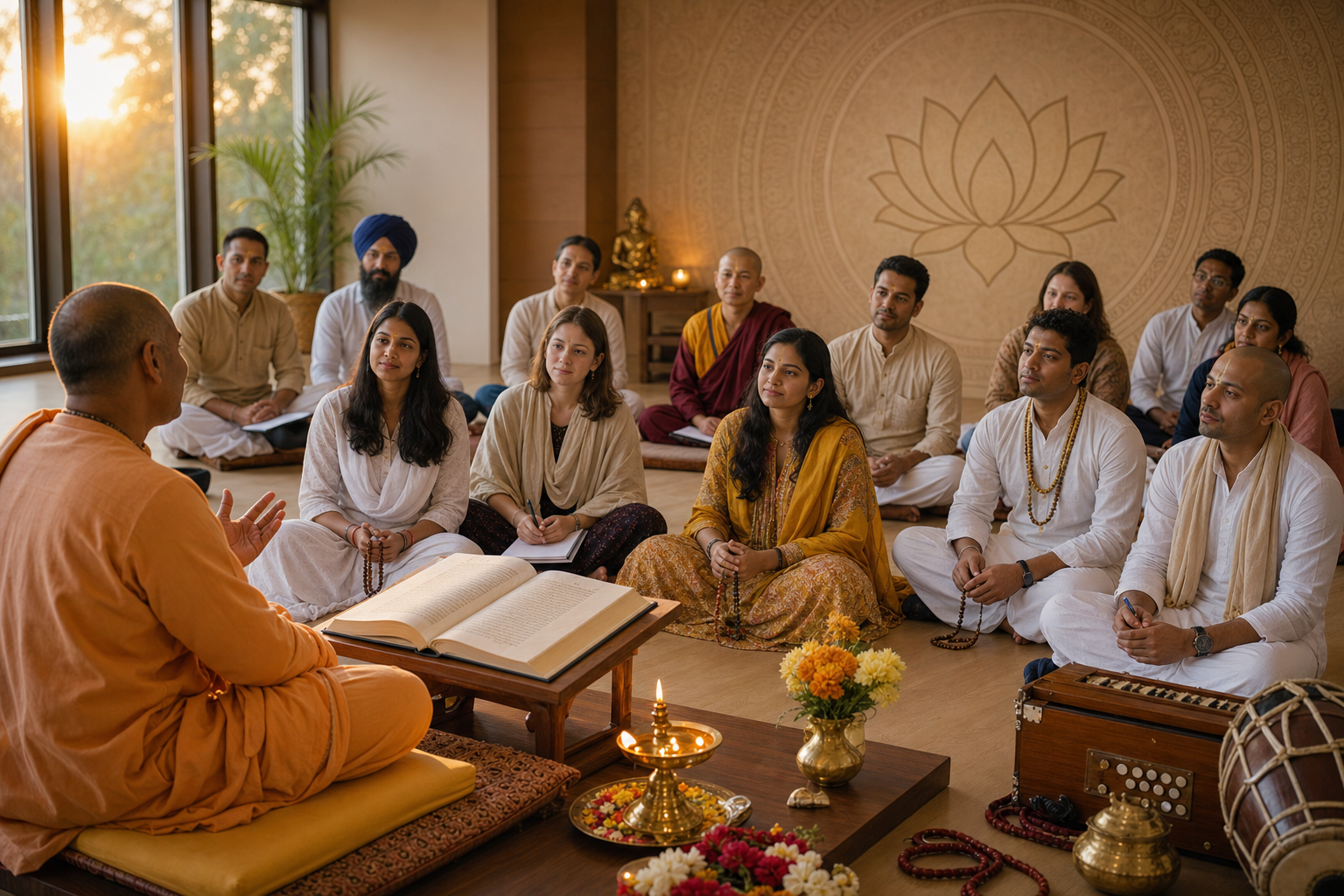
The Friday Sanga class dated 3 July 2026 and associated with HG Bhagavat Ashraya Das may be understood as part of a wider living tradition of sacred association, scriptural reflection, disciplined practice, and community-centered spiritual learning. The available source material provides only the title and a thumbnail image, so a responsible treatment must avoid inventing a transcript or attributing specific statements that cannot be verified. At the same time, the title itself offers enough context to examine the meaning of Friday Sanga within the broader framework of Krishna consciousness, Bhakti Yoga, Sanatana Dharma, and the shared dharmic emphasis on inner transformation through disciplined remembrance, ethical living, and association with sincere seekers.
In the Vaishnava context, sanga is not merely a social gathering. It is a deliberate spiritual environment in which hearing, chanting, inquiry, service, and mutual encouragement become instruments of refinement. The technical significance of such gatherings rests on a foundational insight found across Hindu Dharma and many dharmic traditions: consciousness is shaped by association. The mind absorbs values, habits, fears, aspirations, and patterns of speech from the company it keeps. Therefore, sacred association is treated as a practical discipline rather than a sentimental preference.
Friday Sanga, in this sense, functions as a weekly rhythm of restoration. For many practitioners, the week is spent amid professional pressure, family responsibilities, digital overstimulation, and moral ambiguity. A structured spiritual gathering interrupts that momentum and reorients the mind toward dharma. This is one reason such sessions remain meaningful in modern urban life. They do not ask participants to reject the world, but to return to it with clearer intelligence, steadier conduct, and a more devotional orientation.
The presence of a teacher such as HG Bhagavat Ashraya Das in the title also points to the importance of the guru-shishya tradition. In dharmic learning, knowledge is not treated as information alone. It is transmitted through character, discipline, example, and lived application. A class becomes valuable not only because it explains scripture, but because it demonstrates how scriptural vision can be applied to ordinary human challenges: conflict, ego, desire, discouragement, duty, gratitude, and the search for meaning.
Within Gaudiya Vaishnavism, sacred learning is often centered on Bhagavad Gita, Srimad Bhagavatham, the teachings of Sri Chaitanya Mahaprabhu, and the devotional lineage carried forward by acharyas such as Srila Prabhupada. The technical structure of this tradition places emphasis on sambandha, abhidheya, and prayojana. Sambandha clarifies the relationship between the individual soul, the Supreme, and the world. Abhidheya explains the process of devotional practice. Prayojana identifies the ultimate goal: pure love of Krishna, expressed through service, humility, remembrance, and surrender.
A Friday Sanga class can therefore be read as more than a lecture. It is a pedagogical setting where sambandha is remembered, abhidheya is encouraged, and prayojana is kept visible. This matters because spiritual life often weakens when the goal becomes vague. Without a clear conception of purpose, practice can become mechanical, cultural, or performative. Regular sanga helps restore the connection between doctrine and experience, between philosophy and conduct, and between devotion and daily responsibility.
Bhakti Yoga, as presented in the Bhagavad Gita, is not anti-intellectual. It integrates knowledge, action, meditation, and devotion into a coherent discipline. The Gita repeatedly addresses the unstable mind, the pull of the senses, the difficulty of duty, and the need for steady remembrance. In this technical sense, bhakti is both theological and psychological. It recognizes the Supreme as the proper object of love, while also offering methods for redirecting attention, purifying intention, and transforming habitual patterns of thought.
The emotional power of Friday Sanga lies in this combination of philosophy and human reality. A person may understand the concept of atman intellectually, yet still feel restless, anxious, proud, or wounded. A person may know that dharma is important, yet still struggle to act rightly under pressure. Sacred association helps bridge this gap. It allows philosophical principles to be heard repeatedly, discussed collectively, and embodied gradually. The result is not instant perfection, but a more honest and disciplined movement toward spiritual maturity.
One of the most important themes in any bhakti-centered gathering is humility. In Vaishnava theology, humility is not weakness or self-hatred. It is accurate self-understanding before the Divine. It frees the practitioner from the exhausting need to dominate, impress, or control. When humility is cultivated properly, it produces steadiness, gratitude, and receptivity. It also softens sectarian pride, making it possible to honor sincere seekers across Hinduism, Buddhism, Jainism, and Sikhism without diluting one’s own tradition.
This point is especially important for a blog committed to dharmic unity. Dharmic traditions are not identical, and academic honesty requires recognizing their distinct metaphysics, practices, historical developments, and theological commitments. Yet they share deep civilizational concerns: liberation from ignorance, ethical self-restraint, reverence for disciplined practice, respect for realized beings, and the recognition that human life should be directed toward more than consumption and ego. A mature presentation of Friday Sanga can honor Vaishnava specificity while also strengthening a wider culture of mutual respect among dharmic paths.
The concept of association is also visible beyond Vaishnavism. Buddhist sangha emphasizes the community of practitioners who support the path of awakening. Jain communities preserve vows, austerity, non-violence, and scriptural study through disciplined collective life. Sikh sangat brings devotees together in remembrance, kirtan, seva, and equality before the Guru’s wisdom. These traditions differ in doctrine, but they converge on one practical truth: the individual spiritual journey is strengthened by collective discipline and noble association.
From an academic perspective, Friday Sanga also reflects the continuity of oral teaching in Indian spiritual culture. Before mass publishing, digital media, and formal classroom systems, sacred knowledge was preserved through recitation, commentary, dialogue, memorization, and lived participation. Even today, a class format continues this ancient method. The teacher interprets a text or theme, the community listens, questions arise, and the teaching becomes part of collective memory. This living transmission is one reason dharmic traditions have survived social disruption, migration, and modern fragmentation.
The weekly nature of such gatherings is not incidental. Spiritual transformation depends on repetition. A single inspiring talk may produce enthusiasm, but regular hearing produces depth. In Bhakti Yoga, repeated shravana and kirtana gradually reshape the inner world. Shravana, or hearing, allows sacred sound and scriptural meaning to enter consciousness. Kirtana, or glorification and chanting, engages speech and emotion. Smarana, or remembrance, carries the teaching into the private life of the mind. Together, these practices make devotion practical rather than abstract.
Modern life often treats attention as a commodity. Social media platforms, advertising systems, and entertainment cycles compete aggressively for the mind. In contrast, a sanga asks the mind to become available to truth. This is a deeply technical form of discipline. It involves attention regulation, value clarification, emotional purification, and ethical reorientation. The sacred gathering becomes a counterweight to distraction, not by rejecting technology altogether, but by restoring hierarchy: the soul must not become subordinate to the feed, the market, or the restless senses.
The title Friday Sanga also suggests accessibility. A Friday gathering often meets people at the threshold between work and rest, obligation and reflection. It can become a bridge from worldly intensity into devotional quietude. This rhythm has practical relevance for householders, students, professionals, and families. Dharmic life is not limited to monastic settings. The home, workplace, community hall, temple, and online classroom can all become extensions of sadhana when guided by sincerity and proper understanding.
In Krishna consciousness, sadhana is not merely private meditation. It includes chanting the holy names, studying scripture, honoring prasadam, serving devotees, worshiping the Lord, and conducting one’s life with integrity. The social dimension is crucial because ego often hides in isolation. In community, patience is tested, service becomes concrete, and respect must be practiced rather than merely admired. A Friday Sanga can therefore reveal both the beauty and the difficulty of spiritual life. It offers encouragement, but it also asks for refinement.
The role of scripture in such a class should be emphasized. Dharmic traditions do not treat scripture as a decorative symbol. Scripture is a pramana, a source of knowledge, especially in matters beyond ordinary sense perception. In the Vaishnava tradition, shastra provides metaphysical orientation, ethical instruction, devotional mood, and historical memory. When scripture is studied with guidance, it prevents spirituality from becoming vague emotion. When it is applied with compassion, it prevents learning from becoming dry intellectualism.
A responsible academic reading of Friday Sanga must also recognize the importance of community formation. Religious gatherings create shared vocabulary, shared memory, and shared moral expectations. They teach participants what is admirable, what is dangerous, what is sacred, and what is worth pursuing. In healthy dharmic communities, this formation should produce compassion, self-control, truthfulness, service, reverence for elders, protection of the vulnerable, and respect for sincere spiritual diversity.
This does not mean that every religious community automatically fulfills its ideals. Dharmic traditions themselves are aware of hypocrisy, pride, ritualism, and spiritual immaturity. The Bhagavad Gita, the Bhagavata Purana, Jain ethical literature, Buddhist monastic texts, and Sikh teachings all warn against external religiosity without inner transformation. Therefore, the real measure of sanga is not attendance alone. Its measure is the gradual purification of conduct, speech, thought, and intention.
The devotional path also gives special attention to sound. Mantra, kirtan, recitation, and scriptural hearing are not secondary ornaments. They are central methods of consciousness transformation. In Gaudiya Vaishnavism, the chanting of the holy names is regarded as especially powerful in the present age. This is not only a matter of belief but also of disciplined practice. Sacred sound gives the restless mind a pure object, the voice a sacred function, and the heart a way to express dependence on Krishna.
For many participants, the most relatable aspect of a Friday Sanga is the sense of being spiritually recalibrated. The pressures of the week can produce fatigue, irritability, comparison, and forgetfulness. A well-guided class can bring perspective back into view. It reminds the listener that human dignity is not measured only by productivity, wealth, or social approval. It rests in the deeper identity of the self and in the capacity to serve with love, intelligence, and steadiness.
The theme of service is central here. Seva is not charity performed from superiority. It is an expression of spiritual identity. In Bhakti Yoga, service is the natural function of the soul when freed from selfishness. In Sikh tradition, seva is likewise inseparable from devotion and community. Jain and Buddhist traditions also emphasize compassion, restraint, and responsibility toward other beings. These shared ethical currents show why dharmic unity can be built not by flattening differences, but by honoring the civilizational seriousness of practice.
Friday Sanga can also be viewed as a response to loneliness. Modern society often produces crowded isolation: many contacts, few deep bonds; constant communication, little genuine listening. Sacred association counters this by creating a space where people gather around transcendence rather than transaction. The value of such a space is not merely emotional. It is civilizational. Communities that gather around dharma preserve memory, transmit values to younger generations, and offer moral resistance to shallow materialism.
The title’s reference to HG Bhagavat Ashraya Das also reflects the devotional culture of respectful address. Honorifics in Vaishnava communities are not meant to create personality worship. Properly understood, they remind participants that spiritual life is received through humility and gratitude. Respect for teachers, elders, and practitioners helps train the ego, provided that respect remains aligned with shastra, accountability, and sincere conduct. A healthy tradition honors persons because they carry service, not because they replace the Divine.
In a technical discussion of sanga, the distinction between sentiment and practice is essential. Sentiment may inspire the beginning of spiritual life, but practice sustains it. A person may feel devotion during a class, yet the test comes afterward: how speech changes at home, how anger is handled, how time is used, how food is honored, how duties are performed, and how others are treated. The true fruit of sacred association is visible in these ordinary details.
The Friday Sanga format also helps protect spiritual life from fragmentation. Without regular structure, practice can become dependent on mood. When the mind feels inspired, one chants or studies; when distracted, one postpones. A weekly gathering creates accountability and rhythm. It reminds participants that devotion is not merely a private preference but a disciplined relationship. In this sense, community becomes a support for freedom, because it helps the practitioner resist the tyranny of impulse.
For readers approaching this topic from outside ISKCON or Gaudiya Vaishnavism, the broader lesson remains accessible. A life without noble association easily becomes shaped by whatever is loudest. A life supported by sincere sanga gains access to memory, correction, encouragement, and shared aspiration. Whether one speaks of bhakti, dhyana, seva, ahimsa, simran, or self-inquiry, the principle remains powerful: the company of the sincere strengthens the search for truth.
The class title, though brief, points toward a larger dharmic concern: how spiritual traditions remain alive across generations. They survive not only through books, temples, festivals, or institutions, but through repeated gatherings where teachings are heard, questioned, sung, remembered, and practiced. Friday Sanga belongs to this living pattern. It represents continuity in a time of distraction and offers a practical reminder that dharma becomes durable when it is shared with humility and lived with discipline.
The most constructive way to receive such a gathering is not as passive content, but as an invitation to examine one’s own life. What kinds of association are shaping the mind? What is being heard repeatedly? What desires are being strengthened? What duties are being avoided? What practices are being neglected? These questions are central to genuine sadhana. They move spiritual discussion from the level of admiration to the level of transformation.
Ultimately, Friday Sanga is significant because it joins knowledge, devotion, community, and practice. It affirms that Bhakti Yoga is not an escape from life, but a disciplined way of seeing life in relation to Krishna. It also contributes to a broader dharmic culture in which Hindu, Buddhist, Jain, and Sikh traditions can be honored as serious paths of refinement, restraint, wisdom, and liberation. When such gatherings are conducted with humility, scriptural grounding, and compassion, they become more than weekly events. They become instruments of inner clarity and civilizational renewal.
Inspired by this post on Dandavats.








Leave a Reply
You must be logged in to post a comment.