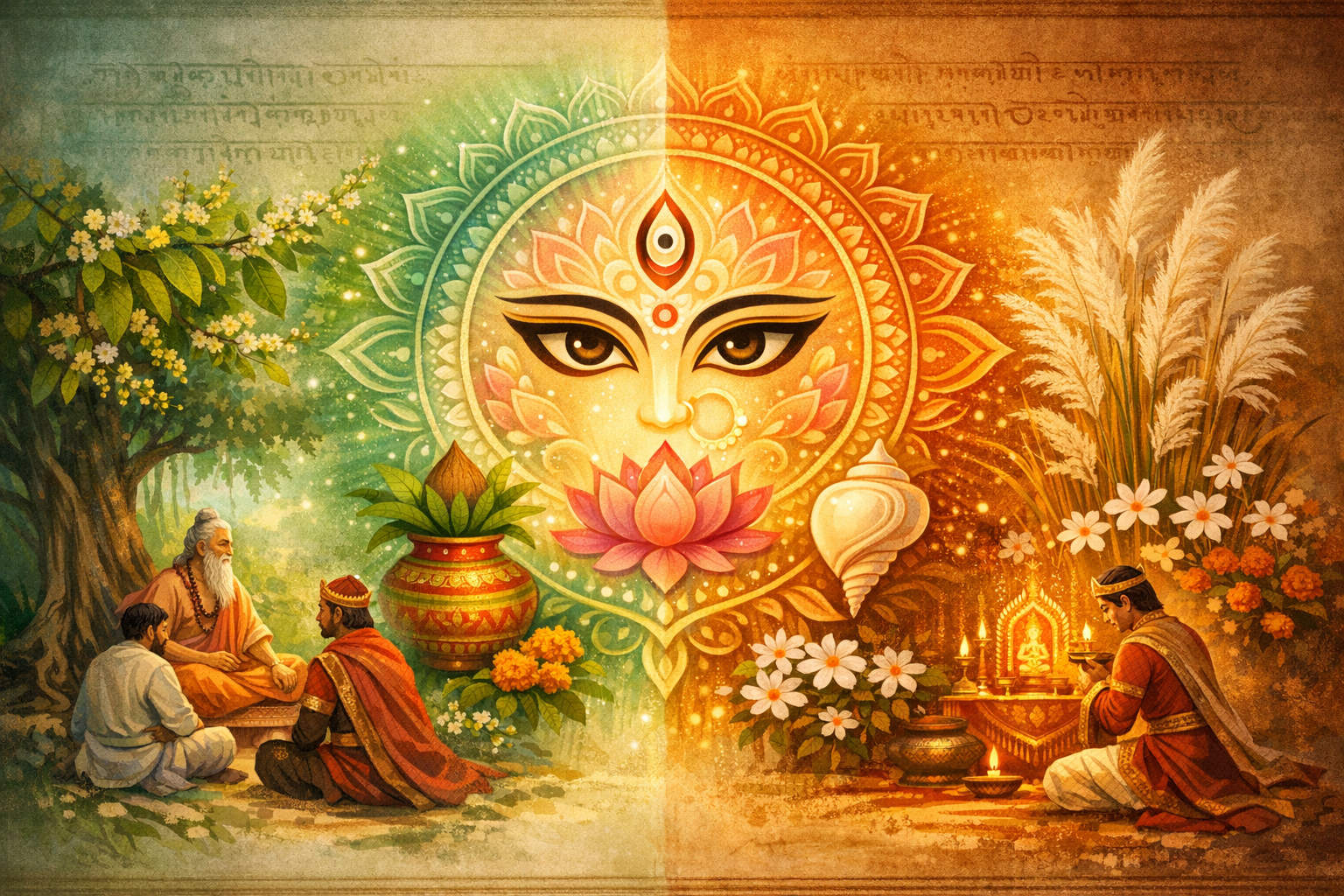
Durga Puja’s celebrated autumn pageantry (Sharad Navratri) often obscures an older thread running through ancient Hindu texts and ritual memory: the archetypal first worship of Maa Durga is situated in the spring cycleBasanti Pujawhile the autumn observance is linked, in widely told narratives, to Sri Rama’s Akal Bodhan before the war against Ravana in Lanka. This perspective, rooted in Purāṇic framing and later regional retellings, highlights a two-season sacred rhythmChaitra (spring) and Ashwin (autumn)that has coexisted across the Hindu way of life for centuries.
The textual anchor for this understanding lies in the Markandeya Puranaespecially the Devi Mahatmya (Durga Saptashati)whose narrative frame presents King Suratha (Surath) of the lunar dynasty and a merchant as paradigms of devotion, inquiry, and divine grace. Popular retellings sometimes spell the title as “Markendaya Purana,” but the work is universally recognized as one of the most influential ancient Hindu texts shaping Shakta theology and the ritual grammar of Durga Puja.
According to the Purāṇic account, King Suratha belonged to the lunar dynasty, yet fate turned against him. Defeated by enemies and betrayed by shifting loyalties in his court, he experienced the fragility of temporal power. The narrative emphasizes a deeply human motif: even after loss, the mind clings to remnants of status and possession. Suratha’s reflections on this paradox draw him toward a forest hermitage where the sage Medhas dwells.
There he meets a dispossessed merchant, expelled by his own kin yet painfully attached to those who wronged him. The convergence of king and merchantKshatra and Vyaparacreates a representative spectrum of human suffering and attachment. Both approach the sage with a single question: why does the mind, even when wronged, return again and again to its objects of attachment? The sage responds by revealing the workings of MahamayaDevi’s power that both veils and reveals ultimate truth.
Guided by the sage, Suratha and the merchant undertake disciplined worship of Goddess Durga. The Devi Mahatmya describes their tapasjapa, vrata, and single-pointed meditationsustained over a prolonged period (traditionally remembered as three years). The narrative intent is theological and practical: devotion (bhakti), discipline (abhyāsa), and philosophical inquiry (jnana-vichara) converge as a complete sādhanā.
When the Goddess manifests, the king and merchant ask for distinct boons that illuminate the twin ideals of the tradition. Suratha seeks the protection and restoration of his sovereignty and the assurance of enduring rulership; the Devi grants him kingship in the present life and the future role of Savarni Manu. The merchant yearns for self-knowledge and dispassion; the Devi confers abiding wisdom (jnana) and detachment (vairagya). The frame story thereby encodes a philosophical map for householders and renunciants alike.
How does this narrative connect to seasonality? The Devi Mahatmya itself functions as the liturgical core for Durga Puja across both spring and autumn cycles. Later scriptural and ritual manualssuch as passages in the Devi Bhagavata Purana and the Kalika Puranaexplicitly describe Navaratri observances in Chaitra (Vasant Navratri or Basanti Puja) and in Ashwin (Sharad Navratri). Many regional traditions remember the spring cycle as the earlier, archetypal setting for Devi’s worship, which helps explain why autumnal invocation is styled as akal“untimely” or “out of season”in some tellings.
This is where the legend of Sri Rama’s Akal Bodhan becomes central. Before the war in Lanka, Rama is said to have invoked Maa Durga in the autumn, awakening the Goddess “before her customary spring worship” to seek victory over adharma. Bengali textual culture (including the Krittivasi Ramayan and regional Purāṇic compilations) helped popularize this episode, and Eastern India’s Shardiya Durga Puja eventually blossomed into the grand festival known today. The autumn cycle, therefore, is not secondary in value; rather, it exemplifies how living traditions adapt time and liturgy to ethical purpose.
The Hindu lunisolar calendar clarifies the twin-season framework. Chaitra (March–April, in most years) inaugurates the traditional New Year in many regions and culminates in Rama Navamithe ninth day that also closes the spring Navaratri. Ashwin (September–October) marks the autumnal Navaratri, culminating in Mahanavami and Vijaya Dashami. Variations such as the amanta and purnimanta month reckonings mean the exact Gregorian dates vary by region, yet the ritual architectureKalash Sthapana (Ghatsthapana), daily upasana, Ashtami-Navami observances, and Dashamiremains coherent across India.
Ritually, both cycles draw from the same scriptural reservoir: the recitation of the Durga Saptashati (Devi Mahatmya), Shodashopachara (the sixteen honors), homa, Kumari Puja in some lineages, and Sandhi Puja at the Ashtami–Navami juncture. The theological emphasis is equally shared: the triumph of dharma over adharma, the restoration of inner sovereignty (śānta-rajya) alongside worldly duty (svadharma), and the awakening of courage, compassion, and clarityvirtues cherished across the dharmic family.
Historically, Navaratri and Mahanavami have also served as royal rites of statecraft and renewal. The Vijayanagara Empire’s Mahanavami celebrations are a well-documented example of kingship aligned to sacred time, although not every inscriptional mention of “Mahanavami” specifies an exclusive Durga focus. Such evidence underscores a broader civilizational pattern: sacred time (Navaratri) periodically re-centers moral order (dharma), whether in the household, the polity, or the inner life.
For many families, the fragrance of shiuli blossoms in the autumn or the first spring breezes in Chaitra evokes memories of lamps, mantras, and shared meals. These sensory anchors demonstrate why living traditions retain both cycles. Spring speaks to renewal and beginnings; autumn honors harvest, gratitude, and decisive action. Together, Basanti Puja and Sharad Navratri map the full arc from inner preparation to outward courage, a rhythm that resonates with everyday life.
This twofold rhythm also dialogues naturally with the wider dharmic milieu. In the spring window, Sikh communities mark Vaisakhi, many Buddhist traditions observe Vesak, and Jains celebrate Mahavir Jayantidistinct observances, yet all inflected by themes of renewal, ethical discipline, and compassionate service. Emphasizing Basanti Puja as an early paradigm and Sharad Navratri as a living adaptation supports a larger vision of unity-in-diversity across Hinduism, Buddhism, Jainism, and Sikhismeach walking its path while honoring shared civilizational values.
From a textual-critical standpoint, it is prudent to note that Purāṇas often transmit layered ritual memories rather than single historical “firsts.” The Devi Mahatmya supplies the archetypethrough King Suratha and the merchantwhile later Purāṇic and regional sources articulate explicit seasonal liturgies. Within that continuum, the Basanti Puja claim coheres with early ritual logic, and the autumnal Akal Bodhan narrative coheres with a dharmic response to crisisboth equally formative of the tradition as practiced today.
For practitioners wishing to honor the spring origin memory, observance during Chaitra may include Kalash Sthapana on the first day, daily recitation of the Durga Saptashati, simple satvik offerings, and charitable service (seva) that concretizes the Devi’s virtues in society. Equally, participating in Sharad Navratri affirms the ethical imagination behind Akal Bodhan: invoking divine strength to confront injustice, cultivate fearlessness, and restore balance.
In sum, the Purāṇic story of King Suratha and the merchant in the Markandeya Purana provides the enduring template for Durga Puja as a path of devotion, wisdom, and rightful action. Remembering Basanti Puja as the earlier seasonal setting and Sharad Navratri as the Rama-linked adaptation allows both cycles to be appreciated on their own termseach illuminating how Hindu festivals, grounded in ancient Hindu texts, continue to harmonize spiritual insight with daily life and to strengthen unity across the dharmic traditions.
Inspired by this post on Hindu Blog.