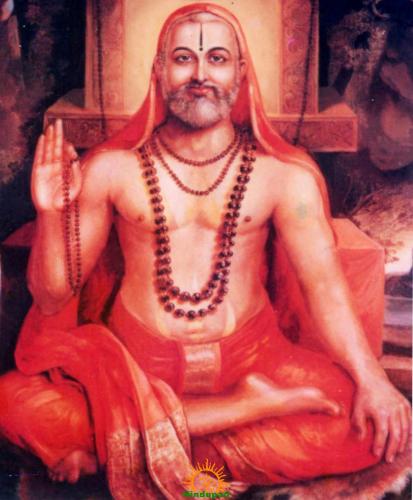
Vanara Sarabha is remembered in the Ramayana as a fearless commander in Lord Rama’s army, a vanara general whose presence on the battlefield reportedly struck terror into adversaries. Associated in tradition with the Salveya Mountain, Sarabha exemplifies the disciplined courage, loyalty, and strategic clarity that defined Rama’s allied forces as they rallied to uphold dharma.
As part of the vanara ranks organized under Sugriva, Sarabha’s figure illuminates how Rama’s campaign depended on many capable commanders beyond the most celebrated heroes. Such leaders represented the union of physical prowess with moral purposean ideal that the Ramayana frames as dharma-yuddha, a righteous struggle conducted within ethical bounds. In this context, Sarabha’s steadfastness contributes to the epic’s broader portrayal of collective responsibility in times of moral crisis.
The Ramayana repeatedly situates its warriors within a sacred geography, drawing vanaras from diverse mountainous regions. The association of Sarabha with Salveya Mountain underscores the epic’s expansive cultural landscape, wherein nature, community, and duty converge. This geographical imagination also evokes a living heritage in which the memory of valor is inseparable from the land and its dharmic values.
Textual traditions vary across recensions and regional retellings, and the extent of Sarabha’s exploits is not uniformly detailed. Nevertheless, references to Sarabha as a commander capture a consistent motif: the Ramayana’s victory depends not only on singular feats but on a disciplined corps of leaders and companions. Even brief mentions serve a narrative function, foregrounding solidarity, organization, and the ethical tenor of Rama’s cause across Sundara Kanda and Yuddha Kanda.
Interpreted symbolically across dharmic thought, Sarabha’s courage aligns with principles shared by Hinduism, Buddhism, Jainism, and Sikhism. The ethic of righteous action, inner discipline, and service resonates with frameworks such as viriya (steadfast energy), tapas (austerity and focus), and the saint-soldier ideal that integrates ethical restraint with protective duty. In this reading, vanara valor is not mere force; it is duty guided by compassion, restraint, and clarity of purpose.
For contemporary readers, Sarabha’s image offers a lens on leadership and integrity. Effective command balances strength with humility, speed with deliberation, and loyalty with justice. The Ramayana’s commanders demonstrate how courage is most transformative when anchored in a moral compassan insight that remains relevant for community life, public service, and personal conduct.
Within the epic’s narrative, Sarabha stands as a reminder that great endeavours are sustained by many steadfast contributors. While towering figures such as Hanuman, Jambavan, and Angada often take center stage, commanders like Sarabha ensure coherence, resolve, and unity of purpose. Their example amplifies a core message of the Ramayana: collective commitment to dharma secures lasting peace more reliably than individual glory alone.
Ultimately, the memory of Vanara Sarabha invites a unified appreciation of dharmic traditions. His legendary steadfastness embodies a shared ethiccourage in service of righteousnessthat traverses sects and schools. In honoring such figures, the Ramayana encourages a broad, inclusive understanding of moral strength, one that harmonizes the many paths that uphold truth, compassion, and order.
Inspired by this post on Hindu Blog.