
The Dhyana Bindu Upanishad occupies a distinctive place within the spiritual literature of Sanatana Dharma because it treats meditation not as a vague ideal, but as a disciplined movement from outer ritual awareness toward inner realization. It is traditionally counted among the Yoga Upanishads, a group of minor Upanishads concerned with yogic practice, mantra, subtle physiology, breath, concentration, and the direct knowledge of Atman and Brahman. The received source describes it as associated with the Krishna Yajurveda, composed in the anustubh metre, and extending to 106 verses; broader manuscript traditions also show that the text circulated in more than one recension, with shorter and longer versions attached in different catalogues to different Vedic affiliations. This textual complexity is not unusual in the history of the minor Upanishads, where oral instruction, regional transmission, and yogic lineages often preserved overlapping forms of the same teaching.
The title itself is revealing. Dhyana means meditation, and bindu suggests a point, drop, seed, or concentrated essence. The Dhyana Bindu Upanishad may therefore be read as a teaching on the “point of meditation,” the subtle centre where wandering attention is gathered, refined, and directed toward the deepest truth of the self. In practical terms, the text speaks to a universal human problem: the mind is scattered, the senses are outward-facing, and the inner life remains hidden unless attention is patiently trained. The Upanishad responds by presenting yoga as a method of interiorization, where breath, sound, posture, and contemplation become instruments for spiritual clarity.
The Upanishad opens with a reverential tone toward yoga. This praise is not ornamental; it sets the philosophical premise for the entire work. Yoga is not merely physical discipline, nor is it restricted to posture or bodily health. It is a comprehensive path through which the seeker steadies the body, regulates prana, disciplines the mind, and becomes capable of realizing the unity of Atman and Brahman. In this sense, the Dhyana Bindu Upanishad belongs to the same wide dharmic current that includes Vedanta, Hatha Yoga, mantra practice, and contemplative traditions across Hindu, Buddhist, Jain, and Sikh spiritual culture, all of which value self-discipline, inner awareness, and liberation from ignorance.
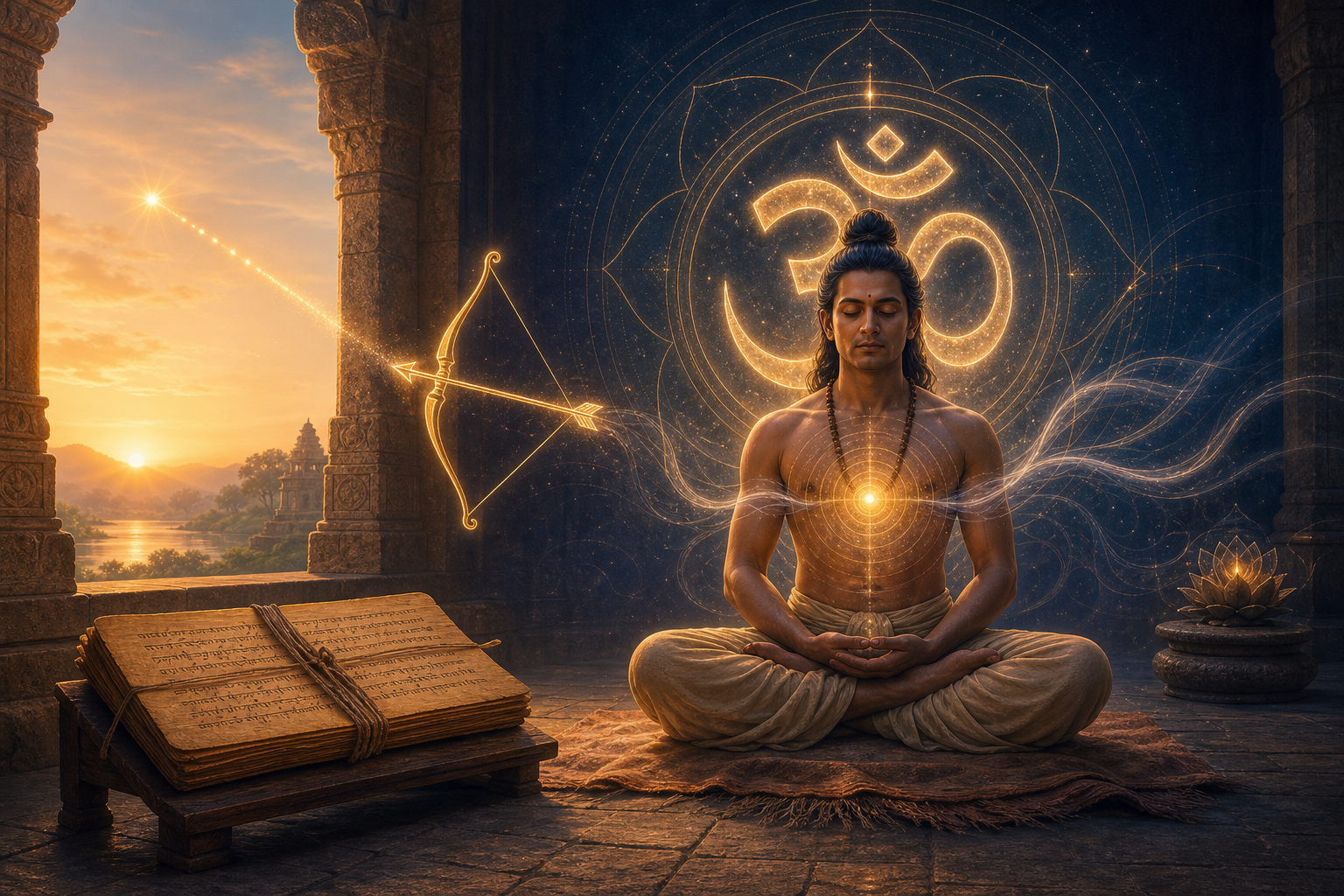
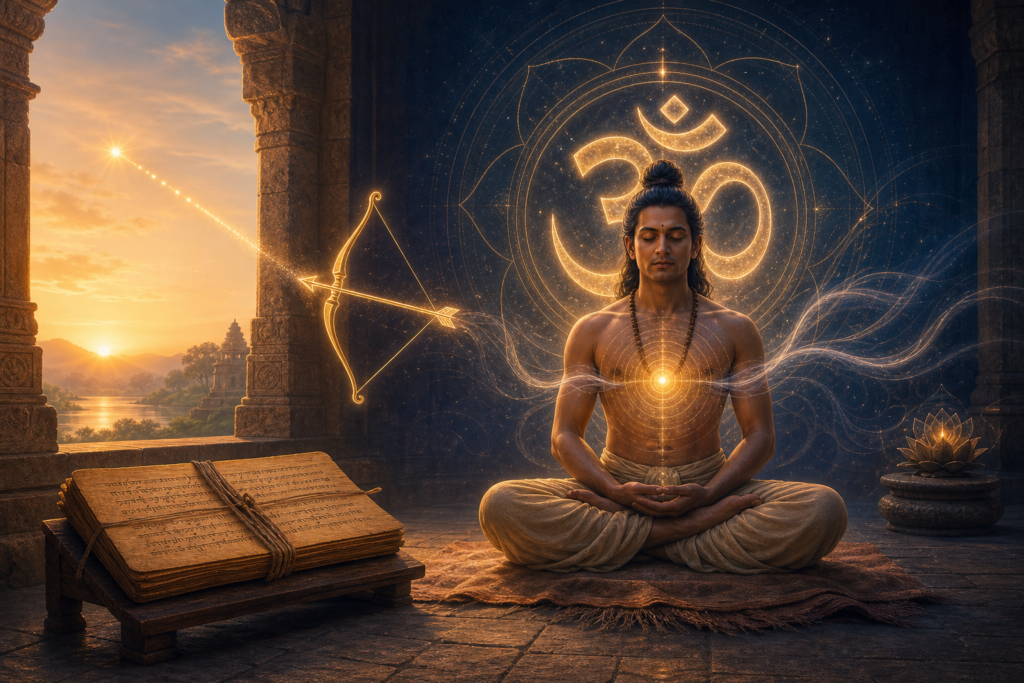
One of the most striking aspects of the text is its insistence that the sacred syllable Om is central to meditation. Om is treated not merely as a sound to be pronounced but as a subtle support for contemplation. In the Upanishadic imagination, Om gathers within itself the movement from the visible to the invisible, from speech to silence, from thought to pure awareness. The Dhyana Bindu Upanishad uses the well-known metaphor of Om as a bow, the individual self as an arrow, and Brahman as the target. This metaphor, also associated with the broader Upanishadic tradition, gives the teaching a technical precision: meditation is not passive drifting, but directed concentration.
This metaphor deserves close attention. A bow must be held steadily; an arrow must be aligned; a target must be known; the release must be controlled. Likewise, the practitioner must cultivate bodily steadiness, ethical preparation, mental focus, and philosophical understanding. Om becomes the instrument by which consciousness is aimed toward Brahman. The arrow is the self that has been sharpened by discipline. The target is not an external object but the ultimate reality that is already the ground of one’s being. Such imagery makes the Dhyana Bindu Upanishad both poetic and technical, because it gives the contemplative path a concrete structure without reducing its mystery.
The Upanishad also presents the inner self as hidden yet present in every being. Traditional summaries compare this presence to fragrance in a flower, oil in a seed, or butter in milk. These metaphors are powerful because they do not suggest that divinity must be imported from outside. Rather, the sacred is already latent, awaiting discovery through proper practice. This is a deeply humane teaching. It means that meditation is not an escape from life but a refinement of perception. The same person who feels distracted, anxious, or fragmented may, through sustained discipline, discover a deeper centre of awareness beneath the turbulence of ordinary experience.
The Dhyana Bindu Upanishad therefore stands within the Upanishadic conviction that Atman is not merely an individual ego. Atman is the innermost principle of consciousness, the witness of bodily experience, mental movement, sensory perception, and memory. Brahman is the limitless reality underlying all existence. The contemplative purpose of the text is to lead the practitioner from identification with the changing body and mind toward recognition of the changeless spiritual principle. This is not a rejection of the body; rather, the body becomes a disciplined vehicle through which subtle knowledge becomes possible.
The longer recension of the Dhyana Bindu Upanishad is especially important for the history of Yoga philosophy because it describes a sixfold yogic method. This system differs from the famous eight-limbed framework of Patanjali’s Yoga Sutras, though it shares the same broad concern with discipline, concentration, and liberation. The sixfold structure includes asana, regulation of breath, withdrawal or restraint, steadiness, dhyana, and dharana. The presence of such a system shows that the yogic tradition was never monolithic. Different lineages preserved different practical frameworks while remaining oriented toward the same inner transformation.
Asana in this context means much more than bodily exercise. It refers to a stable seat, a posture fit for meditation. The text mentions traditional postures such as Siddhasana, Bhadrasana, Simhasana, and Padmasana. The emphasis is not athletic display but steadiness. The body must be composed enough that attention can move inward. This older understanding is important for modern readers, because contemporary yoga is often encountered through movement, flexibility, and wellness culture. The Dhyana Bindu Upanishad reminds that posture was historically a means toward concentration, not an end in itself.
Prana, or vital energy expressed through breath, occupies another central role. Yogic literature repeatedly observes that the mind and breath move together. When breathing is restless, thought tends to be restless; when breathing becomes rhythmic and subtle, thought becomes more capable of stillness. The Dhyana Bindu Upanishad participates in this tradition by presenting breath control as a necessary support for meditation. Such teaching is both spiritual and psychological. Anyone who has experienced fear, grief, anger, or deep peace knows that breath changes with inner state. Yoga reverses that relationship: by refining breath, the practitioner learns to refine the mind.
The Upanishad’s approach to meditation is also connected with pratyahara, the withdrawal of the senses. This does not mean hostility toward the world. Rather, it means that the senses are no longer permitted to drag the mind compulsively from object to object. In ordinary life, attention is constantly claimed by sound, image, appetite, memory, ambition, and fear. Pratyahara restores sovereignty to consciousness. The practitioner learns to observe without being pulled apart. This discipline remains profoundly relevant in the digital age, where attention has become one of the most contested resources of human life.
Dharana and dhyana represent progressively deeper forms of inner collectedness. Dharana is concentration, the binding of attention to a chosen support. Dhyana is meditation, a more continuous flow of awareness toward that support. The Dhyana Bindu Upanishad treats these not as abstract definitions but as lived stages of practice. The mind must first be gathered, then sustained, then refined. This progression explains why the text places so much value on discipline. Spiritual insight is not produced by intellectual curiosity alone; it matures when knowledge, breath, posture, mantra, and ethical restraint work together.
The text also includes material associated with subtle yogic anatomy, including references to Kundalini, inner channels, and the symbolic union of Shiva and Shakti. Such language should be read carefully. In yogic traditions, Shiva often represents pure consciousness, while Shakti represents dynamic power or energy. Their union is not merely sectarian imagery; it symbolizes the integration of stillness and movement, awareness and energy, transcendence and embodiment. This symbolism is especially valuable for a dharmic reading of the text, because it shows how diverse theological images can serve a shared contemplative purpose.
The Dhyana Bindu Upanishad is not narrowly sectarian. It invokes forms such as Vishnu and Shiva in ways that point beyond rivalry toward spiritual synthesis. For some practitioners, Om may be contemplated as the formless Brahman; for others, it may be approached through a chosen divine form. This flexibility is a hallmark of dharmic spirituality. The text does not demand that all seekers have identical temperaments. Instead, it recognizes that meditation can be supported by sound, symbol, deity, breath, and philosophical inquiry. Such pluralism strengthens unity because it allows diversity of practice without losing sight of the ultimate aim.
This feature has special importance for contemporary readers. Hindu traditions have long included Vaishnava, Shaiva, Shakta, Smarta, Vedantic, Tantric, and yogic currents, each with its own language and devotional emphasis. Buddhism, Jainism, and Sikhism also preserve rich disciplines of meditation, self-restraint, ethical living, and liberation from egoic bondage. The Dhyana Bindu Upanishad can be appreciated within this larger dharmic family as a text that emphasizes inner transformation over external division. Its vocabulary is Hindu and Upanishadic, yet its concern with disciplined awareness resonates widely across Indian spiritual civilization.
Another significant theme is silence. The Upanishadic tradition often treats silence not as emptiness but as fullness beyond speech. Om itself moves toward silence: after the audible vibration fades, awareness remains. The Dhyana Bindu Upanishad points the practitioner toward that subtle interior quiet where the ordinary mind loosens its grip. In lived experience, this silence is not always easy. The first encounter with inwardness may reveal restlessness, unresolved emotions, and the constant noise of thought. The text’s disciplined method exists precisely because genuine silence must be cultivated, not assumed.
The emotional power of the Dhyana Bindu Upanishad lies in its confidence that inner disorder is not final. Human beings are capable of refinement. Breath can be steadied. Speech can be purified. Attention can be reclaimed. Desire can be understood. Fear can be witnessed. The inner self can be known. Such teaching does not deny suffering, but it refuses to reduce the person to suffering. This is why the text remains meaningful even outside formal monastic settings. Its vision speaks to householders, students, seekers, and contemplatives who wish to live with more clarity and less fragmentation.
The text also corrects a common misunderstanding about yoga. Yoga is sometimes imagined as either purely physical or purely mystical. The Dhyana Bindu Upanishad shows that classical yoga is both practical and metaphysical. It gives attention to posture, breath, sound, concentration, and subtle energy, but it directs all of them toward knowledge of the self. Without philosophy, practice can become mechanical. Without practice, philosophy can become merely verbal. The Upanishad unites both dimensions: the body is disciplined, the breath is refined, the mind is concentrated, and consciousness is turned toward Brahman.
Its use of poetic metre, especially the anustubh structure noted in the source tradition, also matters. The metre made teachings easier to memorize, recite, and transmit. In a culture where sacred knowledge was preserved through oral discipline, verse was not decoration; it was a technology of memory. The compactness of Upanishadic poetry allowed complex ideas to be carried across generations. The Dhyana Bindu Upanishad therefore belongs to a world in which philosophy was chanted, contemplated, embodied, and transmitted through the guru-shishya relationship.
From a historical perspective, the Dhyana Bindu Upanishad reflects the evolving relationship between early Upanishadic non-dual insight and later yogic methods. The older Upanishads often emphasize knowledge of Atman and Brahman through inquiry, negation, and contemplative insight. The Yoga Upanishads add a more technical vocabulary of practice: posture, breath, mantra, bindu, nada, Kundalini, and subtle centres. This does not represent a contradiction. Rather, it shows the tradition becoming more practical and embodied, asking how the great truth of the Upanishads can be realized through disciplined sadhana.
The Dhyana Bindu Upanishad is also connected to the broader group of Bindu Upanishads, including texts such as Amritabindu, Tejobindu, Nadabindu, and Brahmabindu. These works share an interest in meditation, Om, subtle sound, and the concentrated point of awareness. Together, they show that the idea of bindu was not marginal. It functioned as a symbol of essence, subtlety, and condensation. The seeker begins with a small point of attention, but that point opens into vastness. This is one of the paradoxes of meditation: the narrower the concentration becomes, the more expansive the realization may be.
For modern practitioners, the Dhyana Bindu Upanishad offers several practical lessons. First, meditation requires preparation. A restless lifestyle cannot instantly produce deep concentration. Second, sound and breath are powerful gateways into awareness. Third, the body should be respected as a vehicle of realization, not dismissed as an obstacle. Fourth, spiritual symbols can be read inclusively, with Vishnu, Shiva, Shakti, Om, Atman, and Brahman all contributing to a larger contemplative vision. Finally, the goal of yoga is not self-display but self-knowledge.
The text also invites humility. Its teachings are compact, and some of its subtle yogic references require guidance, context, and careful interpretation. Not every practice described in older yoga literature should be attempted without preparation or competent instruction. Breath practices, energetic disciplines, and intense concentration can affect the body and mind deeply. The academic and spiritual value of the Upanishad lies not in casual experimentation but in understanding its integrated vision: ethical steadiness, bodily discipline, breath regulation, mantra, meditation, and realization belong together.
At its deepest level, the Dhyana Bindu Upanishad teaches that the sacred is not distant. The journey of meditation is a journey from dispersion to centre, from sound to silence, from outward identity to inward knowledge. Om becomes the bridge. Breath becomes the discipline. The body becomes the seat. The mind becomes the instrument. Atman becomes the discovery. Brahman becomes the truth in which the seeker, the path, and the goal are finally understood as one continuous reality.
This is why the Dhyana Bindu Upanishad remains a valuable text for the study of Upanishads, Yoga philosophy, Hindu spirituality, and dharmic contemplative traditions. It is brief when compared with large philosophical works, but it contains a complete map of inner practice. Its language is symbolic, yet its purpose is practical. Its metaphysics is profound, yet its first demand is simple: become steady, listen deeply, gather the mind, and enter the point of meditation where the finite self begins to recognize its limitless ground.
Sources consulted for factual orientation include traditional summaries of the Dhyana Bindu Upanishad, the Yoga Upanishad classification, references to the Muktika canon, and scholarly discussions associated with Narayanasvami Aiyar’s Thirty Minor Upanishads, T. R. Srinivasa Ayyangar’s The Yoga Upanishads, Paul Deussen’s studies of the Upanishads, and modern reference summaries such as https://en.wikipedia.org/wiki/Dhyanabindu_Upanishad. These sources reflect the important point that manuscript traditions differ, especially concerning Vedic affiliation and verse count, while the central identity of the text as a Yoga Upanishad focused on meditation, Om, Atman, Brahman, and yogic discipline remains consistent.
Inspired by this post on Hindu Blog.









Leave a Reply
You must be logged in to post a comment.