
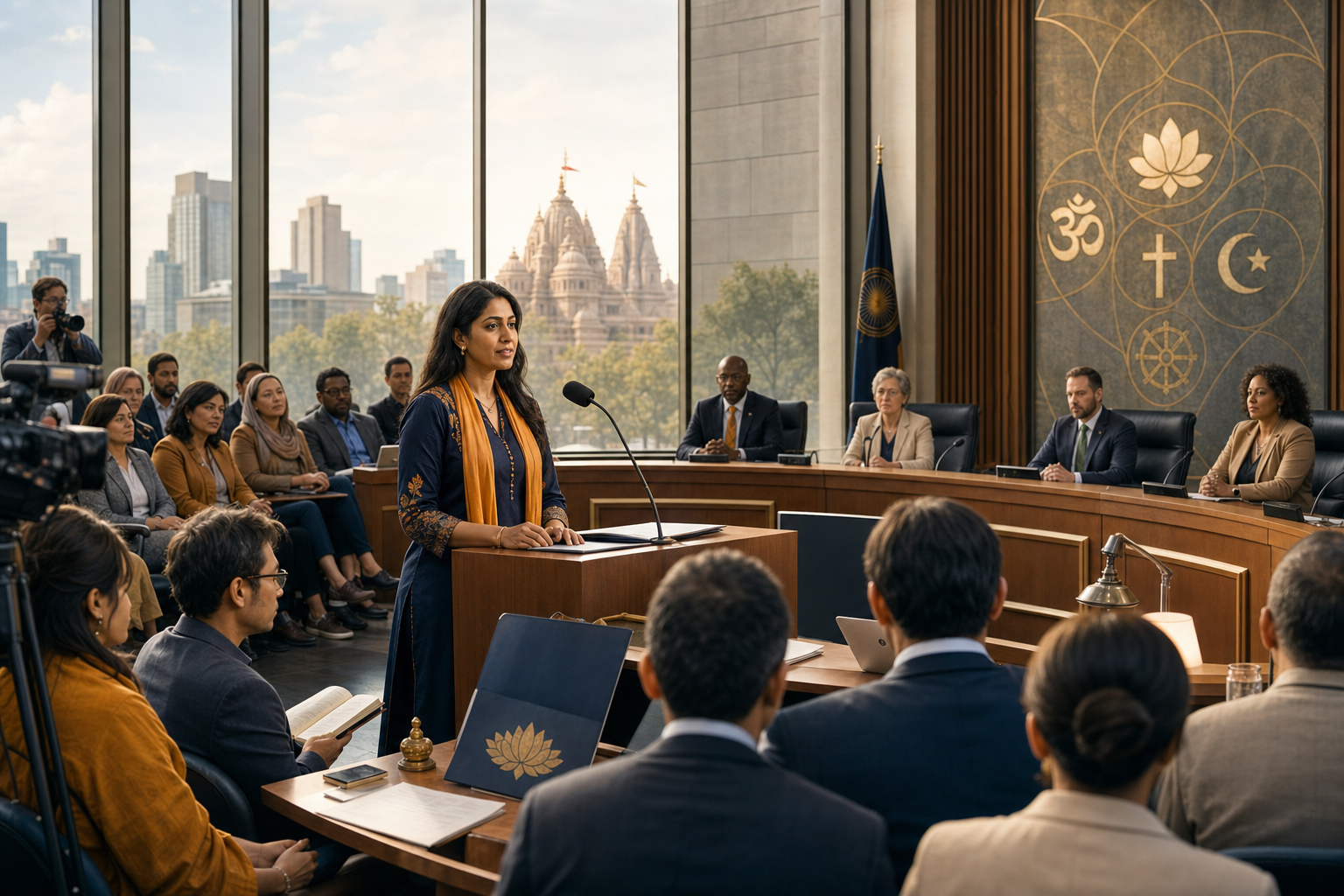
The controversy surrounding Pieter Friedrich, as documented by the Coalition of Hindus of North America (CoHNA) in its November 18, 2025 article, raises a serious civic question: how should public institutions distinguish legitimate criticism from rhetoric that appears to stigmatize an entire religious community? The issue is not merely about one activist, one city council meeting, or one disputed political claim. It concerns the broader place of Hindu Americans in democratic life, the responsibilities of journalists and campaigners, and the standards that should govern public discourse when minority communities are discussed in official forums.
CoHNA’s account describes Friedrich as a self-styled journalist who has, for years, focused intense criticism on Hindu Americans who publicly affirm their faith, culture, and civilizational heritage. According to the organization, his recent appearances before city councils and public bodies in places such as Atlanta and Palo Alto have included inflammatory claims against Hindu advocacy organizations, including CoHNA itself. The central allegation is that these interventions are not neutral investigations but part of a pattern intended to discredit Hindu civic participation and deter Hindu Americans from speaking openly in public life.
Any serious evaluation of such a claim requires care. In a free society, activists and journalists must be able to question organizations, criticize ideologies, and challenge political networks. That freedom is essential. Yet the same democratic tradition also requires scrutiny of speech that moves from criticism of institutions into broad suspicion toward a religious minority. When Hindu advocacy is repeatedly framed as inherently dangerous, foreign, or suspect, the result can be a climate in which ordinary Hindus feel that participation in civic life carries a reputational penalty.
This distinction is central to the debate on Hinduphobia in the United States. Hinduphobia does not mean that Hindu organizations are beyond criticism, nor does it mean that political movements connected to India cannot be debated. It refers to patterns of prejudice, stereotyping, hostility, or selective suspicion directed at Hindus as Hindus. In practice, such hostility often appears through loaded labels, guilt by association, selective outrage, and rhetoric that treats Hindu identity itself as a civic threat. The concern raised by CoHNA is that Friedrich’s activism has crossed this line.
The most serious example cited in the source material concerns Congressman Raja Krishnamoorthi, a Hindu American public official. CoHNA states that in 2022 Friedrich chanted “death to Raja Krishnamoorthi” and “Nazis out, Raja must go” during a protest targeting the congressman. Such rhetoric, if accurately reported, is not ordinary political disagreement. It combines a hostile slogan invoking death with an extreme historical comparison, directed at a Hindu American elected representative. Reverend Jesse Jackson reportedly condemned the language as “racist, bigoted, incendiary rhetoric” that had no place in civic or political discourse.
The significance of Reverend Jackson’s condemnation lies in its civil rights context. American public life has long recognized that minority participation can be chilled not only by formal discrimination but also by campaigns of intimidation, vilification, and reputational targeting. When a Hindu American officeholder is confronted with language that invokes death or Nazi comparisons, the immediate target may be an individual, but the wider message can be felt by an entire community: visibility comes with danger, and public pride in heritage may invite demonization.
CoHNA’s title also places the allegations within a wider pattern: homophobia, antisemitism, and Hinduphobia. This framing matters because prejudice is rarely isolated in a single category. Public figures who normalize contempt toward one vulnerable community may also exhibit hostility toward others. The ethical test is not whether a critic uses the language of human rights or social justice, but whether the method of criticism respects human dignity consistently. A rhetoric of liberation that demeans Jews, Hindus, LGBTQ people, or any other community loses moral credibility.
In the American civic setting, Hindu advocacy organizations often work on issues familiar to many minority communities: temple safety, school curriculum representation, hate crime recognition, religious accommodation, and the right to maintain cultural identity without being treated as politically suspect. These concerns are not unusual. Jewish, Sikh, Buddhist, Jain, Muslim, Christian, and other communities also organize around religious literacy, public policy, and civil rights. The democratic norm is not to deny such advocacy, but to evaluate it fairly and without collective demonization.
The language used to describe Hindu organizations therefore carries real consequences. Terms such as “extremist,” “supremacist,” or “fascist” should not be deployed casually, especially in city councils or public hearings where officials may lack specialist knowledge of South Asian politics, Hindu traditions, or diaspora institutions. Such terms can shape public perception quickly. If they are used without proportionate evidence, they can damage reputations, create fear among volunteers, and discourage Hindu Americans from engaging with local government.
A technical problem in many public controversies involving Hindu Americans is the collapse of distinct categories. Hinduism as a religious and civilizational tradition is not identical to any one political party, advocacy group, nation-state, or policy position. The Hindu diaspora is internally diverse, including people from India, Nepal, Sri Lanka, Bangladesh, Pakistan, the Caribbean, Southeast Asia, Africa, Europe, and North America. It includes practitioners connected to Vaishnava, Shaiva, Shakta, Smarta, and many other traditions, as well as families shaped by Jain, Buddhist, Sikh, and broader Dharmic cultural inheritances. Reducing this complexity to a single political stereotype is analytically weak and socially harmful.
This is especially important for a blog committed to unity among Dharmic traditions. Hinduism, Buddhism, Jainism, and Sikhism have distinct theologies, histories, disciplines, and institutions, yet they also share a long civilizational conversation shaped by dharma, ethical self-cultivation, spiritual inquiry, nonviolence, service, and the pursuit of truth. Public discourse that vilifies one Dharmic community often affects the others, because outside observers may not understand the internal distinctions. A climate hostile to Hindu identity can easily become a climate suspicious of temples, gurudwaras, meditation centers, Sanskrit learning, yoga traditions, and Indic civilizational memory more broadly.
At the same time, Dharmic unity does not require defensiveness or uncritical solidarity. It requires intellectual honesty. Organizations operating in public life should be open to fair questions, transparent about their goals, and accountable for their conduct. However, accountability must be based on evidence, not insinuation. The ethical standard should be consistent: criticize actions, examine documents, evaluate public statements, and avoid converting political disagreement into religious suspicion.
For Hindu Americans, the emotional dimension of this debate is not abstract. Many families have spent decades building temples, teaching children languages and festivals, explaining Hindu symbols in schools, and correcting misconceptions about caste, karma, deities, rituals, and dharma. When public activists portray Hindu pride as inherently threatening, it can feel like a return to older patterns of exoticization and prejudice. The community’s request is often simple: to be treated with the same nuance and fairness extended to other minorities.
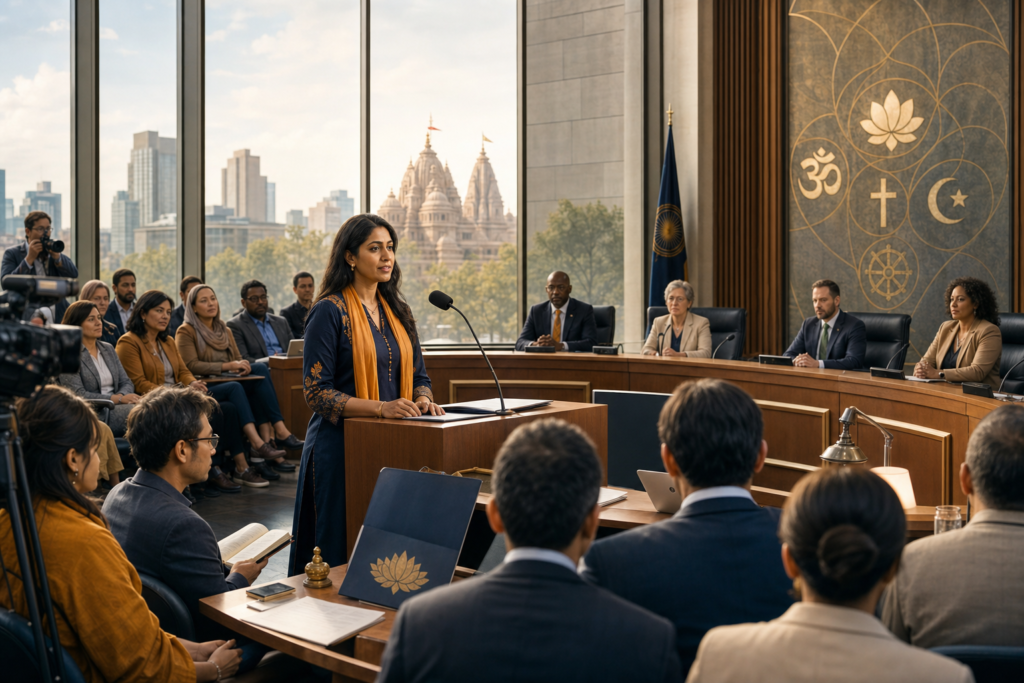
City leaders therefore have a particular responsibility. Local governments are not courts of ideological purity, but they are guardians of civic trust. Before giving weight to claims made against minority religious organizations, officials should ask whether the evidence is specific, whether the accused have had an opportunity to respond, whether the language used is proportionate, and whether the speaker has a documented pattern of inflammatory conduct. Public bodies should not become platforms for religious stereotyping under the appearance of activism.
Media literacy is equally important. The label “journalist” carries public authority, but journalism is defined by method: verification, fairness, context, correction, and proportionality. Advocacy can produce useful information, but advocacy that repeatedly targets one community while ignoring complexity should be read critically. In matters involving Hindu Americans, South Asian politics, or Dharmic traditions, responsible reporting should distinguish between evidence-based criticism and narrative warfare.
The CoHNA article ultimately presents Friedrich as an example of a broader challenge facing Hindu advocacy in North America: the struggle to participate in civic institutions without being caricatured. Whether the setting is a city council, university campus, school board, or media panel, Hindu Americans increasingly encounter a public vocabulary that can treat their identity as a problem to be managed rather than a tradition to be understood. That tendency deserves rigorous challenge.
A more constructive model is available. Public debate can reject hate speech while preserving strong criticism. It can oppose antisemitism, homophobia, Hinduphobia, anti-Sikh prejudice, anti-Buddhist hostility, anti-Jain ignorance, Islamophobia, and other forms of religious or identity-based hatred without turning human rights language into a weapon against selected communities. It can recognize that pluralism is not protected by silencing minority voices, but by creating fair conditions in which those voices can be heard.
In that sense, the Friedrich controversy should not be viewed only as a dispute between one activist and one organization. It should be studied as a test case in democratic ethics. How should public institutions respond when activism appears to blur into vilification? How should minority communities defend themselves without abandoning openness to scrutiny? How can journalists, lawmakers, and citizens discuss Hindu advocacy with the same care they would expect in discussions of Jewish, Sikh, Buddhist, Jain, Muslim, Christian, or other communities?
The answer begins with precision. Criticism must be specific. Evidence must be verifiable. Language must be proportionate. Religious identity must not be treated as guilt. Civic participation by Hindu Americans should be judged by the same democratic standards applied to every community. When those standards are upheld, public life becomes stronger, not weaker, and Dharmic communities can contribute openly to the shared civic good.
Inspired by this post on Hindu Post.







Leave a Reply
You must be logged in to post a comment.