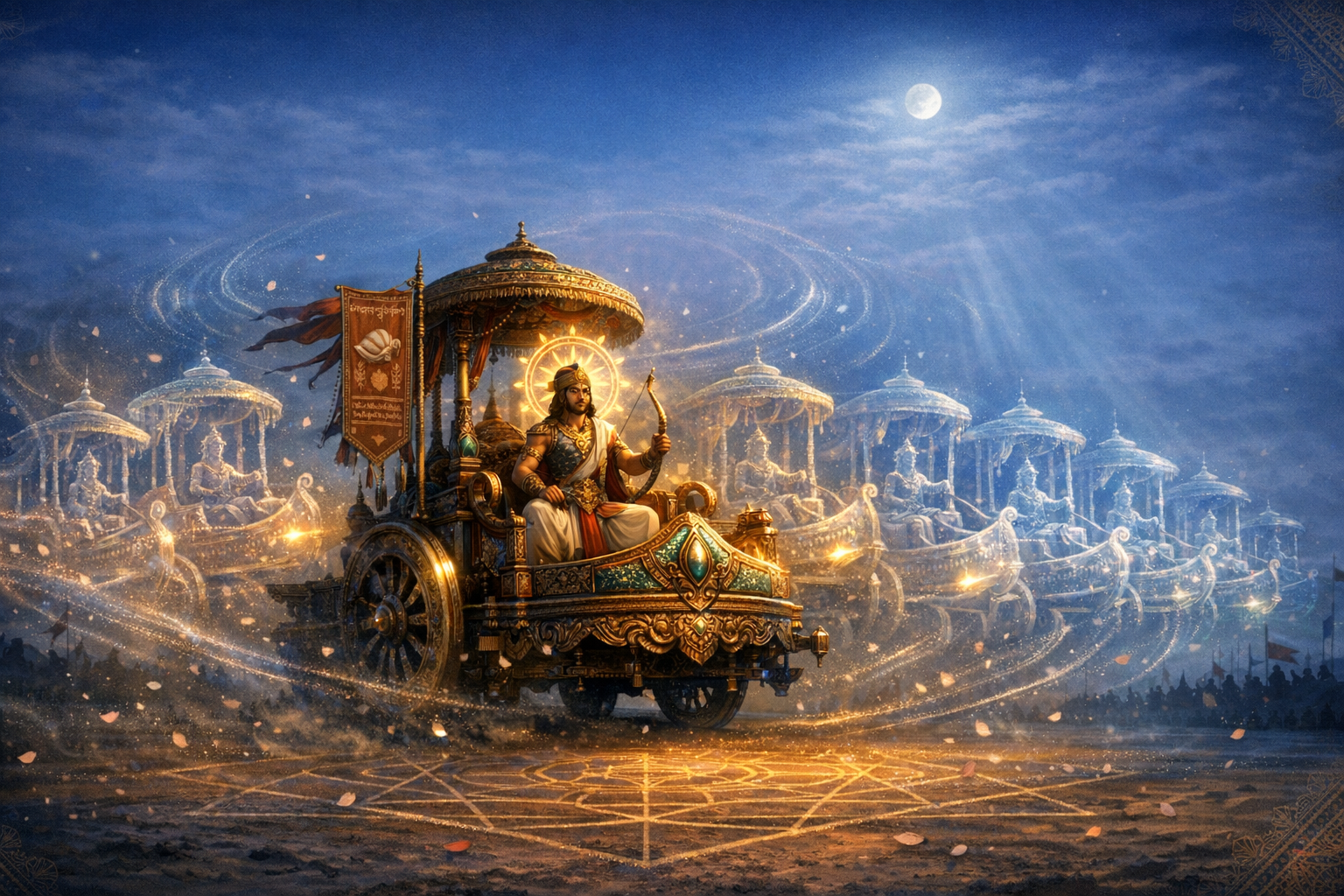
Among the celestial armaments of Ancient India, the Gandharva Astra occupies a singular place as a weapon of vision, sound, and perception rather than brute destruction. In the Mahabharata and allied Ancient Hindu Texts, astras are not merely projectiles but sophisticated mantric technologies, each with a distinct cosmological signature and ethical purpose. The Gandharva Astra aligns with the Gandharvascelestial beings renowned for music, fragrance, and subtle enchantmentmaking this astra a paradigmatic tool of strategic illusion and battlefield misdirection.
Unlike elemental weapons such as Agneya (fire), Varuna (water), or Vayavya (wind), the Gandharva Astra aims to reshape the enemy’s sensory field. Traditional lists and oral recensions describe it as generating shimmering apparitions, phantasmal cavalry and chariots, and resonant acoustics reminiscent of conches, drums, and celestial song. In this sense, it belongs to the mohana–stambhana class of astrasdevices that confound, stupefy, and delayrather than to the outright annihilative class typified by the Brahmastra.
Epic literature situates such illusion-making within a larger theory of war (yuddha-śāstra) that acknowledges deception as a bounded, ethically supervised practice. Kautilya’s Arthashastra discusses deceptive tactics under kutayuddha and māyāyuddha, while Puranic dhanurveda sections (for example, in the Agni Purana) treat the orchestration of formation, signaling, and misdirection as legitimate arts when subordinated to dharma. The Gandharva Astra thus exemplifies a classical preference for non-lethal superiority and the principle of minimum violence, prioritizing disorientation over destruction.
Textual motifs in the Mahabharata illuminate this logic. Vana Parva recounts the Gandharvas’ mastery of music, dance, and subtle powers, and later books describe nocturnal engagements in which perception itself becomes contested terrain. Rakshasa-māyāmost dramatically marshaled by Ghatotkachacreates bewildering doubles, phantom terrains, and illusory war engines to exhaust and terrify opponents during the Kurukshetra War. Although Ghatotkacha’s art is distinct from a formal Gandharva Astra, both operate within the same strategic grammar: alter what the foe can see, hear, and trust.
Ratha Māyā, the chariot-centered art of deception, occupies a cognate niche. The term denotes techniques that multiply, mask, or mislocate chariots on the field: decoy standards, mirrored formations, dust-cloud manipulation, and dazzling, reflective paneling designed to bleed silhouettes into glare. In seasoned hands, Ratha Māyā could simulate reinforcements, conceal a retreat, or draw missile fire away from a commander. As an operational doctrine, it coordinated with vyūha (battle arrays), banner codes, and drum-and-conch signaling to choreograph mass perception across the battlefront.
Gandharva Astra and Ratha Māyā converge in their intended effect: they induce cognitive overload. Illusory chariot multiples force archers to waste shafts, while spectral soundscapes scramble the timing of cavalry charges. In an era when śabda-vedhi (sound-guided) archery and line-of-sight targeting were both prevalent, such manipulations degraded decision cycles, broke formations, and opened corridors for precise, dharma-compliant strikes that avoided unnecessary carnage.
The mechanics of invocation (prayoga) reveal the discipline behind these arts. Classical astra practice requires mantra, mudrā, dhāraṇā (focused attention), and controlled prāṇa. Adhikārarightful eligibilityremains central: the wielder must possess training, restraint, and a pledge to withdraw an astra (upasaṁhāra) once its legitimate aim is met. Within this framework, the Gandharva Astra can be seen as a mantric field-effect tool that modulates the ambient experience of combatants, transforming the battlespace into a contested sensorium.
Operationally, the Gandharva Astra would likely be deployed to cover a flanking maneuver, veil an elite unit’s ingress, or protect a critical withdrawal. Ratha Māyā, by contrast, is the visible doctrine by which such concealment is tactically realized: masked standards, feinting charioteers, duplicate pennons, and modular formations that bloom or collapse to imitate changing force ratios. Together they produce the classical equivalent of multi-domain deception: optical, acoustic, and symbolic.
Epic episodes offer illustrative case material. During nocturnal warfare, Ghatotkacha’s māyā stretches adversarial cognition beyond its limits, forcing Karna to expend his once-in-a-lifetime Vasavi Śaktian asymmetric exchange engineered through illusion to minimize friendly losses elsewhere. In another register, the famed stratagem used to neutralize Jayadratha relies on environmental manipulationan eclipse-like gloom attributed to the Sudarśana Chakraachieving surprise without indiscriminate slaughter. Although not explicitly labeled Gandharva Astra, these episodes validate the larger doctrinal insight: shaping perception can be more humane and decisive than escalating force.
Countermeasures also appear in the tradition. Rigorous drill sustains formation integrity when senses mislead; standardized signal codes reduce vulnerability to false acoustics; and tightly coupled chariot-infantry teams hedge against decoys. Mentally, breath control (prāṇāyāma) and mantra stabilize attention under fear and astonishment, while experienced commanders rotate fresh units into the line to restore perceptual baselines. Most importantly, ethics constrain response: surviving māyā does not license indiscriminate retaliation.
From a technical perspective, Gandharva Astra and Ratha Māyā presuppose a battlefield science of optics and acoustics avant la lettre. Dust modulation alters contrast and depth cues; reflective fittings weaponize glare; rhythmically staged conches manipulate tempo and collective arousal. In modern terms, these are ancestral analogues of electronic countermeasures, chaff, decoy signatures, and psychological operationsyet anchored in a dharmic ethos that demands proportionality and discriminating intent.
Linguistically, the semantics are telling. “Gandharva” evokes musicality, fragrance (gandha), and entrancement; “Astra” indicates a launched or projected power governed by mantra; “Ratha” centers mobility, shock, and command presence; and “Māyā,” across dharmic philosophies, names the malleability of appearances. Their combination signals an indigenous theory of warfare in which mastery of attention is as valuable as mastery of steel.
Ethically, such instruments are defensible only within Dharma-Yuddhaa just-war framework that forbids wanton harm, protects noncombatants, and prizes the swift restoration of order. The Mahabharata persistently interrogates means and ends; even when illusion secures advantage, the text compels reflection on necessity, proportionality, and the residue of violence upon the psyche of warriors and societies.
This ethical reflection resonates across dharmic traditions. In Vedanta, māyā underscores the provisional nature of appearances; in Buddhism, the critique of śūnyatā and skillful means (upāya) emphasizes compassionate orientation beyond illusion; in Jainism, the disciplines against mithyātva (false perception) guide non-violent conduct; and in Sikh philosophy, māyā names attachment and distraction from truthful living. Read together, these perspectives transform “illusion warfare” from mere stratagem into a meditation on clarity, responsibility, and restraint.
The cross-traditional convergence is especially meaningful in contemporary discussions of War in Hinduism and Ancient India. It suggests that technical brillianceastravidyā, dhanurveda, and logistical ingenuitywas never meant to be severed from spiritual insight. The very tools that can bewilder an enemy are at their most legitimate when they awaken the wielder to the limits of force and the primacy of dharma.
For students of the Mahabharata, this layered view is both intellectually satisfying and emotionally compelling. The Gandharva Astra and Ratha Māyā demonstrate how epic warfare integrates psychology, cosmology, and ethics. They invite modern readers to appreciate Hindu warriors not only for valor but for a civilizational commitment to minimizing harm while defending orderan ideal that remains urgently relevant.
In practical historiography, acknowledging variation across textual recensions and commentarial traditions is essential. Some lists emphasize Gandharva Astra explicitly; others subsume it within broader mohana classes. Likewise, Ratha Māyā finds its primary attestation as a doctrinal cluster rather than a single, named weapon. Such variability should be received as a strength of Ancient Hindu Texts, reflecting a living pedagogy adapted to place, lineage, and circumstance.
Ultimately, the legacy of Gandharva Astra and Ratha Māyā is a vision of warfare as disciplined perception. Victory, in this vision, is less about overwhelming force than about illuminating the right action at the right time with the least necessary harm. That orientationshared in spirit across Hinduism, Buddhism, Jainism, and Sikhismbinds technical mastery to ethical clarity, ensuring that even the most dazzling illusions serve the enduring light of dharma.
Inspired by this post on Hindu Blog.