
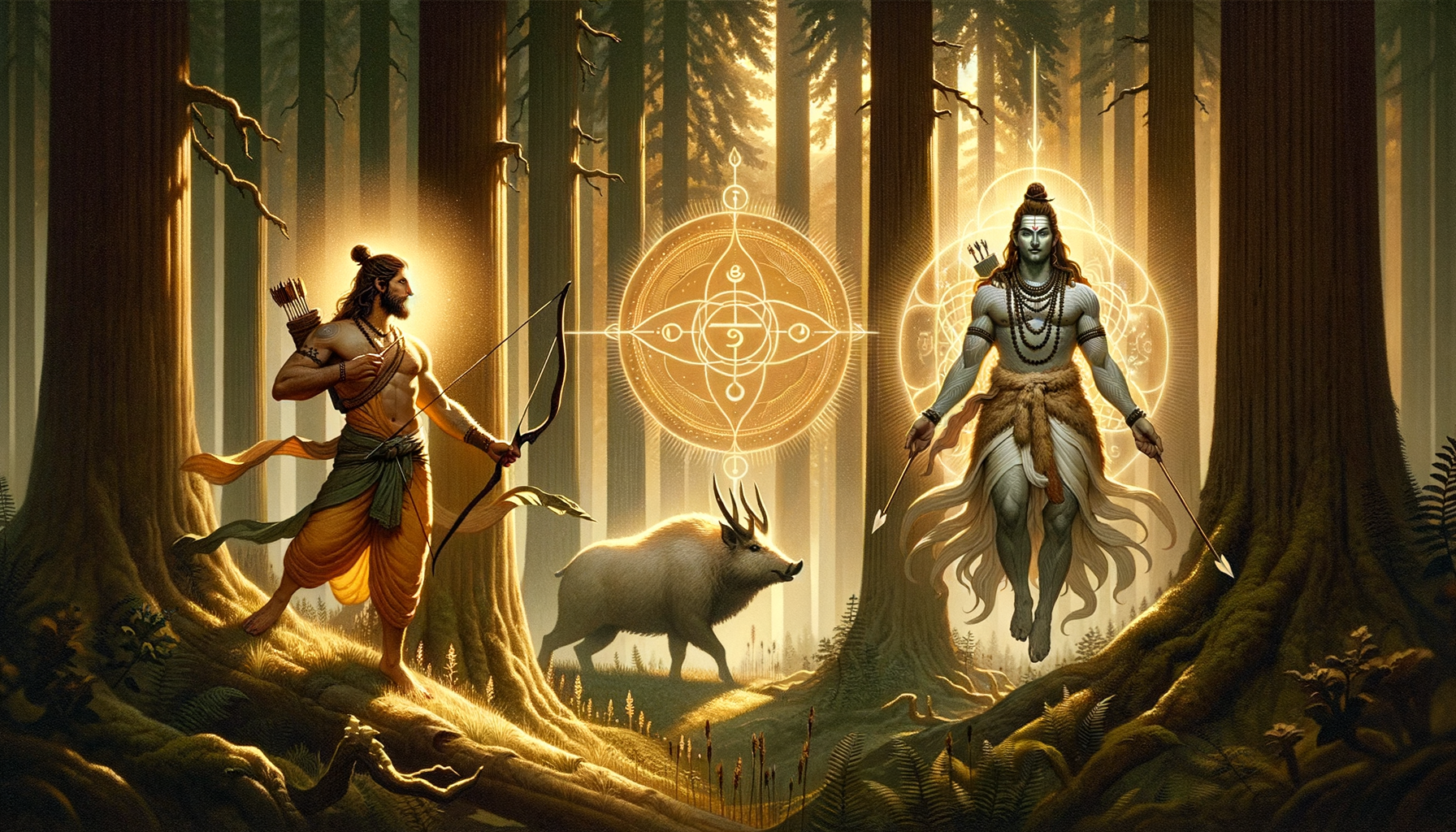
During the Pandavas’ exile in the Mahabharata, Arjuna undertook intense tapasya to honor Shiva and obtain divine weapons for the looming Dharma-Yuddha. His austerity was so severe that heat radiated from his body, and smoke seemed to rise through the forest canopy, unsettling wildlife and nearby ascetics. Within this rigorous discipline, the epic’s narrative frames a transformative encounter that reveals how outer trials mirror inner battles.
In the famed Kirata episode, a fearsome boarMook (often identified as Mūka or Mookasura)charged through the forest, intent on disrupting Arjuna’s meditation. A hunter, the Kirata form of Shiva, appeared simultaneously. Both Arjuna and the Kirata loosed arrows at the boar at once, and the creature fell. A dispute ensued over whose arrow had struck true, leading to a test of strength that Arjuna could not win. Recognizing the extraordinary nature of his opponent, Arjuna fashioned a makeshift worship with forest offerings, and in that reverent moment the Kirata revealed the divine form of Shiva, pleased with Arjuna’s steadfastness and humility.
Shiva then granted Arjuna the Pashupatastra, the supreme weapon, while other devas later bestowed further astras. The demon Mook, slain in the form of the boar, stands as a symbol in this narrative: the wild, tamasic surge of impulse and delusion that charges at the practitioner exactly when tapasya has ripened. Arjuna’s unwavering discipline, his readiness to contend with the unknown, and his final surrender to the sacred order of dharma illuminate how inner courage and humility must be held together to transform raw power into righteous action.
Many readers find the episode emotionally resonant. The vision of Arjuna, tested at the height of austerity, echoes common experiences in spiritual life: moments when distractions intensify precisely as clarity nears, or when an unexpected challenge exposes the limits of pride. The figure of Mook evokes the “inner demon” that appears as anger, fear, or restlessnessimpulses that demand decisive yet discerning response. Arjuna’s choice to honor dharma over ego offers a relatable template for confronting crises with composure and devotion.
Across dharmic traditions, this narrative aligns with shared ethical and contemplative insights. In Buddhism, the confrontation with Mara parallels the slaying of inner defilements through mindfulness and wisdom; in Jainism, tapas is revered as the disciplined path for overcoming kashayasanger, pride, deceit, and greedby inner conquest rather than outward violence; in Sikhism, the integration of nirbhau (fearlessness) with humility reflects the saint-soldier ideal that channels courage in service of righteousness. The Kirata episode thus speaks to a pan-dharmic ethos: transformation through self-mastery, compassion, and steadfast adherence to truth.
Practically, the episode suggests a layered discipline. Tapasya builds resilience; dhyana refines perception; and surrender to dharma aligns action with a larger moral order. Readers often report that structured breath awareness, mantra-japa, or reflective study of epic literature (itihasa) helps cultivate the steadiness seen in Arjuna. When impulses like the “charging boar” arise, one may meet them with mindful observation, ethical restraint, and focused skill in actionKarma Yoga with a clear heart.
Philosophically, the episode refines the distinction between dharma and adharma. Power obtained without humility risks becoming adharma; humility without courage risks inaction. Arjuna’s tapasya, contest with the Kirata, and reception of the Pashupatastra together affirm a balanced ideal: courage guided by wisdom, and wisdom deepened by devotion. In this synthesis, the story maintains its relevance for contemporary seekers across Hinduism, Buddhism, Jainism, and Sikhism, affirming unity in the shared pursuit of inner freedom and compassionate strength.
Inspired by this post on Hindu Blog.










