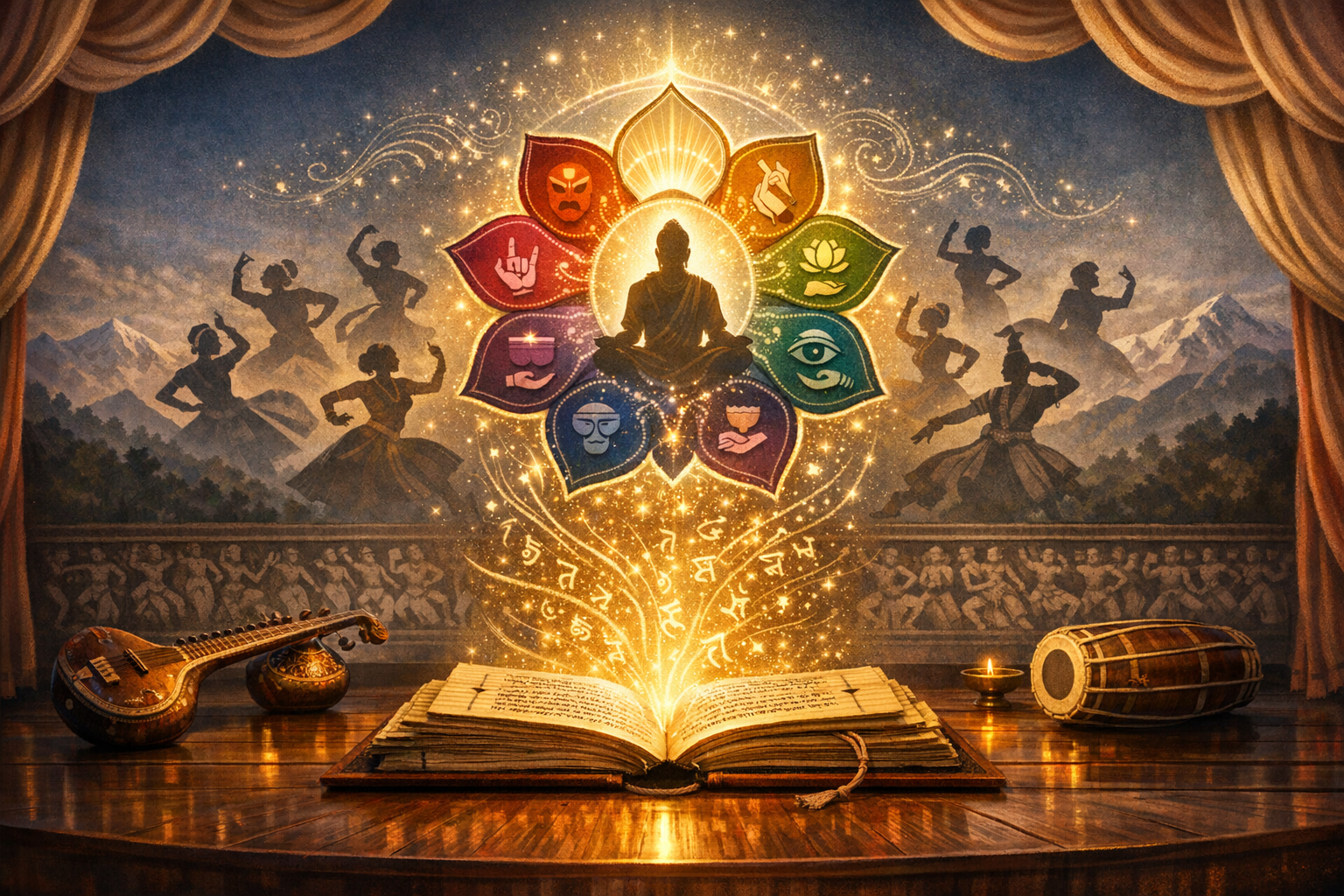
The Natyashastra of Bharata Muni occupies a singular place in the intellectual and artistic history of Ancient India, codifying drama, dance, music, poetics, and stagecraft with a systematic rigor that shaped South Asia’s performance traditions for over two millennia. Within this vast landscape, Abhinavagupta’s Abhinavabharati stands as the most influential and philosophically profound commentary, clarifying foundational aesthetics and offering a coherent framework that continues to guide practitioners and scholars of Sanskrit theatre and Indian classical arts.
Composed in Kashmir between the late 10th and early 11th centuries CE, Abhinavabharati synthesizes centuries of earlier reflection while integrating insights from Kashmir Shaivism, Sanskrit poetics, and practical performance. Its analyses do not merely gloss Bharata’s sutras; they re-animate the treatise for living stagesBharatanatyam, Kathakali, Kathak, Odissi, Kuchipudi, Sattriya, Chhau, Yakshaganaand the wider ecosystem of Indian music and dramaturgy.
Abhinavagupta is renowned not only for Abhinavabharati but also for a sophisticated engagement with poetics (notably the Locana on Anandavardhana’s Dhvanyaloka) and a deep metaphysical vision shaped by Trika Shaivism. His commentary anchors aesthetic experience in a subtle account of consciousness, emotion, and suggestion (dhvani), generating a durable bridge between theory and practice that artists and connoisseurs (sahridaya) continue to traverse.
As a commentary, Abhinavabharati spans the Natyashastra’s multidisciplinary reachrasa theory, abhinaya (expression), the daśarūpaka (dramatic genres), dramaturgical structure, dance and music theory, and stagecraftwhile preserving and critiquing earlier interpretive traditions. Extant portions and citations attest to a comprehensive and methodical approach, making it an indispensable window into both the text and its performance ecology.
At the heart of Abhinavagupta’s analysis lies the celebrated rasa-sutra, vibhāva-anubhāva-vyabhicāri-saṁyogād rasa-niṣpattiḥ. Abhinavabharati clarifies the architecture of aesthetic experience: determinants (vibhāva) evoke stable emotions (sthāyibhāvas), which find outward manifestation in consequents (anubhāva) and are nuanced by transitory states (vyabhicāri- or sañcārī-bhāvas). Through a process of sāmānyīkaraṇa or sādharanīkaraṇa (aesthetic universalization), the spectator, as sahridaya, transcends personal particularities and relishes the distilled essence of emotion as rasa.
Abhinavagupta’s acceptance and philosophical elevation of śānta rasa (tranquility) is especially consequential. He positions śānta as the apex that harmonizes the spectrum of rasasśṛṅgāra (love), hāsya (comic), karuṇa (pathos), raudra (fury), vīra (heroic), bhayānaka (fearful), bībhatsa (odious), adbhuta (marvelous)orienting aesthetic savor toward interior quietude. This orientation resonates with dharmic contemplative ideals broadly shared across Hinduism, Buddhism, Jainism, and Sikhism, where equanimity, compassion, ahiṁsā, and sehaj (effortless harmony) are valued as culminating dispositions.
Abhinavabharati intervenes decisively in earlier debates. Against Lollaṭa’s view that rasa is simply the actor’s personal emotion and Śaṅkuka’s inference model that treats performance as a cue for audience deduction, Abhinavagupta argues that rasa is a universalized aesthetic relish in the spectator’s consciousness. He assimilates and refines Bhaṭṭanāyaka’s insights on bhoga (aesthetic enjoyment) and sādharanīkaraṇa, showing how theatre suspends ordinary egoic stakes so that art can be experienced as shared, luminous feeling.
Leveraging Anandavardhana’s theory of suggestion (dhvani), Abhinavagupta situates rasa as the supreme content of poetic and dramatic suggestion (rasa-dhvani). In this account, language, gesture, and music exceed denotation; they operate through an evocative surplus that unfolds the rasa latent in the text and performance. The Abhinavabharati thus binds Natyashastra’s dramaturgy to Sanskrit poetics in a single, coherent aesthetic vision.
On expression (abhinaya), the commentary refines Bharata’s fourfold schemaāṅgika (bodily), vācika (verbal), āhārya (costume and set), and sāttvika (involuntary psychophysical signs). It details how glances, postures, gait, and hand-gestures (hasta) articulate āṅgika; how prosody, diction, and intonation ground vācika; how costuming, ornaments, and makeup shape āhārya; and how tears, horripilation, voice-choking, and pallor arise as sāttvika-bhāvas when the inner state becomes intensely live on stage.
Abhinavabharati’s attention to sāttvika-bhāvas is especially instructive for performers training in Indian classical dance and theatre. These involuntary signs, correctly oriented, do not mimic private emotion; rather, they reveal a clarified, universalized mood that a prepared spectator can relish. The commentary thereby sets pedagogical expectations for technique, inner alignment, and audience address that remain current across Gharanas and paramparas.
In dramaturgy, Abhinavabharati elucidates the daśarūpakamajor dramatic forms such as nāṭaka, prakaraṇa, bhāṇa, prahasana, dima, vyāyoga, samavakāra, vīthi, īhāmṛga, and utsṛṣṭikāṅkaand clarifies how plot materials, heroes, and sentiments suit each genre. Equally, it explains foundational compositional architecture through sandhi (junctures) like mukha, pratimukha, garbha, vimarśa, and nirvāhaṇa, enabling staged narratives to graduate tension, deepen rasa, and resolve with aesthetic inevitability.
On music and dance, Abhinavabharati transmits and elucidates core Natyashastra materials: the 22 śrutis, the grāmas (notably ṣaḍja- and madhyama-grāma), mūrchanās, and jātis that anticipate later rāga-s. It links rhythm and movement through tala principles while articulating the triad nṛtta (pure dance), nṛtya (expressive dance), and nāṭya (drama), and connects choreographic units to the 108 karaṇas memorialized in temple sculpture. The overall result is a grammar that undergirds both Margi (classical) and Deśi (regional) practices.
Stagecraft receives comparable care. Abhinavabharati comments on the ritualized prelude (pūrvaraṅga), curtain (yavanikā), backstage (nepathya), and the musician’s ensemble (kūṭapa), and it clarifies conventions that make theatrical illusion ethically sound and aesthetically credible. These protocols ensure that even stylization (nāṭyadharma) can coexist with lifelike representation (lokadharma) without collapsing artistic integrity.
Central to Abhinavagupta’s aesthetics is the figure of the sahridayathe attuned spectator whose sensibility and preparation allow the rasa to blossom. The commentary links this receptivity to ethical cultivation: by relishing refined emotions without personal stakes, audiences practice empathy and discernment. In this sense, Natyashastra-guided performance becomes a civilizational instrument for lokasaṅgrahasocial cohesion through shared feeling and insight.
Abhinavabharati’s orientation supports unity across dharmic traditions. The cultivation of karuṇā (compassion) aligns with Buddhist and Jain ethics; śānta resonates with meditative equipoise; and devotionally-inflected rasas, shaped by rāga and tāla, harmonize readily with Sikh kīrtan’s aesthetic and contemplative aims. Rather than privileging a single sectarian path, Abhinavabharati articulates a shared aesthetic field in which Hindu, Buddhist, Jain, and Sikh communities can recognize common values of restraint, empathy, balance, and joy.
Textually, the commentary also preserves earlier discussions by citing, refining, and sometimes correcting prior authorities, thereby functioning as an intellectual archive. Modern critical editions and translations have made Abhinavabharati widely accessible, revealing its role as a keystone for the interpretation of Bharata’s treatise and as a touchstone in the broader history of Indian aesthetics.
Its influence is unmistakable in contemporary pedagogy. When Bharatanatyam teachers speak of navarasa, when Kathakali exponents calibrate raudra or karuṇa through precise āṅgika and sāttvika cues, and when Odissi choreographies integrate mārgi grammar with regional idiom, they operate within frames Abhinavabharati clarified. The same frames help storytellers, directors, and musicians across genres sustain narrative credibility and emotional depth.
Practically, Abhinavabharati invites a disciplined method: identify vibhāvas with dramaturgic care; map the relevant sthāyibhāva; orchestrate anubhāvas and sañcārī-bhāvas with calibrated abhinaya; and rely on dhvani to carry suggestion beyond explicit speech. This method is as applicable on classical stages as it is in modern theatre, dance-theatre, and cinematic acting grounded in Indian aesthetic principles.
Comparatively, Abhinavabharati offers a distinct alternative to Western frameworks such as Aristotelian catharsis. Where catharsis often emphasizes purgation of pity and fear, Abhinavagupta’s rasa emphasizes a non-possessive savoring of universalized emotion culminating in tranquility. The juxtaposition illuminates Indian aesthetics as an ethics-infused contemplative art that refines sensibility while protecting the autonomy of the aesthetic sphere.
Abhinavabharati also speaks to the digital era. Even when performances migrate to screens, the sahridaya principle, dhvani-driven suggestion, and abhinaya grammar remain operative, guiding creators to preserve immediacy and nuance. The commentary’s insistence on clarity of vibhāva and integrity of expression provides a blueprint for sustaining rasa across new media without sacrificing classical depth.
Taken together, Abhinavabharati transforms the Natyashastra from a compendium into a living philosophy of art. It integrates theory and practice, joins poetics to performance, and aligns aesthetic cultivation with ethical and contemplative growth. For artists, scholars, and audiences across dharmic communities, it remains a master keyunlocking how drama, dance, and music can delight, instruct, unify, and ultimately quiet the heart.
Inspired by this post on Hindu Blog.