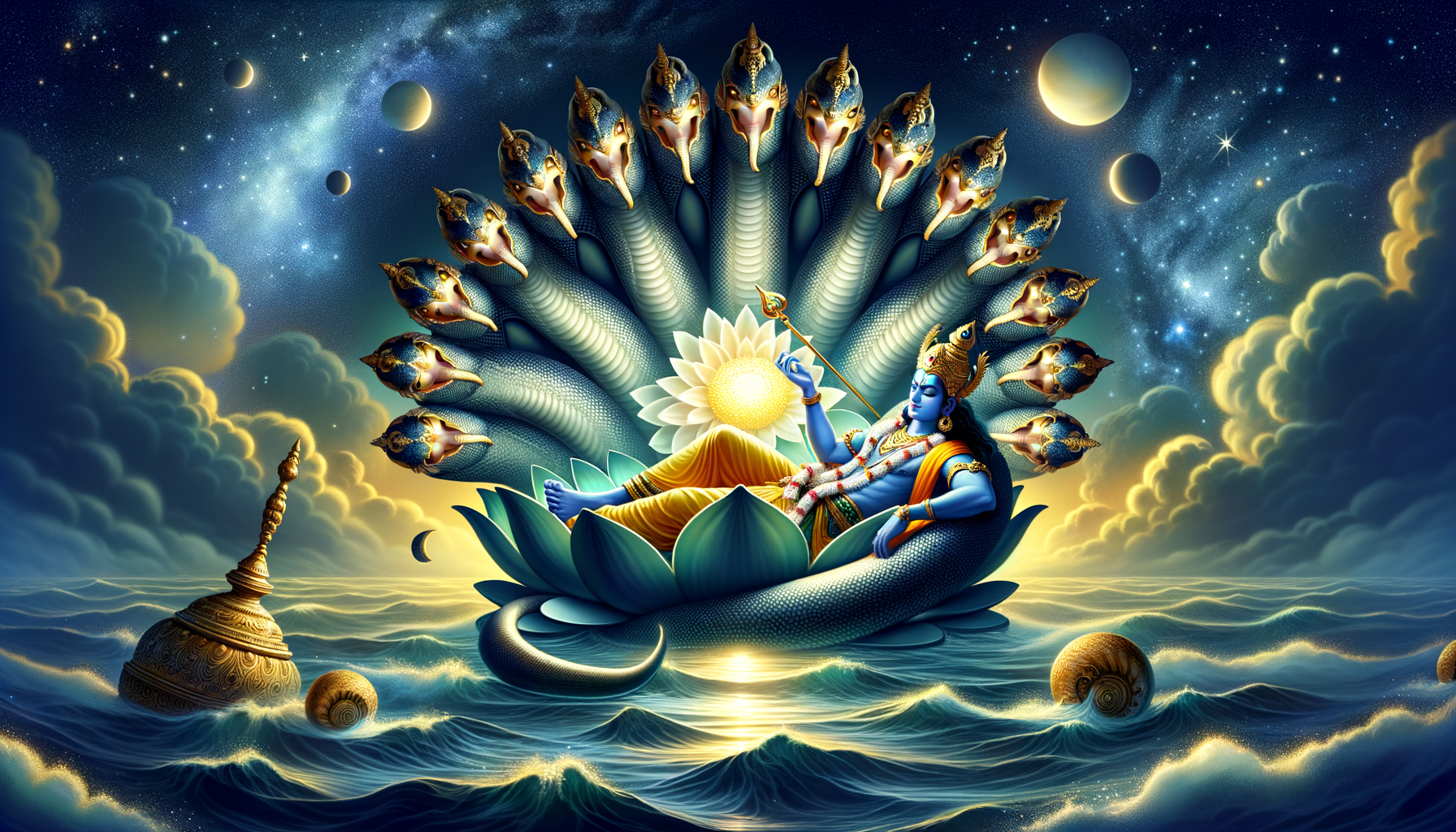
The enduring image of Lord Vishnu reclining upon the infinite cosmic ocean, resting on Ananta or Shesha as the lotus of creation arises from his navel, stands among Hinduism’s most profound symbols. More than artistic devotion, this visual conveys layered metaphysical insights, scriptural foundations, and a contemplative map for spiritual life. It gathers cosmology, psychology, and ethics into a single, serene tableau.
Classical sources in the Puranas describe primordial waters (often rendered as the ocean of milk, Kshira Sagara) as the undifferentiated field prior to manifested creation. In this state, Vishnu abides in yoga-nidra, a conscious repose, upon Ananta—“the infinite”—whose coils signify boundless time and cosmic stability. From Vishnu’s navel springs the lotus on which Brahma, the creator, is seated, indicating the emergence of ordered cosmos out of latent potential. The scene thus harmonizes the Trimurti functions of preservation, creation, and cyclical renewal.
Philosophically, water (apas) represents the fluid, formless substratum that can assume countless shapes without losing its essence. Vishnu’s repose upon it signifies presence within and beyond change—a poised awareness upholding the world’s continuity. Ananta or Shesha symbolizes enduring order amid temporal flux, while the lotus conveys the universe blossoming from purity and clarity, unstained by the medium from which it emerges. Together, these motifs teach that preservation is not passivity but dynamic equilibrium grounded in consciousness.
Psychologically, the cosmic ocean mirrors the mind’s vastness and depth. When its surface grows still through dhyana and mindful living, it reflects truth with clarity. Vishnu’s yoga-nidra becomes a metaphor for restful vigilance, a state in which awareness remains steady while phenomena arise and subside. This reading aligns with core Hindu philosophy: sustained sattva—luminosity, balance, and peace—enables wise action without inner turbulence.
Ethically and ecologically, the symbol venerates water as the matrix of life. Reverence for the ocean under Vishnu’s protection encourages stewardship of rivers, lakes, and seas as sacred trusts. In this way, cosmic imagery informs everyday responsibility, linking spiritual insight with compassionate action. Preservation, at the heart of Vishnu’s role, becomes a guiding principle for environmental care and cultural continuity.
Resonances across dharmic traditions reinforce this unifying vision. The lotus, central to Buddhist imagery, blossoms unstained from water, signaling spiritual awakening within the world. In Jain thought, the very term “Tirthankara” evokes a ford-maker who helps beings cross the stream of samsara. Sikh practice honors the sarovar as a place of purification and reflection, where inner stillness is cultivated amid community. Across Hinduism, Buddhism, Jainism, and Sikhism, water symbolizes purity, passage, and presence—binding diverse paths in shared wisdom.
For devotees and practitioners, this iconography nurtures devotion and contemplation. Darshan of Vishnu on Ananta Shesha invites an inner quietude that steadies the heart. It offers a lived reminder: in the midst of change, rest is found in the consciousness that sustains all. The image inspires trust in dharma, courage in service, and compassion in relationship to all beings.
Ultimately, Vishnu’s resting place upon water conveys a comprehensive teaching: the cosmos arises from, and is preserved by, a conscious ground that is serene, supportive, and infinite. Water embodies the fertile potential of becoming; Ananta ensures continuity through time; the lotus signals the dawning of ordered creation. The symbolism unites cosmology and practice, inviting a life of balance—anchored in clarity, guided by dharma, and open to the shared heritage of the dharmic family.
Inspired by this post on Hindu Blog.