Rabindranath Tagore offers a penetrating reading of Kalidasa’s poetry, locating a sustained tension between the outer and inner worlds, the real and the ideal. This critical lens brings to light a civilizational dialogue within Sanskrit literature, wherein worldly splendour repeatedly encounters ascetic restraint, and artistic beauty interrogates ethical purpose.
Raghuvamsha (Raghuvamsa) embodies this tension with unusual clarity. In classical Sanskrit poetics, tragic endings are generally discouraged, and one might expect the epic to culminate triumphantly with the reign of Rama, the zenith of Raghu’s line. Yet Kalidasa drives the narrative further, closing with decline and dissipation. Tagore reads this choice as the poet’s quiet disturbancea refusal to let praise obscure the moral trajectory of power unmoored from discipline.
The founding vision of the Raghu dynasty itself is rooted in restraint. Raghu is born in a hermitage, the fruit of his parents’ tapas, signalling that expansive sovereignty must arise from inner mastery. Across the epic, the suggestion recurs: enduring achievement follows rigorous ascetic preparation, not indulgence.
Kalidasa underscores the point by beginning not in a court but in a forest āśrama. King Dilipa and Queen Sudakshinasovereigns of a sea-girt realmserve humbly by tending the cows of sages, exercising devotion and self-control. The contrast at the close is stark: Agnivarna’s intoxicated excesses glow with dazzling description, yet the glow resembles a consuming blaze rather than the steady light of virtue.
Tagore highlights Kalidasa’s luminous metaphors: the epic’s dawn is serene and restrained, like a hermit-lad crowned with matted locks, waking the earth gently with promise. Its evening flares briefly in many-coloured splendour before darkness descendsan image of splendour sundered from substance. The effect is not mere aesthetic balance; it is moral architecture.
From this architecture emerges a civilizational reflection: power anchored in tapas elevates, while luxury without measure corrodes. Read through the shared values of Hinduism, Buddhism, Jainism, and Sikhism, the critique is integrative rather than divisive. Self-restraint, ethical clarity, and service are common dharmic threads; indulgence untethered from Dharma risks private sorrow and public decay. In this sense, Raghuvamsha reads as a call for unity around inner discipline as the true ground of outer excellence.
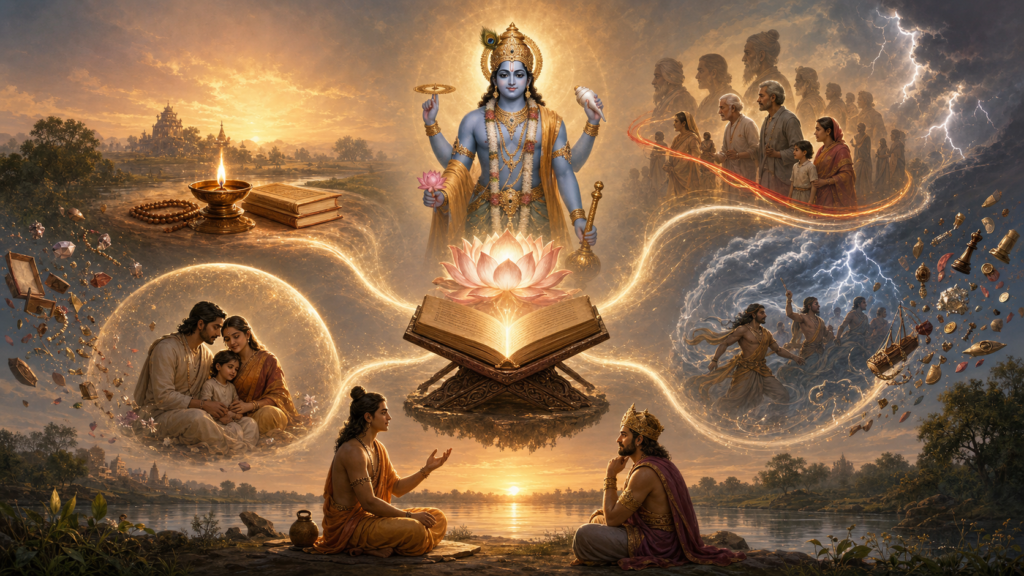
Kumarasambhava proposes the constructive resolution that complements the epic’s warning. Tagore notes that Kalidasa frames true strength as the harmony of renunciation and enjoyment: only their union generates creative power. When Shivarenunciation personifiedwithdraws entirely, the cosmos lacks active guardianship; when Parvati is encircled only by familial joys, demonic forces surge. The Upanishadic counsel “tyaktena bhunjeetaah” thus becomes the poem’s keynote: enjoy through relinquishment, not addiction.
The ethical psychology is precise. Evil arises when pride or passion isolates a part and exalts it above the whole; “Sin is this revolt against the whole out of attachment to a part.” Renunciation, then, is not negation but completionyielding a temporal attachment to gain the eternal, surrendering selfishness for love, and trading transient pleasure for abiding bliss. Within this frame, passion must be refined, not repressed, so that enjoyment aligns with Dharma.
Kalidasa’s narrative makes the lesson concrete. Parvati fails when she seeks Shiva through Cupid’s arrow, but succeeds through tapas, attaining a union that dignifies both renunciation and delight. The insight resonates widely across dharmic traditions: the Buddhist Middle Way, the Jain ethic of aparigraha held by both ascetics and householders, and the Sikh synthesis of miri-piri all affirm a measured integration of inner discipline and worldly responsibility.
For contemporary readers navigating abundance and aspiration, Tagore’s reading of Kalidasa offers a lucid roadmap from Sanskrit literature: cultivate inner mastery before assuming outer power; let enjoyment be tempered by relinquishment; and yoke capability to compassion. Raghuvamsha warns against the splendour of flame without fuel, while Kumarasambhava shows how balanced energies kindle creative strength. In unison, they invite a dharmic unityacross Hinduism, Buddhism, Jainism, and Sikhismaround the timeless ethic of disciplined joy.
Inspired by this post on Dharma Dispatch.