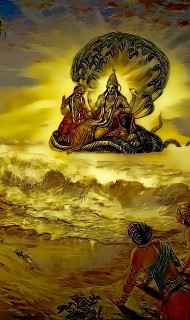
This analysis examines the origin of the universe through two complementary lenses: the Srimad Bhagavatam and modern Big Bang theory. Rather than contesting one another, these perspectives invite a comparative exploration of cosmology, metaphysics, and the limits of human knowledge, encouraging dialogue across dharmic traditions while maintaining academic rigor.
In the Srimad Bhagavatam, the state preceding material manifestation is termed pradhana (SB 3.26.10p). It is described as a void-like, unmanifest condition in which matter and space are not yet differentiated. Though unmanifest, the totality of material potential is said to be present and densely concentrated, resting beyond the operation of familiar physical laws and beyond ordinary perception.
In Big Bang theory, the initial condition is commonly representedby classical extrapolationas a singularity. This singularity indicates a limit of current models, where general relativity ceases to provide reliable descriptions and space-time, matter, and energy cannot be meaningfully separated in ordinary terms. While not necessarily implying a literal point in contemporary physics, this formulation conveys an extremely hot, dense, and law-transcending initial state for the observable universe.
Set side by side, pradhana and the singularity suggest a resonance: both articulate a pre-manifest condition in which familiar notions of matter, space, and time have not yet emerged, and both point to a domain where known laws do not fully apply. This is a heuristic comparison, not an equation of categories; the Srimad Bhagavatam speaks in metaphysical and theological terms, while Big Bang cosmology proceeds from empirical models. Yet the parallel invites thoughtful reflection on how ancient scriptures and modern science approach beginnings.
Across dharmic traditionsHinduism, Buddhism, Jainism, and Sikhismthere is a shared humility before ultimate origins and a recognition of primordial potentiality prior to form. Such convergences strengthen a spirit of unity in spiritual diversity, encouraging respectful engagement between scriptural insights and scientific inquiry, and fostering a holistic appreciation of both Vedic cosmology and contemporary astrophysics.
For many readers steeped in science and spirituality alike, these resonances evoke a sense of wonder. They underscore that careful comparative analysis can deepen understanding without collapsing differences, and that the origin of the universe remains a profound subject where rigorous cosmology and contemplative wisdom together enrich the search for truth.
Inspired by this post on Dandavats.