Devdutt Pattanaik’s formulation of the “Vedic people” offers a carefully balanced narrative: Indo-Aryan speakers entered the subcontinent around four millennia ago, interacting with communities in the Indus–Saraswati region after the urban phase had waned. In this view, horses and a Proto-Indo-European (PIE) tongue accompany migration, while the Rig Veda emerges later in North-West India through the refinement of older hymns and the composition of new ones, ultimately compiled in Vedic Sanskrit with demonstrable local linguistic influences.
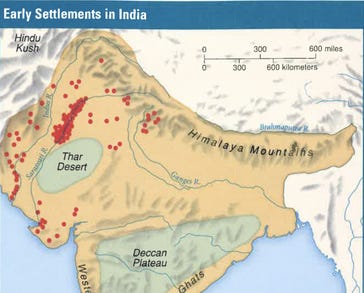
School materials in the United States, such as a California 6th-grade history textbook, also acknowledge early settlements along both the Indus and the ancient Saraswati rivers. This geographic emphasis aligns with archaeological distributions that show dense Harappan sites along the Ghaggar–Hakra paleochannel often associated with Saraswati. The Vedic corpus describes Saraswati as a mighty river in a known landscape, suggesting cultural memory intimately rooted in the region rather than a distant, purely remembered homeland.
For many readers, this convergence of textual and archaeological signals raises an important question: if Vedic communities knew Saraswati as a great river, did their cultural formation occur while the river still flowed robustly? The Indus–Saraswati urban system experienced climatic and hydrological variability due to tectonics and weakened monsoons, and the timing of Vedic composition becomes crucial to any proposed migration chronology.
Archaeological and linguistic scholarship increasingly favors a cosmopolitan Indus–Saraswati milieu rather than a single-language civilization. Jonathan Mark Kenoyer has argued that multiple language familiesDravidian, Austro-Asiatic, Sino-Tibetan, and Indo-Aryanlikely coexisted in Harappan settlements. Paul Heggarty has further explored the possibility that Indo-European speakers could have reached regions such as Mehrgarh much earlier than once assumed, allowing for a more gradual language history in North-West India.
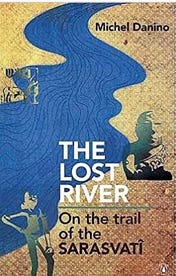
Competing attempts to reconcile Saraswati references with strict Aryan Migration dates have proposed alternate identifications (for instance, Helmand/Harahvaiti in Afghanistan) or even questioned the river’s historical existence. However, multidisciplinary studiesgeomorphology, satellite imagery, on-ground stratigraphy, and Vedic textual geographyhave strengthened the association of Saraswati with the Ghaggar–Hakra system. Michel Danino’s synthesis in “The Lost River” surveys this evidence holistically, foregrounding how textual memory, terrain, and settlement patterns intersect.
The Indo-European homeland debate has narrowed to a smaller set of models: (1) an Anatolian–Neolithic origin tied to early farming; (2) a zone south of the Caucasus with later dispersal; and (3) a Pontic–Caspian steppe homeland (between the Volga and Dnieper) during 4500–3000 BCE. Beyond invasion or elite dominance, demic diffusion remains an important mechanism. Peter Bellwood, correlating farming expansions with archaeology in the Gangetic plains, posits earlier-than-assumed arrivals in the North-West, allowing time for a Vedic linguistic tradition to form locally and spread gradually.
The “horse question” is likewise nuanced. If horses arrived with Indo-Aryans around 2000–1500 BCE, one might expect a sharp increase in equine remains and iconography soon after. Yet the archaeological record shows horse depictions becoming more common much later, particularly by the Mauryan period. This pattern cautions against simplistic markers and supports a more complex, regionally varied adoption of equids and related technologies.
Religious continuities also deserve careful attention. Evidence for tree veneration in Harappan contexts parallels references in the Rig Veda and Atharva Veda, while fire altarscentral to Vedic sacrificial practicehave been found at sites such as Kalibangan, where a series of aligned rectangular structures recalls Vedic hearth arrangements. Such convergences do not “prove” a single civilizational identity, but they do illuminate shared ritual grammars within a connected cultural landscape.
For those navigating classroom discussions or family conversations, the debates on Aryan Migration versus Out of India can feel polarized. A dharmic lensone that recognizes the shared civilizational matrix of Hinduism, Buddhism, Jainism, and Sikhismhelps reframe the discourse from contestation to continuity. Regardless of where the PIE homeland is ultimately placed, the Indus–Saraswati region emerges as a crucible in which languages, rituals, and social forms circulated, interacted, and evolved.
Approached this way, the discussion shifts from proving exclusivist origins to understanding a plural and layered past. The Indus–Saraswati civilization appears increasingly as an interconnected networkmultilingual, multi-ritual, and multi-regionalwithin which Vedic traditions matured. In that shared space, later dharmic traditions drew from common ethical sensibilities, sacred geographies, and philosophical inquiries, sustaining unity amid diversity.
The most responsible conclusion is provisional yet constructive: Saraswati’s memory in Vedic literature, Harappan settlement geography, and evolving linguistic hypotheses collectively support a deep, local grounding for Vedic culture within North-West Indiawithout denying broader Indo-European linkages. This integrative perspective, anchored in evidence and open to revision, best serves a unifying civilizational narrative that honors the shared heritage of all dharmic traditions.
Inspired by this post on Varnam.