
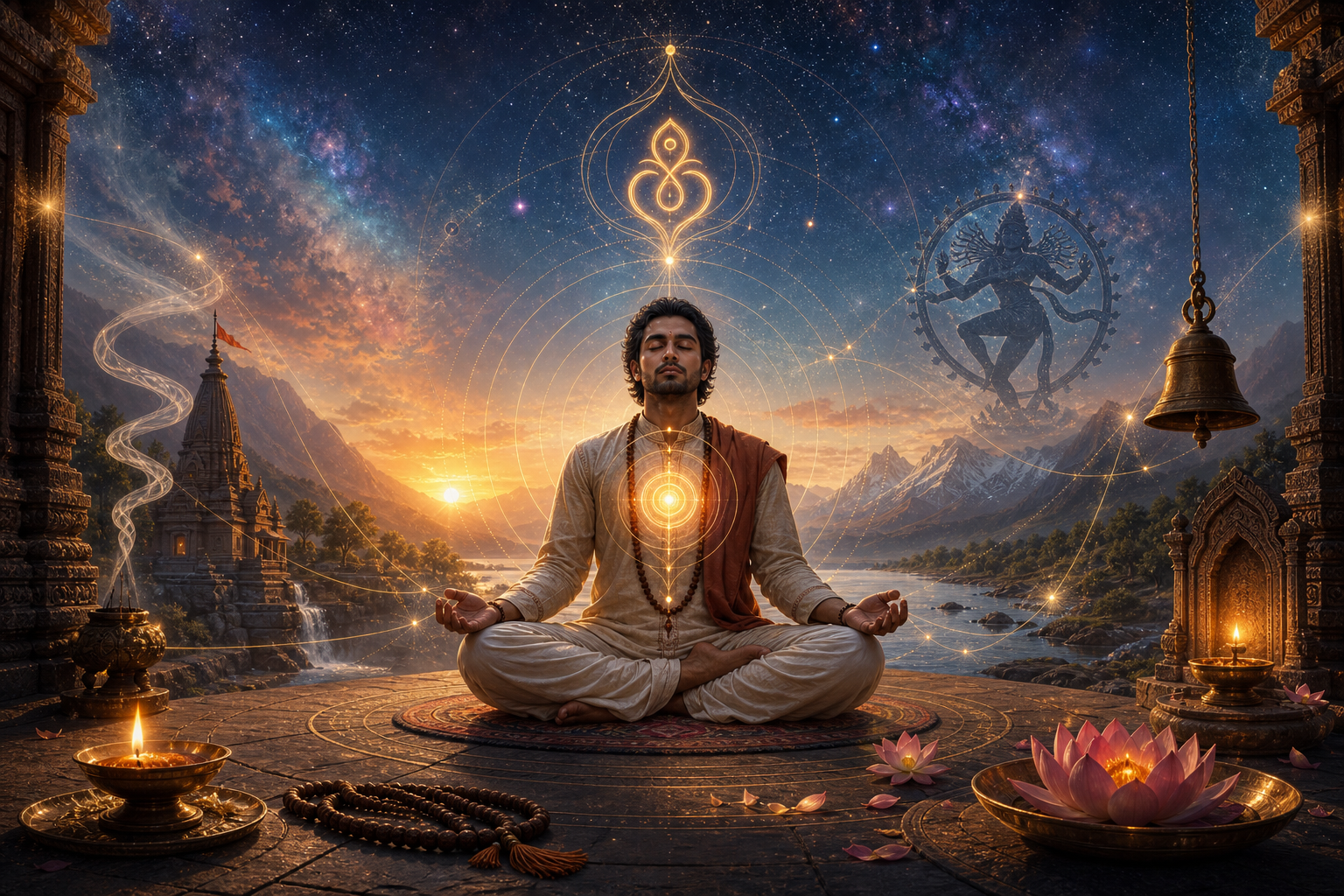
Bliss, vibration, and the Hindu search for harmony. Hindu philosophy often presents bliss not as a passing emotion but as a refined state of being in which consciousness, conduct, breath, sound, and perception become aligned with the deeper order of reality. The idea that bliss arises when inner vibrations harmonize with the universe may sound poetic, yet within Hindu thought it has a precise philosophical foundation. It draws from the concepts of Ānanda, Brahman, Prāṇa, Śabda, Om, Nāda, and the disciplined practices of yoga, meditation, mantra, and ethical living.
In this tradition, the human being is not viewed as an isolated body moving through a mechanical universe. The individual is understood as a layered reality: physical, vital, mental, intellectual, and spiritual. The Taittirīya Upanishad describes these layers through the doctrine of the five sheaths, or pañca kośa, culminating in ānandamaya kośa, the sheath associated with bliss. This framework suggests that happiness becomes more stable as awareness moves from surface-level stimulation toward subtler forms of identity and realization.
The Sanskrit word Ānanda is central to understanding this subject. It does not merely indicate pleasure, excitement, or psychological comfort. In Vedantic philosophy, Ānanda is associated with the nature of ultimate reality itself. The well-known Upanishadic formulation sat-cit-ānanda presents Brahman as existence, consciousness, and bliss. Bliss, therefore, is not treated as something imported from outside; it is uncovered when ignorance, agitation, egoic contraction, and inner disharmony gradually subside.
The language of “vibration” is a modern way of approaching older Hindu ideas about sound, energy, and consciousness. Classical texts do not use the vocabulary of contemporary physics in a simplistic sense, and it would be inaccurate to reduce Hindu spirituality to scientific terminology. Yet Hindu traditions have long recognized that sound, rhythm, breath, intention, and attention shape the mind. This is the deeper context of mantras, Vedic chanting, temple bells, conch sounds, kirtan, japa, and the sacred syllable Om.
Om occupies a uniquely important position in Hindu philosophy. The Māṇḍūkya Upanishad presents Om as a profound symbol of waking, dreaming, deep sleep, and the fourth state, turīya. It is not merely a sound used at the beginning of prayers. It is a contemplative map of consciousness itself. When Om is chanted with steadiness, awareness, and reverence, the practitioner is invited to move beyond scattered thought into a more unified field of attention.
This is where the Hindu idea of inner harmony becomes practical rather than abstract. A disturbed mind experiences the world as fragmented, threatening, noisy, and unstable. A disciplined mind, trained through dhyāna, japa, prāṇāyāma, svādhyāya, and ethical conduct, becomes capable of perceiving order even within complexity. Bliss arises not because the outer world becomes free from difficulty, but because the inner instrument, the antaḥkaraṇa, becomes clearer, quieter, and more aligned with dharma.
The phrase “in harmony with the universe” can be understood through the Hindu concept of ṛta, the cosmic order described in Vedic thought. Ṛta is the principle by which the cosmos is intelligible, rhythmic, and morally meaningful. Later traditions develop this into the language of dharma, the sustaining order that governs personal responsibility, social harmony, ecological reverence, and spiritual growth. To live in harmony with the universe is therefore not a vague emotional condition; it is to live in a way that honors truth, restraint, compassion, gratitude, discipline, and reverence.
The Bhagavad Gita offers one of the clearest explanations of this inner alignment. It teaches that a person established in yoga performs action without obsessive attachment to results. Such a person is not passive or indifferent; rather, action becomes steadier because it is no longer driven by fear, vanity, greed, or constant comparison. The Gita’s vision of equanimity, samatvam, is deeply connected to bliss. When the mind is no longer pulled violently between craving and aversion, it begins to reflect a higher peace.
Hindu spiritual psychology gives great importance to the refinement of the mind. The guṇas, or qualities of nature, provide a technical vocabulary for this refinement. Tamas brings inertia, confusion, and dullness. Rajas brings restlessness, ambition, agitation, and movement. Sattva brings clarity, balance, luminosity, and harmony. Bliss becomes more accessible when sattva predominates, because a sattvic mind can perceive truth without excessive distortion. Diet, company, speech, study, worship, sleep, work, and intention all influence this inner balance.
The yogic tradition deepens this analysis through the concept of prāṇa, the vital force that animates body and mind. Breath is not merely a mechanical exchange of oxygen and carbon dioxide in yogic practice; it is also a doorway into attention, emotional regulation, and subtle awareness. Prāṇāyāma disciplines the breath so that the nervous system, mind, and subtle body can become steadier. When breathing is irregular, emotional life often becomes unstable. When breathing becomes calm, the mind more readily enters meditation.
The relationship between breath and consciousness is not limited to monastic life. Even in ordinary experience, a person under anger, grief, anxiety, or fear breathes differently from a person who is calm, attentive, and grounded. Hindu practices recognize this intimate connection and turn it into a path of transformation. The practitioner gradually learns that inner harmony is not achieved through escape from life, but through a disciplined reorientation of the body, speech, mind, and intention.
Nāda Yoga, the yoga of sound, provides another significant lens. It teaches that sound can serve as a bridge from gross perception to subtle awareness. External sound, such as mantra, bhajan, temple music, or Vedic chanting, can refine attention. Internal sound, approached through deep contemplative practice, symbolizes the movement from sensory dependence toward inner absorption. This tradition does not treat sound as entertainment alone. Sound becomes a sacred method for aligning consciousness with the deeper rhythm of existence.
Mantra practice is especially important in this context. A mantra is not simply a meaningful phrase repeated for comfort. In Hindu tradition, a mantra is a sacred sound-body transmitted through lineage, discipline, and reverence. Its effectiveness depends on pronunciation, attention, faith, repetition, ethical life, and the state of the practitioner. The repetition of a mantra through japa gradually gathers scattered mental energy into a single current. This one-pointedness, or ekāgratā, is essential for deeper meditation.
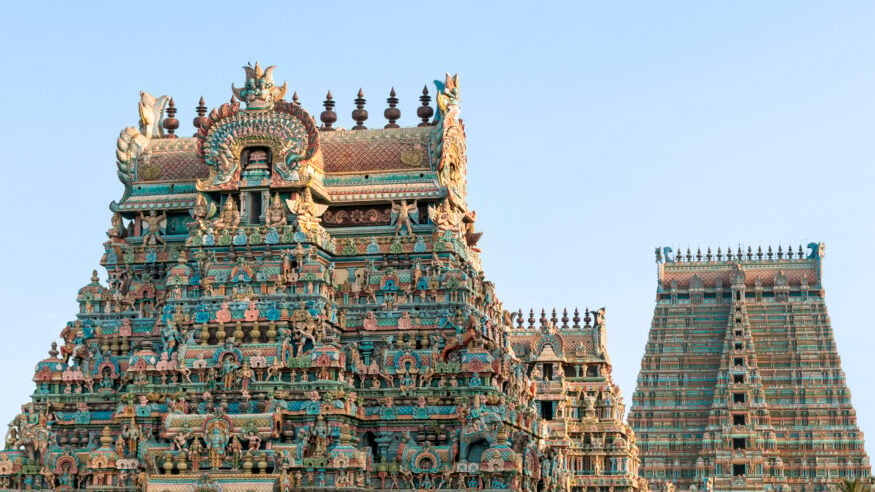
The symbolism of temple worship also reflects this movement toward harmony. The temple is not only a place of communal devotion; it is also a sacred diagram of the cosmos and the human journey inward. The devotee moves from the outer space of ordinary life toward the sanctum, the garbhagṛha, where the divine presence is ritually invoked. Bells, lamps, incense, flowers, mantra, water, food offerings, and circumambulation engage the senses and gradually redirect them toward reverence. In this environment, sensory life is not rejected; it is sanctified.
The symbolism of vibration also appears in the image of Shiva as Nataraja, the Lord of Dance. The cosmic dance represents creation, preservation, dissolution, concealment, and grace. It expresses the dynamic nature of reality: the universe is not a static object but a living process. In this symbolism, bliss is not lifeless stillness. It is the serene center within movement, the unshaken awareness that remains present even as forms arise and dissolve.
The Upanishadic seers repeatedly turn attention from the outer to the inner. Their inquiry asks: What remains constant behind changing sensations, thoughts, roles, successes, failures, and identities? The answer is not reached through belief alone but through disciplined insight. The Self, or Ātman, is described as deeper than body and mind. When the identity of Ātman and Brahman is realized in Advaita Vedānta, bliss is understood as the natural radiance of non-dual awareness.
Other Hindu philosophical schools explain the path differently, yet they share a concern for liberation from suffering and inner disorder. Sāṅkhya distinguishes Puruṣa, pure consciousness, from Prakṛti, nature. Yoga emphasizes disciplined practice and the stilling of mental modifications. Bhakti traditions emphasize loving surrender to the divine. Tantra explores the transformation of energy and embodiment. Vedānta examines the ultimate nature of reality. These approaches differ in method and metaphysics, but each recognizes that ordinary life becomes transformed when consciousness is purified and directed toward the sacred.
This diversity is one of Hinduism’s great strengths and also supports unity among Dharmic traditions. Hinduism, Buddhism, Jainism, and Sikhism each develop distinctive teachings, yet all recognize the importance of disciplined living, compassion, self-mastery, truthfulness, and liberation from ego-centered suffering. Buddhism speaks of mindfulness, compassion, and awakening. Jainism emphasizes ahiṃsā, restraint, and purification of the soul. Sikhism centers devotion, remembrance of the Divine Name, service, and equality. These traditions need not be collapsed into one another to be respected together. Their shared ethical and contemplative concerns strengthen the broader Dharmic civilizational vision.
The idea of harmony with the universe also has ethical implications. A person cannot claim spiritual alignment while cultivating cruelty, exploitation, arrogance, or indifference. Hindu philosophy links inner realization with outer responsibility. Ahimsa, truthfulness, self-restraint, generosity, purity, and compassion are not optional ornaments of spirituality. They are the conditions that make deeper awareness stable. Without ethical grounding, practices involving sound, energy, or meditation can become superficial or ego-driven.
This is why the Yoga Sutras of Patanjali begin the eightfold path with yama and niyama. Before advanced meditation, the practitioner is asked to cultivate non-violence, truthfulness, non-stealing, moderation, non-possessiveness, purity, contentment, discipline, self-study, and surrender to the divine. These principles are not moralism in a narrow sense. They are practical technologies of harmony. A mind burdened by deceit, excess, envy, or violence cannot easily become serene.
Modern life makes this teaching especially relevant. Many people live amid constant digital stimulation, fragmented attention, emotional comparison, and chronic stress. The mind becomes trained to jump from one impulse to another. In such a condition, bliss is often mistaken for entertainment, consumption, praise, or novelty. Hindu philosophy offers a different diagnosis: the problem is not only external pressure but also inner dispersion. The scattered mind cannot taste deep peace because it is rarely present enough to receive it.
Relatable experiences confirm this insight. A quiet morning prayer, a steady breath before a difficult conversation, the sound of a mantra repeated during anxiety, a moment of gratitude before food, or a walk taken with awareness can shift the quality of consciousness. These moments may appear small, but they reveal a larger principle: when attention becomes unified, life becomes less mechanical. The ordinary begins to recover sacred depth.
Hindu teachings do not deny suffering. The epics, Purāṇas, and philosophical texts are filled with conflict, grief, exile, moral ambiguity, and human struggle. The promise of bliss is therefore not sentimental. It is not the claim that a spiritual person never feels pain. Rather, it is the insight that beneath the changing waves of experience there is a deeper ground of awareness. Practice helps the individual relate to life from that ground rather than from constant reactivity.
The distinction between pleasure and bliss is essential. Pleasure depends on contact between the senses and desirable objects. It can be meaningful in moderation, but it is unstable because objects change, bodies change, and preferences change. Bliss, in the spiritual sense, is subtler. It emerges through inner integration, clarity, devotion, wisdom, and freedom from compulsive dependence. Hindu philosophy does not require hatred of the world; it asks for right relationship with the world.
Bhakti traditions express this truth through love. For a devotee of Krishna, Rama, Shiva, Devi, Vishnu, Ganesha, or another chosen form of the divine, bliss is experienced as relationship. The heart becomes harmonized through remembrance, singing, worship, service, and surrender. The doctrine of Ishta Devata acknowledges that individuals may approach the divine through different forms according to temperament, lineage, and inner calling. This strengthens religious pluralism within Hindu practice and affirms that spiritual unity does not require uniformity.
In devotional practice, sound becomes emotion refined into sacred memory. Kirtan, bhajan, and nama-japa allow the community and the individual to participate in shared spiritual rhythm. The voice, breath, body, and heart come together. The practitioner may begin with effort, but over time the practice can become natural, intimate, and transformative. Here, harmony with the universe is not only philosophical knowledge; it is love made rhythmic.
From a Vedantic standpoint, bliss is also connected to the removal of false identification. Much suffering arises from mistaking temporary roles for the whole self. One becomes identified with status, possessions, opinions, wounds, achievements, or social approval. Spiritual discipline does not erase personality, but it loosens the tyranny of limited identity. When awareness is no longer confined to the anxious ego, a more spacious form of happiness becomes possible.
The Hindu view of harmony also includes nature. Rivers, mountains, trees, animals, seasons, planets, and directions are integrated into sacred imagination and ritual life. This does not mean every traditional practice should be romanticized without reflection, but it does show that Hindu spirituality resists a purely exploitative view of the natural world. The universe is not inert material alone; it is a field of interdependence, reverence, and responsibility. Ecological sensitivity is therefore not foreign to Hindu thought. It is deeply consistent with dharmic living.
The technical language of chakras and subtle energy should be approached with care. In yogic and tantric traditions, chakras are not merely decorative symbols or psychological slogans. They belong to sophisticated systems of practice involving mantra, visualization, breath, discipline, and guidance. Popular culture often simplifies these ideas, but their deeper purpose is transformation of consciousness. The movement from gross to subtle, from compulsion to clarity, and from fragmentation to integration remains the central theme.
Academic study can help clarify these concepts, but lived practice gives them depth. Textual knowledge without discipline can become intellectual pride. Practice without knowledge can become sentiment or confusion. Hindu tradition values both jñāna and sādhana: insight and disciplined application. When study, meditation, ethical conduct, devotion, and service support one another, the idea of harmony becomes embodied rather than merely discussed.
The experience of bliss is often quiet. It may not arrive with dramatic visions or extraordinary sensations. It can appear as reduced reactivity, greater patience, a capacity to listen, a lighter relationship with desire, deeper gratitude, and an ability to remain inwardly steady during uncertainty. These signs are spiritually significant because they indicate that consciousness is becoming less governed by agitation and more available to wisdom.
Hindu religion insights on vibration and harmony should therefore be understood in an integrated way. Sound matters, but sound must be joined with attention. Energy matters, but energy must be guided by ethics. Meditation matters, but meditation must be supported by self-discipline. Devotion matters, but devotion must flower into compassion. Philosophy matters, but philosophy must transform perception and conduct. Bliss arises when these dimensions begin to cooperate.
The deepest teaching is that the universe and the individual are not finally alien to each other. Whether expressed through Vedantic non-duality, yogic stillness, devotional surrender, or tantric symbolism, Hindu traditions repeatedly point toward a profound intimacy between consciousness and reality. Human life becomes fulfilled when it stops resisting that deeper order and begins to participate in it with awareness, humility, and love.
Thus, the statement that bliss happens when inner vibrations are in harmony with the universe is best read as a spiritual synthesis. It means that the mind becomes clear, breath becomes steady, speech becomes truthful, action becomes dharmic, devotion becomes sincere, and awareness becomes rooted in the sacred. In such alignment, bliss is not manufactured. It is revealed as the natural fragrance of a life tuned to truth.
Inspired by this post on Hindu Blog.




Leave a Reply
You must be logged in to post a comment.