The question “Why is there suffering?” arises naturally in every life and often accompanies reflections such as “Why am I not happy?” and “Why do challenges seem unending?” Across dharmic traditionsHinduism, Buddhism, Jainism, and Sikhismcoherent answers converge, offering a shared framework for understanding pain, purpose, and the pathway to inner peace. This unity in spiritual diversity affirms that the inquiry into suffering is not a problem to be avoided but a doorway to wisdom, compassion, and transformation grounded in dharma.
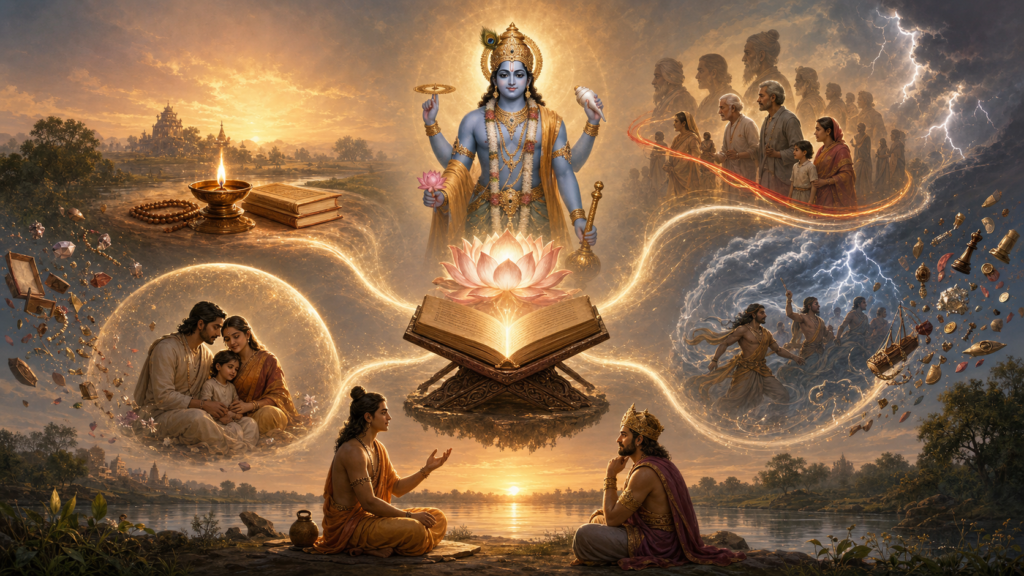
Dharmic sources broadly affirm that conscious beings are more than their physical forms. Embodiment places awareness within a material body and environment, bringing it into contact with changing conditions, relationships, and responsibilities. Engagement with prakriti (material nature) produces a spectrum of experiencessome agreeable, others difficultshaped by perception, interpretation, and response. This view, central to the Hindu way of life and echoed across traditions, frames life as a field for learning rather than a sequence of random events.
The senses and the mind interpret reality through learned patterns (saṁskāras) and tendencies (vāsanās), which generate attraction and aversion. This interpretive process colors events as pleasant or painful and can amplify distress through attachment, fear, or resistance. Teachings resonant with the Upanishads and the Bhagavad Gita, as well as Buddhist, Jain, and Sikh wisdom, converge on a practical thesis: suffering (duḥkha) intensifies when identification with transient experiences eclipses awareness of deeper naturevariously understood as atman, emptiness, pure awareness, or the Divine presence. Recognizing this dynamic is the first step toward inner peace.
When people ask why a world without suffering was not created, dharmic perspectives offer a nuanced response. States or realizations free from sufferingmoksha, nirvana, kevala-jñāna, and Sachkhandare not distant locales but transformations of consciousness in which ignorance and clinging subside. The present human condition, embedded in samsara, becomes a training ground for ethical refinement, insight, and liberation through right understanding and right action. In this light, Mindfulness and discernment are not optional ideals but essential disciplines for steadying the mind and opening the heart.
Karma provides a coherent ethical framework for why individuals encounter varied trials. It neither fatalistically blames individuals nor denies the reality of injustice; rather, it invites responsibility for present choices while inspiring compassion for others. In dialogue with the theme of Karma and reincarnation, the practice of dharmadiscipline, compassion, truthfulness, and servicetransforms suffering into a catalyst for growth. This balance of accountability and empathy supports both personal healing and social harmony.
Practical pathways appear across traditions: mindfulness and meditation cultivate steadiness; self-regulation of the senses (indriya-nigraha) clarifies perception; devotion (bhakti), self-inquiry (jnana), disciplined action (karma-yoga), and compassionate service (seva) align daily life with higher purpose. These time-tested methods strengthen the mind-body connection, integrate breath and attention, and anchor conduct in values that support communities. Read alongside the Upanishads and the Bhagavad Gita, such practices reveal a unified ethic of care and clarity within spiritual diversity.
Everyday experiences illustrate how interpretation shapes pain. Stress at work, the loss of a relationship, or the shock of sudden change can narrow attention and intensify duḥkha. When awareness shifts from reactive habit to reflective wisdomthrough simple acts such as pausing to breathe, observing feelings without judgment, or choosing speech aligned with dharmasuffering becomes a teacher rather than an adversary. In this way, small, consistent practices embody Mindfulness and enable resilient, compassionate responses.
Real-world application strengthens insight. A person facing criticism may notice a surge of aversion and choose to witness the emotion without immediate reaction. Another might approach grief by honoring memories while engaging in seva to relieve the pain of others. Such choices reorient attention from clinging and resistance toward clarity and care, reinforcing the Mind-body connection and supporting inner peace that is stable amid change.
Taken together, the dharmic traditions offer a comprehensive map: understand the workings of mind and karma, cultivate virtues through steady practice, and align life with insight into deeper nature. This shared wisdom nurtures unity in spiritual diversity and invites a culture of mutual respect among Hinduism, Buddhism, Jainism, and Sikhism. With this integrative approach, pain is progressively transformed into a pathway for inner freedom, ethical responsibility, and societal harmony.