
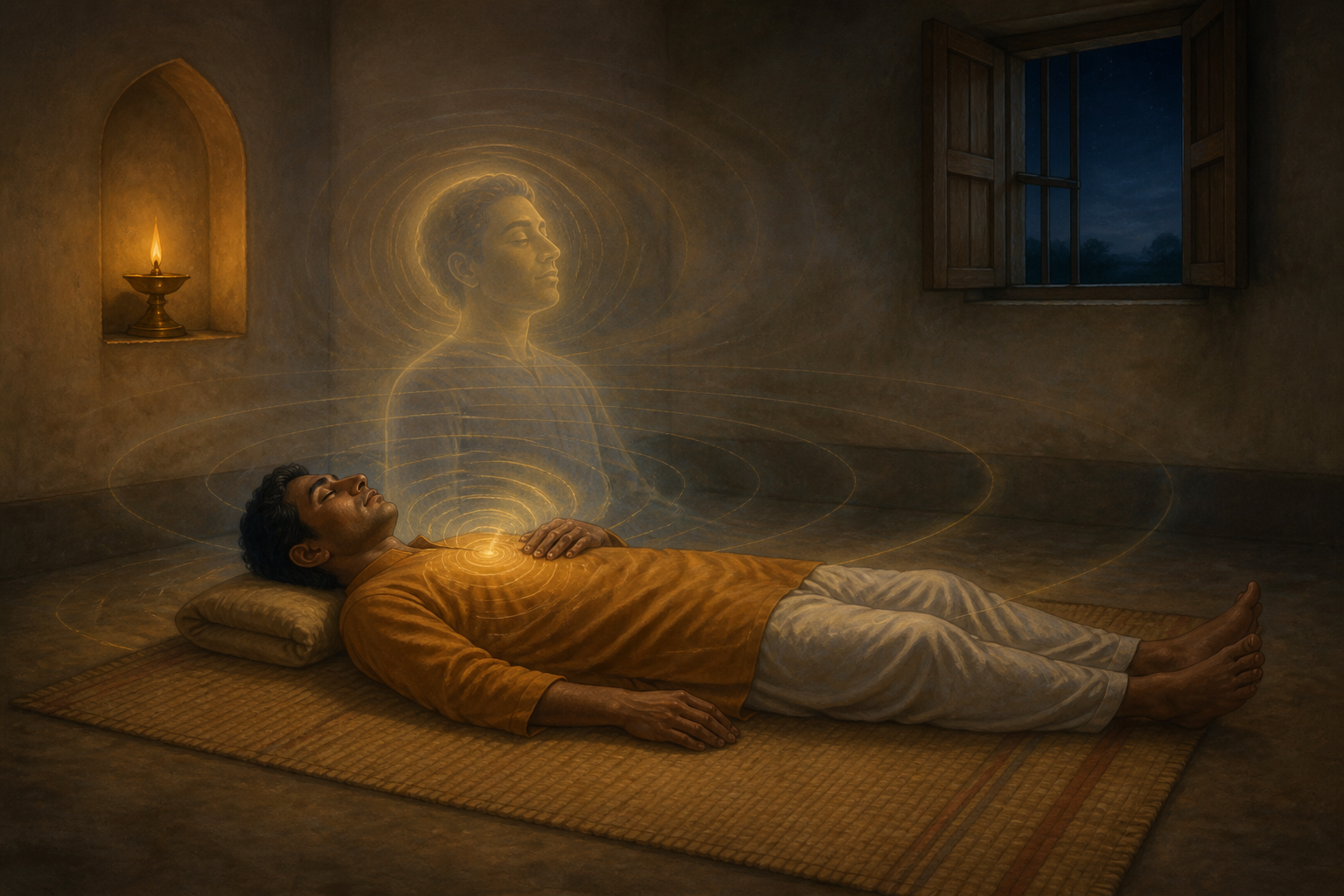
If you have felt yourself floating, looking down at your body, or becoming aware from a point that seemed outside it, the immediate question is usually simple: what happened to me? The difficulty begins when a vivid experience is made to carry a conclusion it cannot establish on its own.
You do not have to choose between declaring that consciousness literally travelled through space and dismissing the event as meaningless. Hindu traditions offer a more disciplined approach: describe the experience, identify the level of consciousness involved, test your interpretation, and judge the state by what it changes in your life.
Begin with the experience, not the conclusion
Out-of-body experience is first a description of how an event felt. Common features include floating, panoramic awareness, an altered sense of location, or seeing the body from a distance. None of those features, however intense, automatically tells you what produced the event or where consciousness actually was.
Keep three layers separate:
- The experience: what you directly noticed, such as loss of bodily boundaries, a changed viewpoint, imagery, sound, stillness, fear, or unusual clarity.
- The interpretation: the framework you use to understand it, such as subtle-body movement, witness consciousness, a meditative absorption, a dream-related state, or altered self-location.
- The metaphysical claim: what you conclude about reality, such as consciousness existing independently of the physical body.
The first layer may be certain in the modest sense that you know what you experienced. The second remains an interpretation. The third requires more than the force or vividness of one event. A perception can be spiritually important without proving that awareness occupied another location in physical space.
This distinction also prevents a false contest between dharma and science. Neuroscience can investigate brain processes involved in body awareness and self-location. Such findings can help explain the conditions under which an experience arises. They do not, by themselves, settle the Vedantic question of whether consciousness is ultimately reducible to those conditions. The reverse is equally important: a Vedantic teaching about Atman does not make every unusual perception proof of disembodied consciousness.
Three Hindu maps clarify what may have shifted

Hindu thought does not give us one laboratory diagram labelled consciousness. It gives us several contemplative maps, each asking a different question. They become useful when you resist turning them into interchangeable explanations.
| Hindu map | Question it asks | How to use it | Guardrail |
|---|---|---|---|
| Sthula sharira and sukshma sharira | Was awareness identified with the gross physical body, or with subtler functions such as prana, mind, and perception? | Use the distinction to describe why an experience felt less dependent on ordinary bodily boundaries. | Feeling detached from the gross body does not, on its own, establish that a subtle entity travelled through physical space. |
| Pancha Kosha | Which sheath dominated the experience: annamaya, pranamaya, manomaya, vijnanamaya, or anandamaya? | Separate changes in bodily sensation, vital energy, thought and emotion, discernment, and bliss instead of calling all of them transcendence. | The five sheaths are lenses for discrimination, not five objects that can be measured or assumed to leave the body together. |
| Drashta-bhava | What remained aware while bodily sensations, thoughts, and the usual sense of I changed? | Attend to the witnessing stance rather than becoming absorbed in the spectacle of floating, light, distance, or imagery. | Emotional numbness, confusion, or mere detachment is not automatically the clarity of the witness. |
The gross-subtle distinction is often the quickest Hindu explanation of an out-of-body state. Sthula sharira names embodied physical existence. Sukshma sharira provides a vocabulary for subtler functions associated with prana, mind, and perception. Yogic and tantric traditions further speak of nadis, sushumna nadi, and kundalini. These terms belong to a technical practice language; they should not be casually treated as names for physical nerves, anatomical tubes, or neurological measurements.
Pancha Kosha Viveka changes the question from Where did I go? to What changed in my experience? Annamaya concerns the bodily or food-formed sheath. Pranamaya concerns vital functioning. Manomaya concerns the mental and sensory-emotional field. Vijnanamaya concerns discernment and understanding. Anandamaya concerns the sheath of bliss. If bodily location faded while thought continued, that is different from a state in which discursive thought quieted but lucid awareness remained. The model helps you notice the difference.
Drashta-bhava goes deeper. Instead of treating consciousness as another object moving from one place to another, it asks you to recognize that which knows changing objects. Body sensation appears and disappears. Images arise and pass. Even ahankara, the I-making tendency that claims an experience as mine, can be observed. In Vedanta, Atman is not reducible to this changing body-mind complex. Advaita Vedanta sharpens that discrimination, but one exceptional state should not be mistaken for final Self-realization.
Patanjali’s eight limbs provide an order of priorities: yama, niyama, asana, pranayama, pratyahara, dharana, dhyana, and samadhi. As attention becomes collected, the ordinary feeling of being a separate embodied observer may loosen. That loosening can make an out-of-body interpretation understandable, but it need not be imagined as a journey. The important movement may be a shift of identification rather than a displacement in space.
Dharmic kinship should not be confused with doctrinal sameness. Buddhist anatta, Jain teachings about jiva, and Sikh practices of Naam simran and sahaj avastha are not substitute labels for Vedantic Atman. Their shared relevance here is practical: disciplined attention, ethical restraint, compassion, and freedom from limiting identification matter more than collecting extraordinary experiences.
Examine the state through disciplined practice
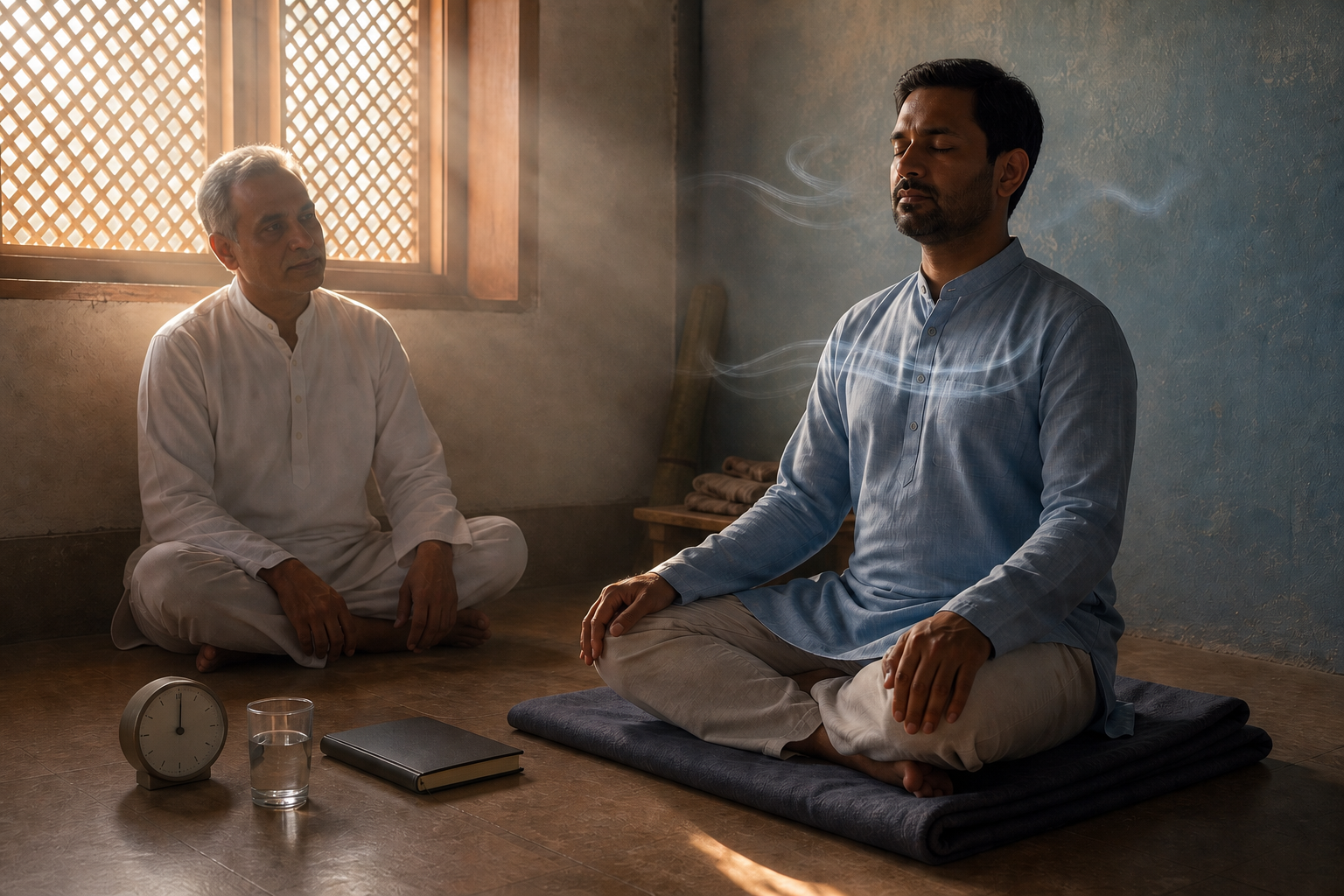
If you deliberately set out to prove that consciousness can leave the body, every unusual sensation will tempt you to confirm the belief you brought into practice. Set a different aim: greater clarity about experience and identification. That intention allows inquiry without making spectacle the goal.
- Start with yama and niyama. Look first at non-harming, honesty, restraint, self-discipline, and the way you are meeting ordinary responsibilities. Ethical disorder makes unusual states harder to interpret because desire, fear, vanity, and avoidance can all shape what you want the event to mean.
- Use a stable practice rather than an escalating experiment. Sit in a sustainable posture. Work with natural breath awareness, a form of pranayama already learned properly, mantra-japa, or a familiar meditation object. Do not improvise aggressive breath retention or attempt to force a dramatic state. Physical distress or disorientation is a reason to stop, not evidence that a breakthrough is near.
- Move from scattered attention toward dharana and dhyana. When attention steadies, notice whether the apparent boundary of the body changes. Do not immediately name the change. Ask whether awareness became clearer, whether imagery became stronger, or whether the sense of being located behind the eyes simply weakened.
- If an unusual state arises, remain observational. Notice the breath, bodily contact points, apparent viewpoint, emotional tone, degree of choice, and whether you can redirect attention. If fear or confusion grows, open your eyes, return to ordinary breathing, feel the support beneath the body, and end the session.
- Write two separate records afterward. Under Observation, record what happened before the state, what you sensed, how the viewpoint changed, and how the state ended. Under Interpretation, record possible explanations. Keeping those columns separate prevents a later theory from rewriting the original memory.
- Track consequences across ordinary life. Note whether the practice leaves you more patient, responsible, clear, and less reactive, or more preoccupied, grandiose, fearful, and withdrawn. Nairantarya abhyasa means continuity of practice; it does not mean continually intensifying techniques in pursuit of another episode.
- Discuss recurring experiences with the right person. A competent guru or experienced teacher can help place a practice-related state within its lineage and method. Ask how the teacher distinguishes concentration, dream imagery, witness consciousness, subtle-body language, and samadhi rather than accepting a dramatic label immediately.
Know when not to spiritualize the experience
Meditation and mantra are not substitutes for medical or psychological evaluation. Seek qualified professional help when episodes are involuntary, frightening, repeatedly disrupt sleep or daily functioning, impair your ability to meet responsibilities, or leave you persistently confused about ordinary reality. If you cannot stay oriented or believe you may harm yourself or someone else, seek urgent local help.
A spiritual teacher and a clinician answer different questions. The teacher may help with the meaning and method of contemplative practice. The clinician assesses health, functioning, and safety. Treating either role as a replacement for the other can leave an important part of the situation unexamined.
Key takeaways for interpreting an out-of-body state
- Treat out-of-body experience as a description of perception before treating it as proof of what consciousness is.
- Use the gross-subtle body distinction, the five koshas, and witness consciousness to ask different questions; do not collapse them into one literal mechanism.
- Follow the yogic order of priorities: ethics, stability, breath, inward attention, concentration, and meditation come before extraordinary claims.
- Keep direct observations separate from spiritual, psychological, and neurological interpretations.
- Measure the value of the state by its effects on clarity, compassion, humility, reactivity, service, and responsibility.
- Stop forceful experimentation and obtain appropriate help when an experience becomes involuntary, distressing, disorienting, or disruptive.
The decisive evidence appears in ordinary life

The strongest practical test comes after the state has ended. Watch what happens during a disagreement, an inconvenient duty, a temptation to display spiritual status, or a moment when nobody will admire your practice. If the experience has deepened discernment, you should gradually become less ruled by reaction and less eager to turn mystery into identity.
An episode that produces fixation, superiority, escapism, or neglect does not acquire spiritual authority because it was vivid. A quieter meditation that makes you more truthful, compassionate, steady, and available for service may represent much sounder progress. The traditional emphasis on ethics, sustained practice, humility, and everyday responsibility protects the seeker from confusing novelty with liberation.
For your next session, do not make leaving the body the assignment. Remain responsibly embodied while observing breath, mantra, sensation, thought, and the one who claims them. Record what you actually notice, carry the resulting clarity into one concrete duty, and let repeated practice reveal whether freedom is growing.
References
