
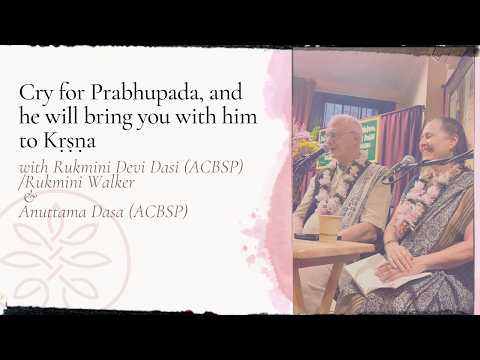

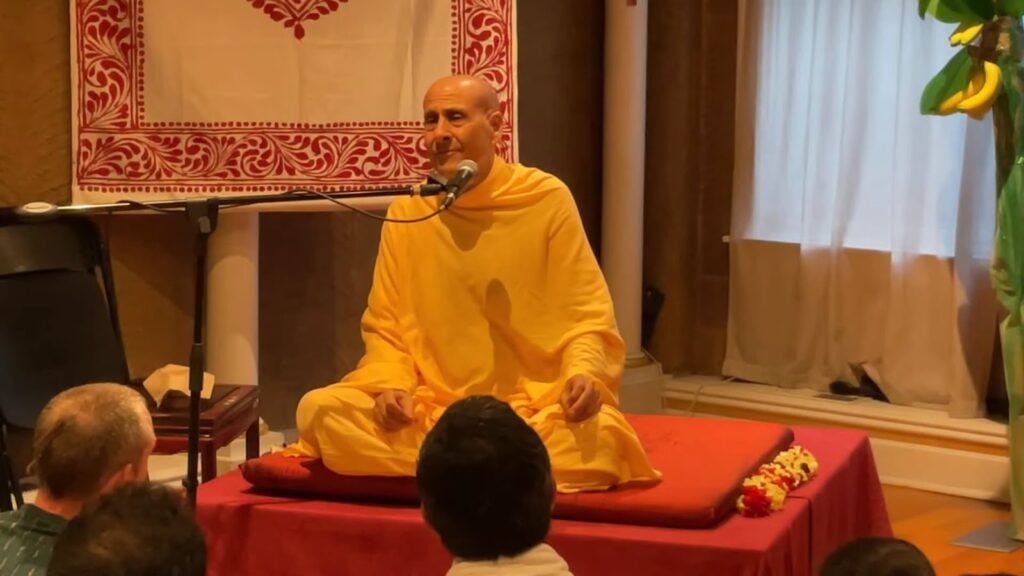
Featured video: Cry for Prabhupada with Rukmini Devi Dasi (ACBSP)/Rukmini Walker. The source description identifies this presentation as a remembrance of Srila Prabhupada delivered by Rukmini Walker (Rukmini Devi Dasi ACBSP) and Anuttama Dasa (ACBSP) at 26 Second Avenue in New York City on Tuesday, July 7, 2026.
The appeal to “cry for Prabhupada” is brief, but its devotional implications are extensive. Within Gaudiya Vaishnavism, such language describes an intensified longing for spiritual guidance, divine grace and sincere service. It does not merely recommend outward emotion, nor does it present sentiment as a substitute for disciplined spiritual practice. It points toward a condition in which the practitioner recognizes personal limitations and turns toward the guru with humility, gratitude and an earnest desire for transformation.
The central message may be summarized in the statement that one who sincerely cries for Srila Prabhupada can be brought by him to Krsna. This is a theological claim grounded in the guru-shishya tradition: the spiritual teacher does not become the final object of worship independently of the Divine, but serves as a transparent guide whose instruction directs the disciple toward Krsna. The guru’s significance therefore rests not only in personal charisma or institutional authority, but in the capacity to transmit teachings, embody devotional conduct and awaken a life of service.
Rukmini Walker’s reflections carry particular weight because they emerge from a lived relationship with Srila Prabhupada. Her published biography identifies her as one of his early disciples and describes a spiritual life shaped by bhakti, teaching, interfaith dialogue and service across several countries. Her testimony consequently belongs to the category of devotional memory: it is personal in origin, theological in interpretation and historically valuable as the recollection of a participant in the formative decades of the Hare Krishna Movement.
Anuttama Dasa’s participation adds another dimension to the presentation. A remembrance shared by two senior disciples is not simply a collection of private impressions. It becomes a form of communal transmission in which memories are preserved, compared and offered to later generations. Such testimony helps listeners understand how Srila Prabhupada’s teachings were encountered in ordinary relationships, practical responsibilities, moments of correction and sustained acts of service—not only through published lectures or formal institutional histories.
The setting at 26 Second Avenue is central to the meaning of the event. The modest Lower East Side storefront is closely associated with the early development of the International Society for Krishna Consciousness in New York. Its historical importance arises from the contrast between its limited physical scale and the international movement that subsequently developed from Srila Prabhupada’s teaching, public kirtan, classes and community-building efforts. Returning to this location transforms a contemporary remembrance into an encounter with the movement’s foundational geography.
Religious history often concentrates on major institutions, celebrated leaders and large public events. The history represented by 26 Second Avenue offers a different lesson. Spiritual communities may begin in unremarkable rooms where a small number of people listen carefully, ask questions, chant together and accept responsibilities. The site demonstrates how a durable tradition can develop through repeated practices and human relationships before it acquires buildings, administrative structures or global visibility.
The word “cry” should be interpreted carefully. In devotional literature, tears may signify grief, repentance, separation, gratitude, compassion or love. Yet physical tears are not an automatic measure of spiritual realization. A person may experience deep devotion without visible emotion, while visible emotion can arise for many psychological and social reasons. The more reliable test is whether remembrance of the guru produces ethical discipline, steadiness, humility, compassion and a stronger commitment to service.
Understood in this way, crying for Prabhupada is an invitation to move beyond passive admiration. It asks whether his teachings have become sufficiently important to shape everyday choices. Longing becomes spiritually meaningful when it generates attentive study, honest self-examination, responsible conduct and care for other living beings. Devotion is not confined to an emotional moment during a lecture; it is tested by what happens after the lecture ends.
This distinction also protects the guru-shishya relationship from personality cults. Reverence for a guru should not eliminate moral reasoning, personal responsibility or careful engagement with scripture. In a mature spiritual relationship, faith and discernment support one another. The teacher provides a path, a body of knowledge and an example, while the disciple is responsible for learning accurately, practicing consistently and avoiding the misuse of spiritual authority.
Srila Prabhupada’s enduring influence is closely connected with his presentation of Krishna consciousness as a complete devotional discipline. Chanting, scriptural study, worship, association, prasadam and seva were not offered as disconnected religious activities. Together they formed an integrated practice intended to redirect attention from self-centered enjoyment toward loving service. The guru’s role was to establish this orientation clearly and show how it could be lived within changing cultural circumstances.
The expression “he will bring you with him to Krsna” also emphasizes mediation rather than possession. Within Gaudiya Vaishnava theology, the genuine spiritual teacher does not claim the disciple for an isolated personal project. The teacher connects the disciple to Krsna, to scripture, to earlier acharyas and to a community of practice. The relationship is therefore both intimate and transgenerational: it joins an individual seeker to a lineage that extends beyond any single personality or historical period.
This perspective helps explain why remembrance occupies such an important place in bhakti. To remember a spiritual teacher is not merely to reconstruct the past. It is to recover the direction of the teacher’s life and ask how that direction can remain active in the present. Anecdotes are valuable when they illuminate principles. Without those principles, memory can become nostalgia; with them, memory becomes a source of guidance.
For later generations who never met Srila Prabhupada personally, this presents both an opportunity and a challenge. They depend upon books, recorded lectures, letters, institutional archives and the recollections of disciples. Each source contributes something different. Published teachings provide textual continuity, recordings preserve voice and emphasis, while personal testimony communicates the relational atmosphere in which instructions were received. Responsible historical understanding benefits from reading these forms of evidence together.
Oral testimony nevertheless requires context. Memory is selective, shaped by later experience and expressed for particular audiences. Recognizing this does not diminish devotional recollections; it permits them to be appreciated with greater precision. Rukmini Walker and Anuttama Dasa speak as disciples whose memories have been interpreted through decades of practice. Their accounts disclose both remembered events and the meanings those events acquired over a lifetime.
That lifetime dimension is especially significant. Initial enthusiasm can begin a spiritual journey, but continuity requires patience. A disciple’s understanding of the guru may deepen through service, responsibility, disappointment, correction and renewed commitment. Senior practitioners can therefore offer more than information about earlier times. They can demonstrate how devotion is reassessed and sustained across different stages of life.
The theme also provides a practical way to understand separation. When a revered teacher is no longer physically present, the relationship does not have to collapse into absence. It may continue through instruction, remembrance and service. In this framework, longing is constructive when it leads the practitioner back to what the teacher asked: chant attentively, study carefully, cooperate with others, cultivate good character and communicate spiritual knowledge with compassion.
Such longing can be especially relatable during periods of uncertainty. Many people seek guidance when familiar plans fail, relationships change or personal confidence weakens. The devotional response is not to deny those experiences. It is to allow vulnerability to expose the need for a more stable spiritual center. Crying for the guru can thus symbolize the surrender of self-sufficiency—the recognition that intellectual knowledge alone does not necessarily produce wisdom, love or disciplined action.
At the same time, spiritual dependence should not be confused with emotional helplessness. A sound guru tradition equips the disciple to become more truthful, responsible and capable of service. Grace does not remove agency; it reorients agency. The disciple still has to hear, reflect, make decisions, repair mistakes and persevere. The prayer for guidance becomes credible through the willingness to act upon the guidance already received.
The presentation can also be situated within the wider landscape of Dharmic traditions. Hindu sampradayas describe several models of guru and acharya; Buddhist traditions preserve relationships with teachers and spiritual friends; Jain communities honor tirthankaras, acharyas and upadhyayas; and Sikh tradition centers the authority of the Gurus and Guru Granth Sahib. These traditions are doctrinally distinct and should not be flattened into a single system. Nevertheless, each recognizes that spiritual knowledge is sustained through disciplined transmission, exemplary lives and communities committed to practice.
This shared concern can strengthen unity without erasing difference. Respectful interreligious engagement begins when each tradition is permitted to speak in its own vocabulary. A Gaudiya Vaishnava testimony about Srila Prabhupada and Krsna can therefore be received on its own terms while also encouraging broader reflection on gratitude, lineage, ethical responsibility and the preservation of sacred knowledge. Unity is most durable when it is built through informed respect rather than forced uniformity.
The guru-shishya tradition also carries educational implications. It assumes that knowledge is not merely a set of propositions transferred from one mind to another. Spiritual knowledge must be heard, interpreted, practiced and embodied. The teacher’s example supplies a living commentary on doctrine, while the disciple’s service tests whether understanding has moved beyond abstraction. This pedagogical model helps explain why personal association remains so highly valued even in traditions with extensive scriptures.
Modern digital media changes the conditions of that transmission. A talk delivered at 26 Second Avenue can now reach listeners far beyond New York, allowing a local gathering to become part of a global archive. This expansion is valuable, but it also encourages rapid and fragmented consumption. A devotional video can easily become another item in an endless feed. The title’s urgent language challenges that habit by asking for attention deep enough to affect consciousness rather than merely occupy a few minutes.
A thoughtful viewing practice can begin with three questions. What does the testimony reveal about Srila Prabhupada’s priorities? Which parts describe a particular historical encounter, and which communicate a general principle of bhakti? Finally, what concrete form could that principle take in daily life? These questions help convert inspiration into study and study into practice.
The phrase “cry for Prabhupada” may then be understood as a call to sincerity. It asks the listener to examine whether spiritual aspiration is merely decorative or genuinely necessary. A sincere cry is not a performance for an audience. It is a refusal to remain satisfied with superficial practice, accompanied by a willingness to receive correction and begin again.
There is also an important ethical dimension to remembrance. Honoring a spiritual predecessor requires more than celebrating achievements. It includes preserving teachings accurately, acknowledging historical complexity, protecting vulnerable members of spiritual communities and resisting the temptation to use sacred authority for personal advantage. Fidelity to a guru is demonstrated through the quality of the culture maintained in that guru’s name.
For this reason, compassion is not secondary to devotion. If remembrance of Srila Prabhupada leads toward Krsna, it should also deepen respect for the spiritual dignity of others. Bhakti redirects the heart away from domination and toward service. Its mature expression can be measured in patience, hospitality, truthfulness and the ability to cooperate across differences without surrendering theological clarity.
The event’s historical setting reinforces this point. The early community at 26 Second Avenue brought together seekers from backgrounds far removed from Srila Prabhupada’s own upbringing in India. Communication across such differences required adaptation as well as fidelity. The subsequent international growth of ISKCON illustrates the possibilities and difficulties of carrying a traditional devotional system into new languages, institutions and social environments.
Rukmini Walker’s presence further highlights the importance of women’s testimony in the preservation of modern bhakti history. Women disciples were participants in worship, artistic work, teaching, administration and community formation. Their memories are necessary for a fuller understanding of how the movement developed. Listening to such testimony is therefore not only an act of reverence; it is part of building a more complete historical record.
Ultimately, the featured presentation invites a movement from memory to responsibility. Srila Prabhupada’s legacy cannot remain confined to anniversaries, sacred locations or affectionate stories. It remains alive when people study the teachings he transmitted, chant with attention, serve without exploitation and create communities in which spiritual inquiry can mature. The emotional force of remembrance finds its proper completion in conduct.
The message is therefore both consoling and demanding. It offers the assurance that sincere longing for spiritual guidance is not ignored, while insisting that longing must mature into practice. To cry for Prabhupada is to seek the path he indicated; to follow that path is to turn toward Krsna through humility, remembrance, disciplined bhakti and compassionate service.
Inspired by this post on Dandavats.







Leave a Reply
You must be logged in to post a comment.