The consecration of the Ram Mandir in Ayodhya has catalyzed a nationwide recalibration of political narratives, and West Bengal stands near the epicenter of this shift. In this evolving context, the competition between the Trinamool Congress (TMC) and the Bharatiya Janata Party (BJP) increasingly turns on the interplay of faith, identity politics, and governance. The emerging dynamic is not merely electoral; it also tests whether Bengal’s civic life can channel cultural symbolism toward inclusive development while safeguarding unity among dharmic traditions.
Within this landscape, Mamata Banerjee’s calibrated signalingoften described as “soft Hindutva”seeks to anchor cultural belonging without abandoning pluralist commitments. Public invocations such as “Jai Mahakal.”, visible engagements with temple visits, and support for festivals like Durga Puja are read as efforts to prevent a one-sided consolidation of the Hindu vote behind the BJP. The strategy appears designed to reassure Hindu constituents while reaffirming a broader coalition that includes Buddhists, Jains, Sikhs, and other communities whose cultural ties and civic aspirations are deeply interwoven in Bengal’s social fabric.
For its part, the BJP has sharpened identity politics by aligning organizational energy with the symbolic potency of the Ram Mandir era. Field operations, digital outreach, and targeted messaging emphasize cultural restitution, national pride, and governance competence. In Bengal, this approach has included outreach to diverse sub-communities and caste groupings, aiming to convert religious sentiment into stable electoral gains across rural and urban constituencies.
At the core of current maneuvering lies a concern about Hindu vote fragmentation versus consolidation. TMC calculations indicate that even modest shifts among Hindu blocs could alter seat arithmetic, while BJP strategists assess whether Ayodhya-linked momentum can translate into durable support beyond episodic mobilization. Both parties thus court community networkssuch as Matua and other influential groupsthrough a mix of cultural signaling, welfare commitments, and constituency services.
Yet electoral behavior in Bengal is rarely reducible to identity markers alone. Voters routinely weigh jobs, inflation, law and order, and social services alongside cultural appeals. As identity narratives intensify, the decisive question becomes whether parties can integrate faith with credible developmentroads, employment, healthcare, educationwithout instrumentalizing religion or eroding Bengal’s plural ethos.
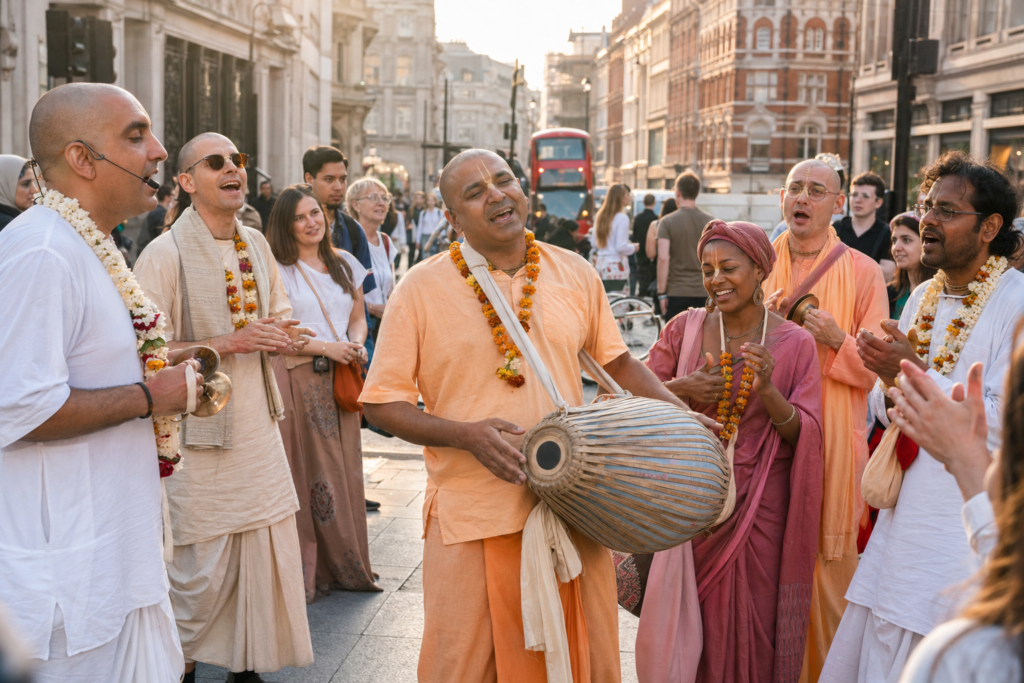
From the vantage point of dharmic unity, the present moment invites a constructive reframing. Cultural reverence across Hindu, Buddhist, Jain, and Sikh traditions can be mobilized toward shared ethicsahimsa, seva, satya, and lokasangraharather than zero-sum competition. Inter-tradition dialogues, joint community service initiatives, and inclusive cultural platforms can strengthen social cohesion while respecting doctrinal diversity. Such measures align with Bengal’s historical capacity for synthesis and its living culture of festivals that bring multiple communities into common civic spaces.
Information dynamics will also shape outcomes. Identity-inflected messages travel fast on social media, and mis/disinformation can exacerbate polarization. Transparent communication, robust fact-checking, and issue-based debatesparticularly on livelihoods, safety, and youth opportunitiesare essential to ensure that democratic contestation remains peaceful, ethical, and oriented toward the public good.
Several indicators merit attention in the months ahead: voter turnout among younger cohorts; shifts in rural versus urban support; the responsiveness of welfare delivery; community perceptions of safety and dignity; and the durability of cross-dharmic civic initiatives. These metrics will reveal whether symbolic politics is translating into institutional trust and everyday well-being.
In sum, the Ram Temple era has undoubtedly reshaped Bengal’s political narrative. TMC’s soft Hindutva signaling and BJP’s identity-forward strategy are converging on the same strategic terrain: the quest to link cultural resonance with governance credibility. The most sustainable path forward, however, lies in affirming dharmic unity and democratic fairnessensuring that cultural pride, constitutional values, and inclusive development reinforce one another in Bengal’s evolving public life.
Inspired by this post on Struggle for Hindu Existence.