The Mundaka Upanishad, a principal text of the Upanishads within Hindu philosophy, offers a profound and disciplined account of creation that links the visible universe to Brahman, the imperishable and ultimate reality. Its teaching does not present a mechanical cosmogony; rather, it uses symbolic imagery to show how the material world arises from, depends on, and ultimately resolves into the eternal. This approach situates creation within a broader spiritual vision that is contemplative, precise, and oriented toward liberation.
A key frame for understanding the theory of creation in the Mundaka Upanishad is the distinction between two kinds of knowledge: apara vidyā (lower knowledge) and para vidyā (higher knowledge). Apara encompasses the Vedas, rituals, and disciplines that refine the mind; para is the direct knowledge of Brahman. The creation teaching falls within apara in method but points unwaveringly to para in aimguiding seekers from cosmological description to the realization of the imperishable source.
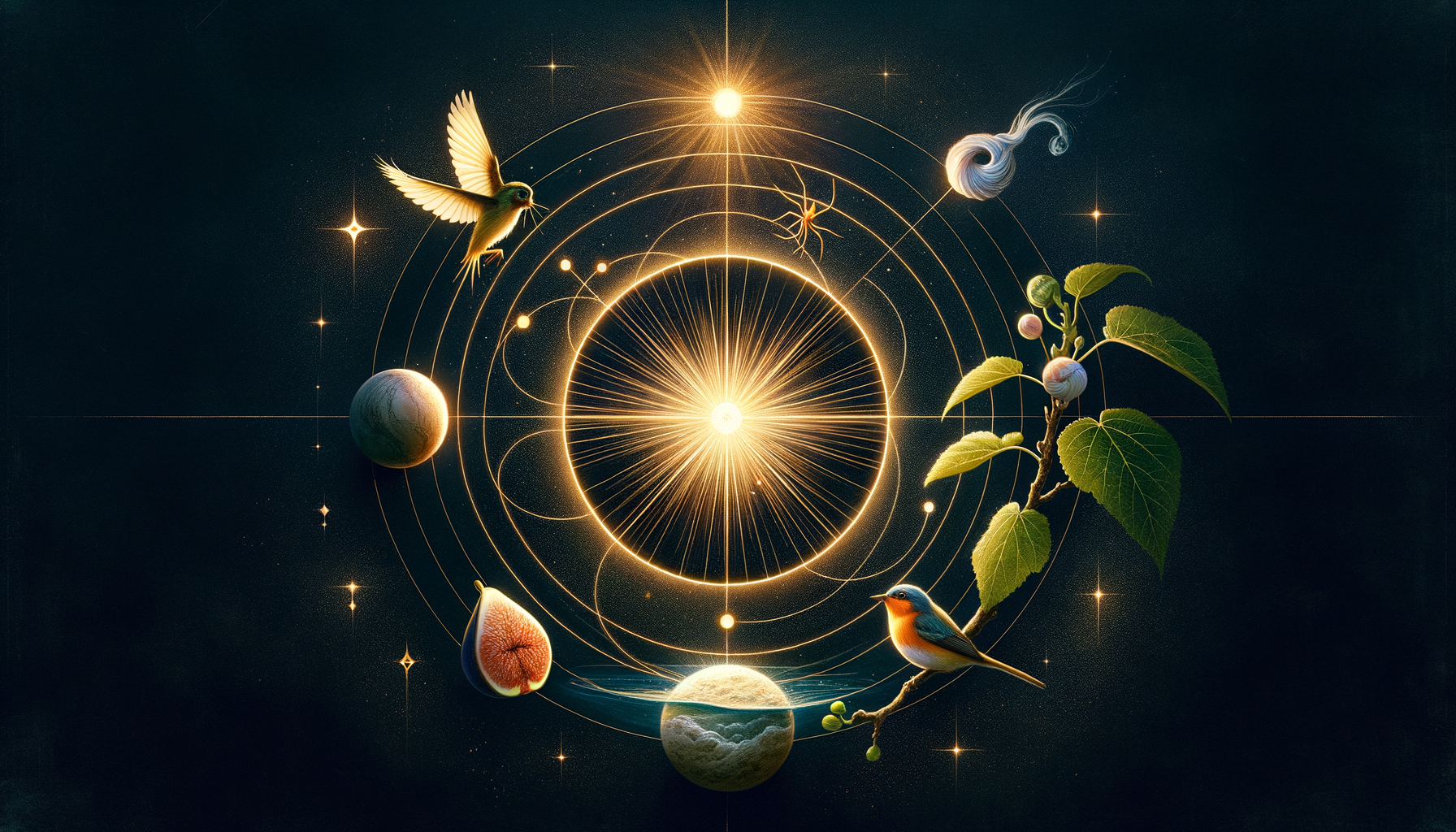
The Upanishad’s signature metaphors convey creation’s dependence and impermanence with clarity and elegance. It compares the universe emerging from the imperishable to a spider casting and withdrawing its web, to plants sprouting from the earth, and to hair growing from a living body. These images communicate that the cosmos issues forth naturally and effortlessly from Brahman, abides for a time, and ultimately returns to its source. The metaphors also preserve Brahman’s transcendence: the source remains untouched by the changing processes that appear within it.
In its cosmological sequence, the Mundaka Upanishad describes an emanation that proceeds from the imperishable reality: from Brahman arise the life-breath (prāṇa), the mind and senses, and the elemental principlesspace, air, fire, water, and earth. This schema is not a literal physics but a contemplative map that situates the diversity of experience within a single, non-derivative ground. It is Hindu cosmology in the service of self-knowledge, pointing beyond multiplicity to the unity of Brahman.
The celebrated parable of two birds on the same tree deepens this vision. One bird eats the sweet and bitter fruits (the individual experiencing self), while the other simply witnesses, serene and resplendent (the Self as Brahman). As the first bird turns its attention toward the second, it discovers freedom from grief and delusion. In the context of creation, this teaching shows how participation in the world need not bind; realization of the witnessing Self transforms the experience of the created order.
These teachings carry practical relevance. Readers may find that observing a spider weaving its web or watching new shoots break through soil evokes the Upanishadic insight: arising and dissolving are ceaseless, and yet the underlying support remains constant. In meditation, this insight translates into steady attentionseeing thoughts, sensations, and emotions as transient appearances sustained by a changeless awareness. Such recognition nurtures humility, ethical clarity, and inner composure.
The Mundaka Upanishad also reorients spiritual priorities. While it respects ritual and learning, it emphasizes that only knowledge of Brahman grants liberation. The purpose of cosmology here is pedagogicalrefining discernment (viveka) and detachment (vairāgya) so that attention can rest in the imperishable. This is a non-dual insight that harmonizes with the contemplative currents across dharmic traditions.
In the spirit of unity among Hinduism, Buddhism, Jainism, and Sikhism, the Upanishadic vision resonates with shared intuitions: the interdependence and conditioned nature of appearances (echoed in Buddhist reflections on arising), the many-sidedness of truth (Jain anekāntavāda), and devotion to the One beyond form and name (Sikh Ik Onkar). Without collapsing doctrinal distinctions, the Mundaka’s symbolic cosmology invites a common contemplative ethiccompassion, non-violence, truthfulness, and inner freedom.
Seen this way, the theory of creation in the Mundaka Upanishad is best read as a doorway rather than a destination. Its metaphors illuminate how the world is pervaded by Brahman while Brahman remains beyond all attributes. By tracing effects back to their cause, the text guides the seeker from multiplicity to unity, from inquiry to insight, and from conceptual understanding to direct realization.
Ultimately, the Upanishad affirms that knowledge of the imperishable transforms one’s relationship to creation itself. The universe appears as an expression of the same reality that shines at the heart of awareness. Recognizing this unitywithin and across all beingsgrounds an ethic of mutual respect and shared responsibility, strengthening harmony among the dharmic traditions and deepening spiritual insight for contemporary life.
Inspired by this post on Hindu Blog.