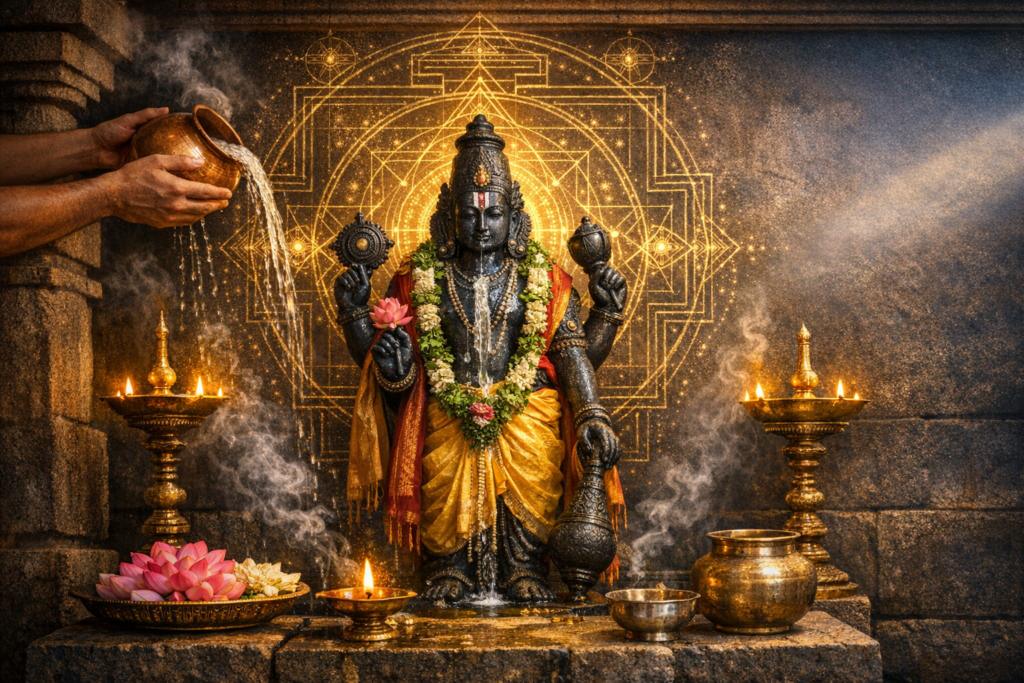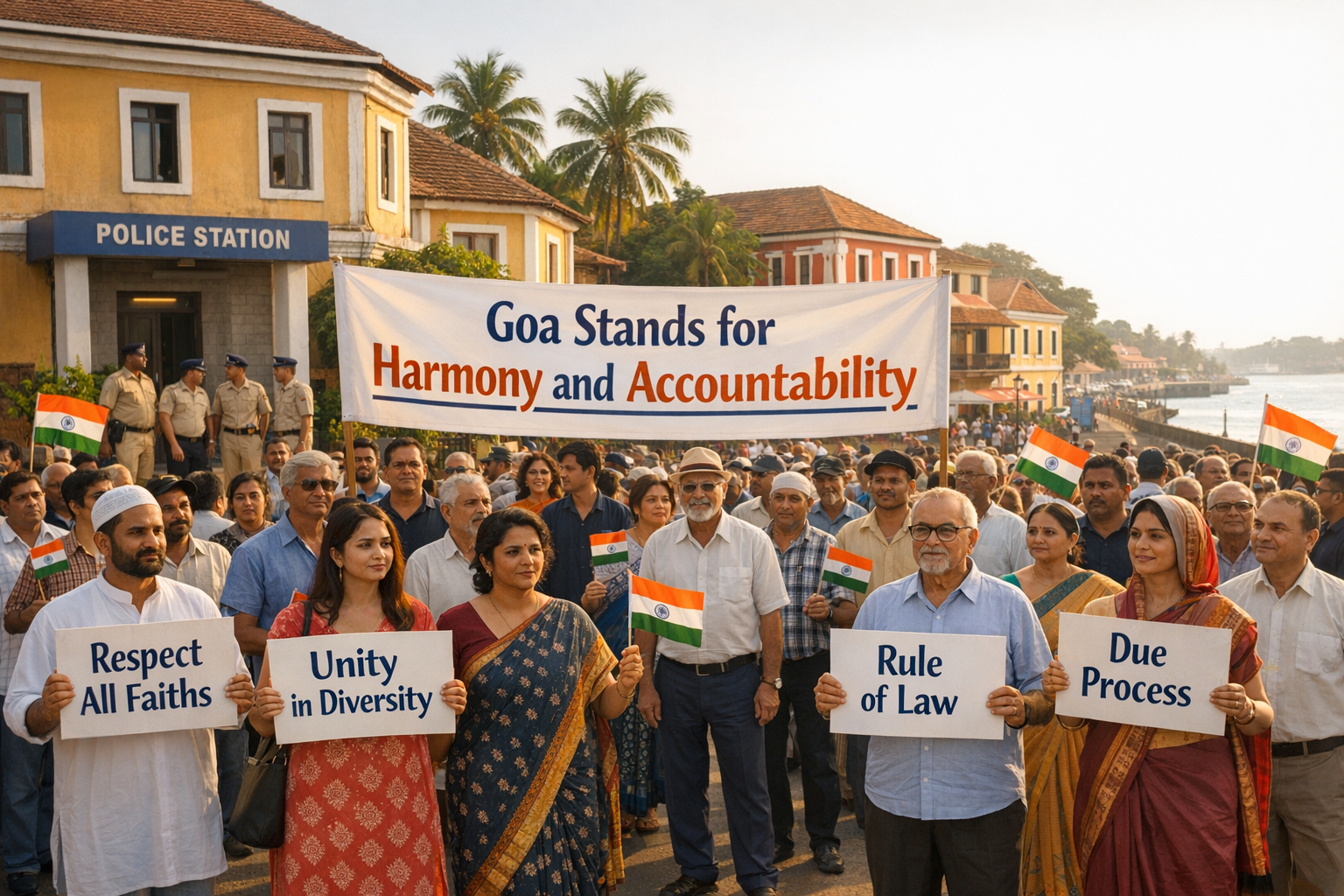
On 3 May 2026, a sizable gathering assembled outside the Panaji Police Headquarters in Goa to protest alleged derogatory remarks concerning Hindu deities. Coordinated primarily by Hindutva-aligned groups, notably Hindu Ekta Manch – Goa, the demonstration sought prompt, lawful action and clear communication from law enforcement about investigative steps taken so far.
The episode illuminates the enduring sensitivity around religious identity in India and the shared dharmic expectation of mutual respect. Within Hindu, Buddhist, Jain, and Sikh traditions—each anchored in ideals such as ahimsa, compassion, and pluralism—demeaning portrayals of sacred figures are widely experienced as an injury to collective dignity. At the same time, the same dharmic ethics counsel restraint, dialogue, and adherence to due process as the legitimate means to seek accountability.
Community testimonies often reveal overlapping emotions—hurt, anxiety about social media virality, and a desire for reassurance that institutions will act fairly. In Goa’s plural public sphere, where festivals such as Shigmo, Ganesh Chaturthi, and other community observances draw participation across neighborhoods, the prospect of contemptuous speech about revered figures unsettles the civic ethos. This social context helps explain why a protest convened quickly and why participants urged both sensitivity and speed from authorities.
A rigorous legal framework governs the balance between the right to protest, freedom of expression, and protection against hate and insult to religion. Article 19(1)(a) of the Constitution guarantees free speech, while Article 19(2) permits reasonable restrictions in the interests of public order, decency, and morality, among others. Article 25 safeguards freedom of conscience and free profession, practice, and propagation of religion subject to public order, morality, and health. These provisions coexist and must be harmonized by careful, fact-based enforcement.
Substantive criminal law sets a high threshold for penal action in such matters. Section 295A of the Indian Penal Code (IPC) criminalizes deliberate and malicious acts intended to outrage religious feelings. Supreme Court jurisprudence, including Ramji Lal Modi v. State of Uttar Pradesh (1957), emphasizes that 295A targets aggravated forms of insult requiring deliberate intent rather than casual or unintentional remarks. Section 153A IPC addresses acts that promote enmity between different groups on grounds of religion and related identities, while Section 505(2) penalizes statements conducing to enmity, hatred, or ill-will. Importantly, Section 66A of the IT Act was struck down in Shreya Singhal v. Union of India (2015), and its use is impermissible; any technology-related inquiry today must instead proceed under extant provisions such as blocking directions under Section 69A IT Act and the Information Technology (Intermediary Guidelines and Digital Media Ethics Code) Rules, 2021.
Procedural due process is equally central. If the alleged speech reaches the threshold of a cognizable offense, an FIR can be registered under Section 154 of the Code of Criminal Procedure (CrPC). Complainants who face refusal can seek recourse under Sections 154(3) or 156(3) CrPC before a Magistrate. Where custodial measures are contemplated, the Arnesh Kumar v. State of Bihar (2014) safeguards—such as the issuance of a Section 41A CrPC notice—aim to prevent unnecessary arrests. Depending on risk and facts, parties may seek anticipatory bail under Section 438 CrPC. Transparency about these steps is crucial to public confidence.
Electronic evidence must be preserved and authenticated with care. The Indian Evidence Act’s Section 65B requires specific certification for admissibility of electronic records. Investigators typically secure original files, server logs, device metadata, and time stamps; they also maintain a chain-of-custody record to protect integrity. When content is alleged to be doctored or decontextualized, forensic audits and platform confirmations help establish provenance, context, and intent—factors that are decisive under Sections 295A, 153A, and 505(2) IPC.
Public order management must preserve rights while preventing escalation. Article 19(1)(b) protects the right to assemble peaceably and without arms, subject to reasonable restrictions under Article 19(3). Police can facilitate safe protests through communication with organizers, route management, and emergency protocols, resorting to prohibitory measures only when proportionate and demonstrably necessary. Clear, timely updates to protesters and residents reduce uncertainty and rumors that often inflame tensions.
Goa’s civic fabric offers a strong base for de-escalation. Centuries of inter-community coexistence have shaped a public culture in which different traditions inhabit shared spaces with ease. That lived pluralism is compatible with firm objection to contemptuous speech and with calm insistence that investigations proceed lawfully. The guiding principle—Sarva Dharma Sambhava—reminds stakeholders that honoring diverse sacred narratives is a shared civic responsibility, not a zero-sum contest.
For complainants and community representatives, meticulous documentation aids lawful resolution. Capturing original posts, URLs, and time stamps, and avoiding further circulation of the offending content prevents additional harm and supports evidence preservation. Submitting a concise written complaint that identifies the elements of intent and public impact helps investigators map the appropriate statutory provisions and set a realistic timeline for updates.
For law enforcement, consistent, public-facing communication preserves trust during sensitive inquiries. Notifying complainants about FIR status, applicable sections, and next procedural steps helps align expectations. If evidence is insufficient to sustain an offense, timely closure reports and reasoned explanations—grounded in the legal thresholds for 295A, 153A, and 505(2)—can prevent the perception of inaction while reinforcing the rule of law.
For digital platforms and intermediaries, robust grievance redressal under the IT Rules, 2021, is paramount. Expedited takedowns for content that prima facie violates platform policies, in tandem with lawfully issued government orders under Section 69A IT Act, can limit harm while investigations proceed. Platform-provided preservation notices ensure that logs and copies remain available to authorities, independent of public takedown visibility.
For civil society and dharmic institutions, structured dialogue can convert moments of grief into durable guardrails for coexistence. Interfaith and intrafaith roundtables that reiterate shared values—non-violence, dignity of the sacred, and the imperative of truthful speech—create norms that travel faster than rumor. When appropriate and lawful, restorative gestures such as public clarifications or apologies have proven to de-escalate community anxieties without displacing accountability.
For educators, media professionals, and opinion leaders, precision in language matters. Differentiating satire from malice, criticism from vilification, and offense from intentional incitement reflects the contours of Indian jurisprudence. Avoiding amplification of the alleged content, and highlighting lawful remedies and the high threshold for penal provisions, reduces the incentive for provocative speech designed to harvest attention.
The Panaji protest points to a wider lesson that transcends a single allegation: resilient pluralism is both principled and procedural. It affirms reverence across dharmic traditions while insisting that grievances be pursued through the Constitution and the criminal process, not through vigilantism or rhetorical escalation. This dual fidelity—to spiritual values and to the rule of law—is the surest pathway to accountability and harmony.
As authorities assess the complaint and any electronic evidence, proportionality, intent, and public impact will remain the key legal filters. Whatever the investigative outcome, a transparent explanation anchored in statutory thresholds and constitutional principles can transform a moment of tension into a reaffirmation of Goa’s inclusive civic compact. That compact—grounded in mutual respect and the pursuit of justice without malice—keeps the social space open for every community to practice, celebrate, and flourish.
Inspired by this post on Struggle for Hindu Existence.