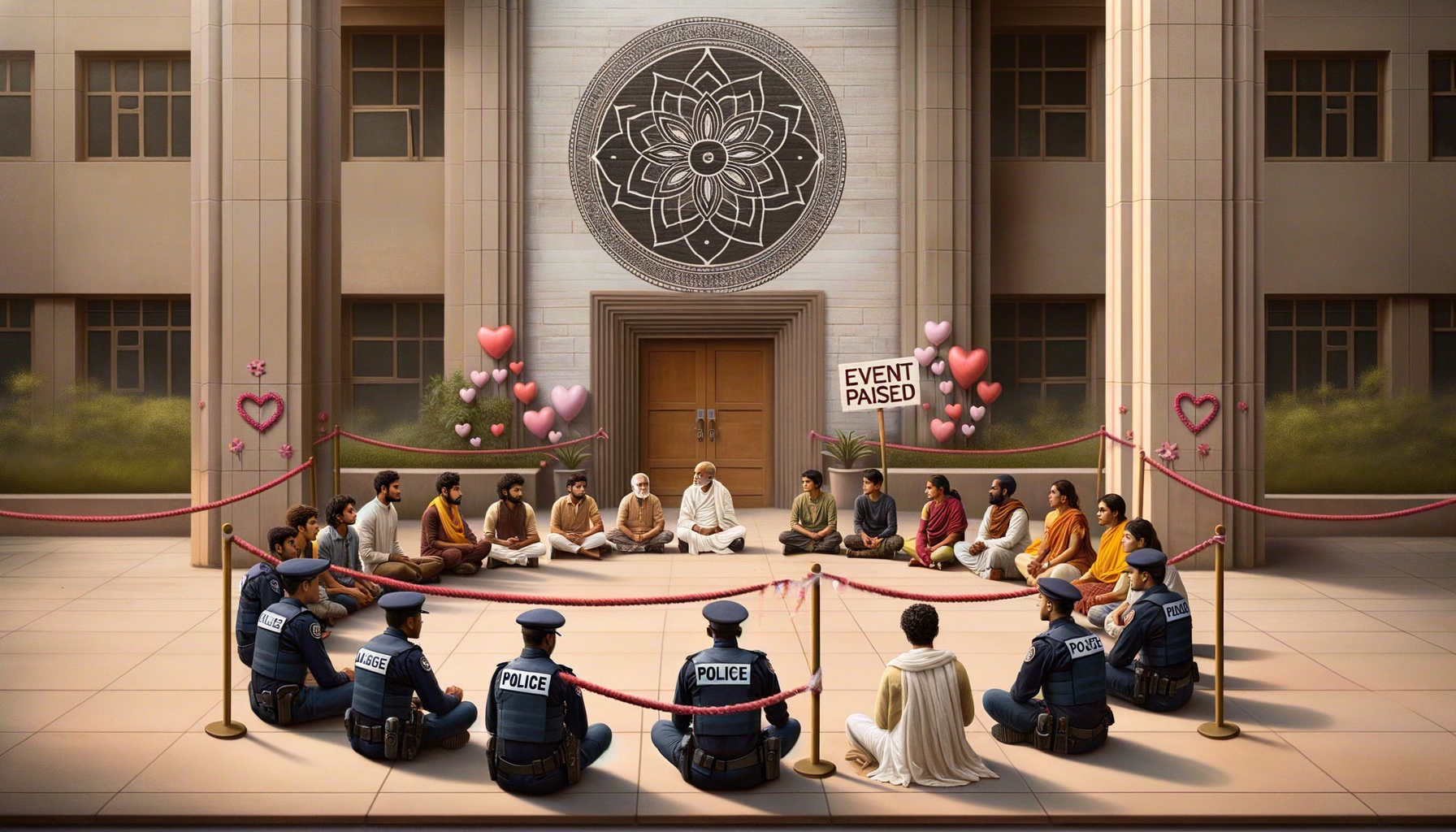
On February 13, 2026, a Valentine’s Week ‘Bake & Sell’ activity at NMIMS Indore was paused after protestors identifying with Hindutva activism entered the campus to oppose the programme. Indore Police intervened and temporarily halted the event to prevent escalation and maintain public order. No major injuries were reported at the time of the intervention, according to local accounts.
The episode reflects a recurring debate across India around Valentine’s Day observances, touching on cultural sensitivity, public expression, and the boundaries of campus autonomy. While some view Valentine’s Day as an individual or student-led celebration of companionship, others perceive it as a commercialized import that can conflict with local mores. These divergent perspectives often meet most visibly in shared civic spaces such as university campuses, where community expectations and student initiatives intersect.
Universities function as formative environments where young adults practice responsibility, creativity, and civic engagement. Student-organized activities like a ‘Bake & Sell’ are typically framed as opportunities for collaboration, skill-building, and community interaction. Transparent permissions, clear communication of objectives, and well-defined codes of conduct can help ensure that such events align with institutional policies while respecting wider community sentiment.
From a law-and-order standpoint, the police decision to pause the programme appears to have been a preventive measure aimed at de-escalation. In situations where opposing groups converge, a calibrated response that prioritizes safety is common practice. Equally important is the protection of lawful expression and peaceful assembly—rights that are best safeguarded through prior consultation, proportionate enforcement, and rapid channels for grievance redressal.
Constructive community engagement offers a viable path forward. Regular dialogue platforms that include students, faculty, administrators, and civil society groups—especially associations representing Hindu, Buddhist, Jain, and Sikh communities—can help clarify expectations around public observances. Conflict-transformation practices, such as facilitated discussion circles and pre-event briefings, reduce misunderstanding and promote mutual respect for cultural and religious sensibilities.
A dharmic lens emphasizes shared values across Hinduism, Buddhism, Jainism, and Sikhism: ahimsa (non-violence), karuṇā (compassion), maitri (friendship), and seva (service). These values encourage persuasion over confrontation, and dialogue over disruption. When applied to campus life, they support a culture where diverse expressions—whether festive, cultural, or educational—coexist without coercion or disrespect.
For many students, campus observances are moments of friendship, learning, and creativity; for many residents, abrupt public displays around newer or commercialized festivals can feel unsettling. Acknowledging both realities enables universities and communities to set thoughtful guidelines that preserve safety, uphold dignity, and protect the plural character of higher education spaces.
The NMIMS Indore incident underscores the need for proactive communication, advance permissions, and inclusive consultation for events that may provoke strong reactions. With balanced protocols, measured policing, and ongoing dialogue rooted in dharmic unity, campuses can reduce flashpoints and model the civility essential to India’s diverse public sphere.
Inspired by this post on Struggle for Hindu Existence.