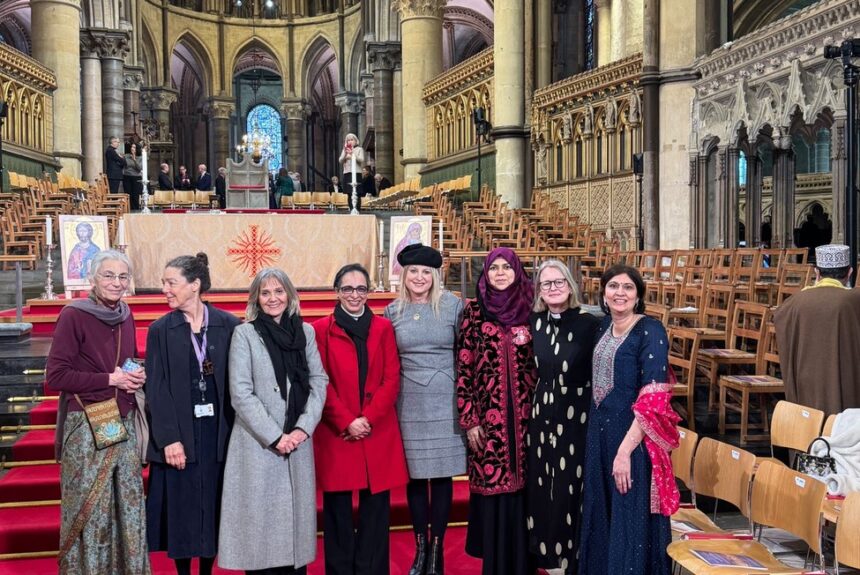
On 25 March 2026, Canterbury Cathedral witnessed a historic moment in the 1,400‑year continuity of the archiepiscopal office: for the first time, a woman was installed on the Chair of St Augustine. Dame Sarah Mullally took her seat before an audience reported at approximately 2,000 distinguished guests, marking a milestone with implications for the Anglican Communion, interfaith dialogue, and public life.
Within Christian ecclesiology, the cathedra (bishop’s chair) is the principal symbol of pastoral and teaching authority. The Chair of St Augustine at Canterbury Cathedral recalls the mission of Augustine, sent in 597 CE, whose work established the See of Canterbury as a foundational locus for English Christianity. An installation on this chair is thus not merely ceremonial; it represents continuity of apostolic teaching and stewardship in a tradition that has shaped religious life, law, and culture across centuries.
The rite of installationalso described as seating or enthronementlocates jurisdiction in the physical symbol of the chair, expressing the office’s doctrinal, pastoral, and metropolitical responsibilities. It is a visible nexus of faith, heritage, and institutional memory. Observers frequently describe such ceremonies as moments in which continuity and change are simultaneously felt: continuity through inherited forms of worship and governance; change through the inclusion of voices and leaders previously absent from the historical record.
The presence of around 2,000 dignitaries and guests indicated the broad resonance of the occasion. Reporting highlighted representation from public life and faith communities, underscoring that milestones in religious leadership are often read as cultural signals that extend well beyond a single denomination. For many present, the atmosphere conveyed a quiet awareness that a threshold had been crossed: tradition had met transformation without relinquishing its core identity.
Situated within the wider Anglican Communionspanning tens of millions of adherents worldwidethe installation is significant for global Christian discourse on women in religious leadership. Since the Church of England opened the episcopate to women in 2014, a pathway has incrementally broadened toward more inclusive governance. Seating a woman on the Chair of St Augustine constitutes a landmark development in that ongoing trajectory, reinforcing the principle that institutional forms can evolve while serving enduring spiritual aims.
From an interfaith perspective, the moment is instructive. It exemplifies how traditions negotiate heritage and reform through legal, liturgical, and pastoral instruments. This negotiationanchored in scripture, commentary, and communal counselhas analogues across many world religions. The significance thus extends into the domain of comparative religion and interreligious dialogue, providing a concrete case study in how stability and adaptation can be held in balance.
Viewed through the lens of dharmic traditions, inclusive spiritual leadership and the honoring of women’s authority have deep civilizational roots. In Hinduism, the recognition of Shakti and the legacy of women saints and scholarsincluding figures such as Akka Mahadeviattest to a longstanding acknowledgment of feminine spiritual power. Contemporary communities continue to witness women serving as gurus, teachers, and scholars, reinforcing the principle that spiritual realization is not delimited by gender.
Buddhist history similarly records the bhikkhuni tradition beginning with Mahapajapati Gotami, with renewed efforts in recent decades to strengthen full ordination lineages and integrate women’s monastic education. These developments contribute to a broader comparative understanding: institutional reform often proceeds through scriptural exegesis, monastic councils, and pragmatic accommodations that preserve vinaya principles while responding to contemporary realities.
In Jainism, women’s ascetic communities have been central to religious practice, teaching, and the transmission of ethical disciplines. Shvetambara orders include large numbers of sadhvis, while Digambara traditions maintain distinctive norms; yet across Jain communities, women’s renunciation and scholarship continue to shape devotional life and moral pedagogy. The durability of these communities highlights how renunciant models adapt across eras while sustaining non-violence, self-restraint, and knowledge-seeking.
Sikh tradition, grounded in the principle of spiritual equality, has long affirmed women’s roles in worship, service, and leadership. Historical exemplars such as Mata Khivi’s stewardship of langar and Mai Bhago’s valor exemplify a framework in which devotion, ethical action, and leadership are open to all. Contemporary Sikh communities continue to expand women’s participation in kirtan, seva, and institutional leadership, reinforcing a scriptural ethos of dignity and inclusion.
Against this comparative backdrop, the Canterbury installation can be read as a practical lesson in Unity in Diversity. By honoring historical forms while embracing women in senior leadership, the event models a pathway that other traditions can appreciate without sacrificing their own doctrinal integrity. It is not a call to sameness, but to respectful coexistencewhat many in South Asian traditions encapsulate as Vasudhaiva Kutumbakam, the recognition that the world is a single family.
For interfaith practitioners and community leaders, the milestone suggests several constructive steps: deepen interreligious dialogue grounded in textual literacy and historical awareness; encourage collaborative community service that foregrounds compassion; and convene educational forums that examine how institutions articulate continuity and change. Such initiatives advance Harmony of faiths and strengthen social cohesion without collapsing the distinctives that give each tradition its internal coherence.
Ultimately, the seating of Dame Sarah Mullally on the Chair of St Augustine is a moment of cultural and spiritual consequence. It speaks to Canterbury Cathedral’s enduring role as a beacon of Christian worship and to the Anglican Communion’s capacity for reflective reform. Read in conversation with Hinduism, Buddhism, Jainism, and Sikhism, it affirms that religious communities can evolve while sustaining fidelity to core principles. In that shared spirit, the milestone offers renewed impetus to interfaith dialogue, women’s leadership, and a deeper commitment to unity grounded in pluralism.
Inspired by this post on Dandavats.