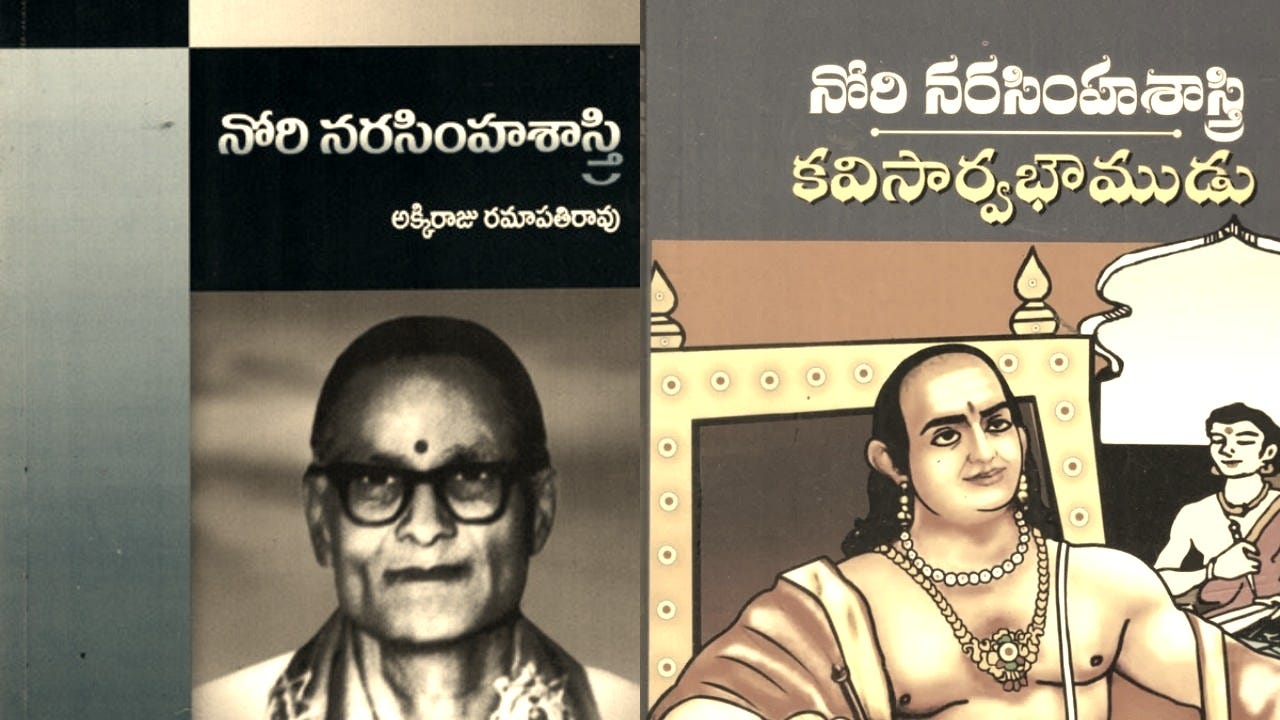
Nori Narasimha Sastry stands as a formative presence in twentieth-century Telugu literature, uniting rigorous historical method with a civilizational ethos anchored in Sanatana Dharma. A practicing lawyer in Repalle in Konaseema (Andhra Pradesh), he earned enduring popular affection as Kavi Samrat because his novels consistently aspire to the tonal density and rhythmic cadence of gadya-kavya, where prose is shaped with the precision and resonance of poetry. The steady circulation of his books across undivided Andhra alongside classical works continues to affirm the longevity of his craft and the cultural trust he commands.
Within Nori’s literary canvas, Srinatha and Bammera Potana emerge as an instructive dyad that reveals how Telugu bhakti poetry and courtly virtuosity can be read together. Potana, an unpretentious Bhakti poet who led a frugal life, composed the Mahabhagavata in sweet, flowing verse that remains etched in public memory; in Andhra, he continues to be the poet most loved by the masses. By juxtaposing Potana with Srinathawhose brilliance and larger-than-life persona still dominate narratives of medieval Telugu poeticsNori reframed their complementary strengths under a single intellectual horizon.
Nori initially envisioned two distinct novels, Kavisarvabhaumudu on Srinatha and Sahajapandityudu on Potana. Recognizing that Srinatha’s flamboyance could overshadow Potana’s inward luminosity, he ultimately fused the projects into Kavidvayamu, a structural decision that allowed both poets to breathe within a balanced narrative frame. In effect, Kavidvayamu functions as a considered continuation of Kavisarvabhaumudu, preserving tonal unity while advancing thematic depth.
The same historical acuity animates Dhurjati, Nori’s novel on the sixteenth-century poet Dhurjati of Sri Krishnadevaraya’s court. Dhurjati’s eventual renunciation of royal patronage, suffused with intense devotion and passion, is situated against the grandeur of the Vijayanagara Empirean era whose political power, aesthetic refinement, and temple-centered cultural economy shaped literary production. Nori’s rendering preserves devotional interiority while delineating institutional contexts with scholarly care.
Beyond these historical novels, Nori authored geeta-nataka (lyrical dramas), padya-nataka (verse dramas), and khandakavya (narrative epic poetry), and translated the Devi Bhagavata into Telugu in a mature Champu style. Champu’s mixed modealternating gadya (prose) and padya (verse)demands an exacting command over meter, cadence, and rhetorical figure; Nori’s execution displays confident prosodic control alongside fidelity to theological and philosophical nuance. Such formal choices do not merely ornament narrative; they carry semantic weight and elevate the aesthetic experience (rasa) for readers attuned to classical poetics.
His linguistic range extended beyond Telugu into Kannada, Sanskrit, Prakrit, Hindi, and English. This polyglot competence strengthened source-triangulation, comparative reference, and the ability to synthesize inscriptions, puranic material, regional chronicles, and modern historiography. It also enabled Nori to translate across idiomsliterary, devotional, juridicalwithout sacrificing precision.
Recognition, including the Central Sahitya Akademi Award, followed naturally from the quality of this oeuvre. Yet the more telling metric is the way these books continue to be read as living textsworks that illuminate cultural continuity while modeling how narrative art can coexist with historical responsibility.
What makes Nori’s achievement remarkable is the historical environment in which he worked. At a time when essential facilities for historical fictionreliable library access, consolidated bibliographies, expert assistance, ease of fieldwork, and archival reachwere scarce, his novels display mature research protocols, evidentiary rigor, and a cultivated familiarity with both textual and material sources. The resulting depictions of cultural, political, and religious life possess a granularity rarely encountered, testifying to a method that prizes truth-seeking over spectacle.
Such comprehensiveness, while not unique, remains uncommon across modern Indian language traditions. Comparisons are often drawn with Rahula Sankrityayan in Hindi, a polymath whose Marxian vantage point shaped interpretations of Indian history and culture. Where Sankrityayan’s narratives occasionally filter data through an ideological frame, Nori’s practice leans toward civilizational continuity within Sanatana Dharma, keeping interpretive attention on institutions, customs, and knowledge-systems as living processes. Each approach offers value; together, they remind readers that methodological transparency is as critical as narrative skill.
In literary architecture, Nori often assigns characters a clearly bounded ethical profilegood, evil, venerable, or exemplarywith fewer gray zones. This technique recalls eighteenth and nineteenth-century Western historical fiction (Walter Scott, Alexandre Dumas, Lew Wallace) and resonates with Bankim Chandra Chatterjee’s patriotic romances. The advantage is moral clarity and swift narrative propulsion; the trade-off is a relative thinning of psychological ambiguity.
Indian aesthetics also values a second path. The highest form of literary art often seeks complex psychological analysis, exploring the inner worlds of characters so that admiration extends beyond isolated episodes or archetypes. In the modern Indian novel, S.L. Bhyrappa exemplifies this vein; the interior dissection of motive, memory, and moral conflict becomes the narrative life-force. Both modes are legitimate, but the aesthetic experience (rasa) afforded by deep psychological inquiry can be especially profound.
Against this benchmark, Kannada historical novelists such as A.N. Krishna Rao (Vijayanagara novels), T.R. Subba Rao (the Chitradurga cycle), and Korati Srinivasa Rao (again Vijayanagara themes) achieved high dramatic tension and memorable set-pieces. Yet, measured by the breadth of civilizational portrayalinstitutions, scholastic lineages, religious life, and the everyday texture of customtheir projects do not consistently maintain the same scope and density that characterize Nori’s reconstructions.
Even with a figure as central as the Vijayanagara Empire, it is reasonable to suggest that A.N. Krishna Rao did not always capture the full range of its grandeur and institutional excellence. T.R. Subba Rao, in contrast, often conveys a more satisfactory cultural surround, though his canvas generally centers on relatively later periods of Indian history, where opportunities to evoke the classical age’s scholastic vitality are inherently fewer.
Part of the divergence lies in philological engagement. To portray the intellectual life of ancient and medieval India with authority, rigorous engagement with major poetic and śāstra traditions is essential. The Kannada historical fiction noted above does not always evidence sustained, text-forward study of such corpora, and this affects how convincingly philosophical, ritual, and scholastic idioms are woven into plot and character.
A parallel comparison refines the picture. Just as Devudu Narasimha Sastri crafted mythological novels such as Mahābrāhmaṇa, Mahākṣatriya, and Mahādarśana, T.R. Subba Rao wrote Beḷaku tanda bālaka (The Boy Who Brought Light) on Nachiketa and 4 × 4 = 1 on Satyakāma. These are ambitious projects; however, the level of primary-source research and śāstric triangulation such works demand appears, at times, to be unevenly realized.
By contrast, S.L. Bhyrappa, though occasionally limited in the density of technical references to ancient poetry and śāstra, remains unmatched in exploring the energetic core of human impulses and emotions. Because the anatomy of the human heart is rendered with such acuity, works set in distant lands and timesParva, Saartha, and Aavaraṇaattain the immediacy of contemporary social novels without sacrificing historical plausibility.
As the Master of poetics Ānandavardhana stated: avyutpattikṛto doṣaḥ śaktyā saṁvriyate kave: kiṁtvaśaktikṛto doṣaḥ sa jhaṭityavabhāsate || Lack of scholarship can be compensated by genius, but lack of genius cannot be compensated by scholarship. This maxim clarifies the comparative landscape: Nori’s scholarly scaffolding and civilizational sensitivity, Devudu’s mytho-poetic reach, and Bhyrappa’s psychological voltage each satisfy different facets of Ānandavardhana’s insight.
Taken together, these writers demonstrate how Indian historical and mythological fiction can integrate truth-seeking research, aesthetic savor, and ethical reflection. Nori Narasimha Sastry’s corpus, in particular, models a research-rich, tradition-conscious narrative method that speaks to a shared dharmic heritage. Its textures of Sanatana Dharma are legible and welcoming across the wider Indic familyHindu, Buddhist, Jaina, and Sikhbecause they elevate values of learning, compassion, renunciation, courage, and unity that all these traditions cherish. The complementarity of methods and sensibilities across languages and regions is not a deficiency but a strength; it enables a plural, polyphonic literary culture where diverse paths converge on the quest for truth.
Inspired by this post on Dharma Dispatch.