Nagapadma Kalam stands at the intersection of sacred art, geometry, music, and ritual in Kerala’s snake temples and household Sarpa Kavu. As a living tradition within Kalamezhuthu, it visualizes the Naga (serpent) upon the padma (lotus), translating theological concepts into a precise, transient floor painting used for puja, healing vows, and communal remembrance of ecological and spiritual continuity.
Across the Indian subcontinent, serpent veneration is both ancient and widespread; in Kerala it is distinguished by a continuous, community-based practice bound to sacred groves, seasonal calendars, and hereditary ritual specialists. While textual references to Naga worship appear in Puranic and Tantric corpora, the grammar of Nagapadma Kalam is principally preserved through oral instruction, temple custom, and the ritual ecosystems of villages rather than a single canonical manual.
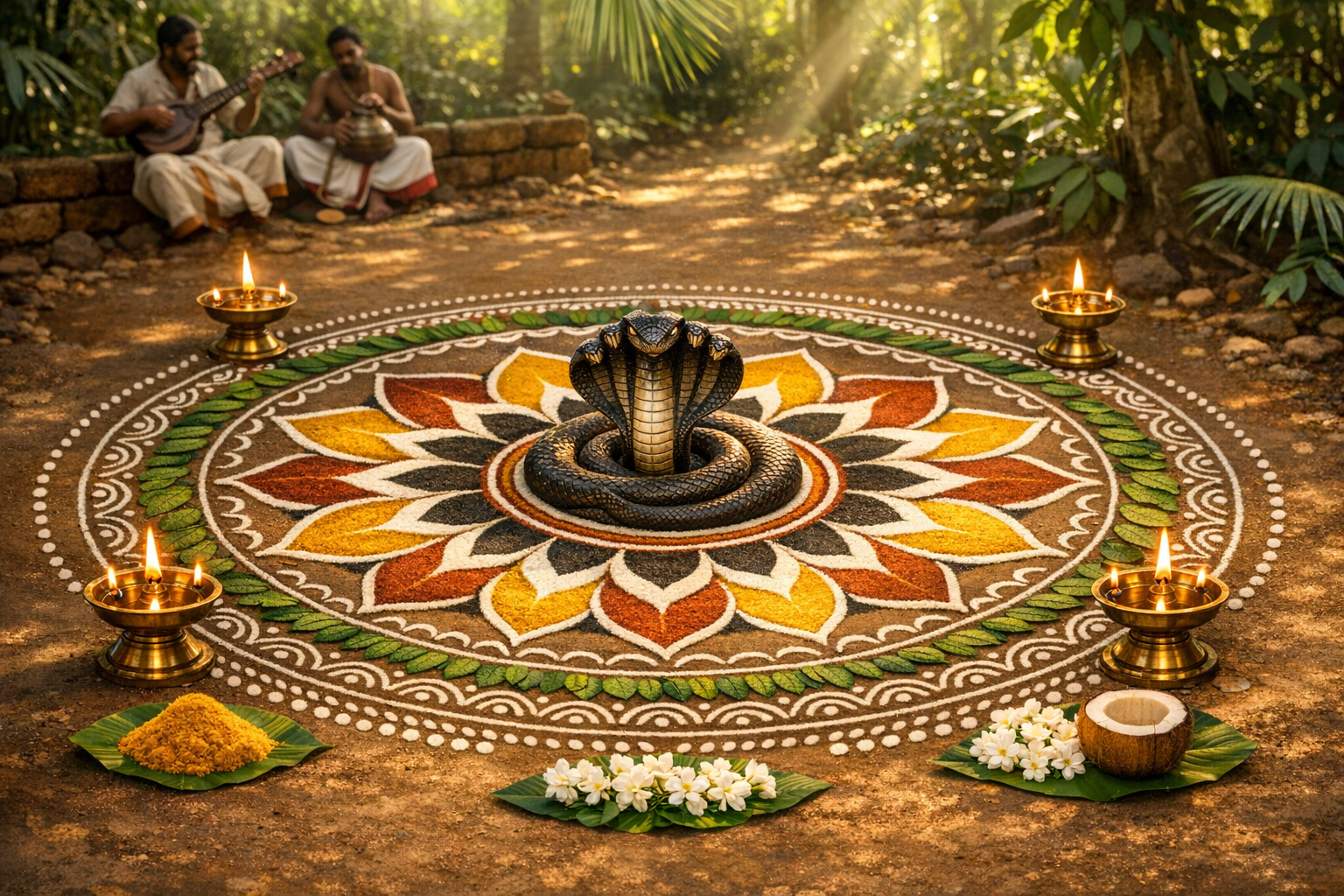
The term Nagapadma Kalam encapsulates the ritual’s core: a lotus geometry (padma) that frames and stabilizes the presence of Naga deities. The kalam is drawn freehand on an earthen or temple floor using colored powders and natural materials. Its creation is an act of invocation; its erasure, an offering and redistribution of auspicious energy to devotees and to the land.
Materials are intentionally elemental. Traditional palettes employ white (powdered raw rice), black (charcoal or burnt paddy husk), yellow (turmeric), red (red earth or chemman; sometimes turmeric combined with alkaline agents for tonal variation), and green (powdered leaf matter). Artisans use fingertips, pinches, and improvised funnels made from coconut leaf to achieve fine line density, shading, and petal gradients. The choice of biodegradable media aligns the practice with Kerala’s customary reverence for living groves and waterways.
Underlying the composition is a padma geometry whose petal countcommonly ashtadala (8), dwadasha (12), or shodasha (16)is selected according to the temple’s tradition, the deity invoked, and the intended vow (vritta). A central bindu anchors the lattice, surrounded by concentric petal rings that establish symmetry and directional flow. The padma guides the placement of the serpent’s coils, hood orientation, and eye-line, balancing dynamism (serpentine motion) with stillness (lotus stability).
Iconographically, Nagapadma Kalam may depict a single-hooded or multi-hooded Naga, intertwined pairs symbolizing complementarities, or processional coils that radiate protectiveness. Motifs such as anklets of dots, wavelets, and leaf garlands articulate breath-like rhythms and boundary sanctity. Although individual styles vary, the kalam adheres to a consistent ritual logic: all lines are purposeful, each color is semantically charged, and the composition is a consecrated space rather than mere ornament.
The ritual sequence follows a carefully staged liturgy. After purifying the ground and establishing the perimeter with rice powder, the padma lattice is laid, the serpent drawn, and lamps (nilavilakku) installed at cardinal points. Offerings may include turmeric, flowers, tender coconut, and regionally specific preparations such as Noorum Palum (a mixture involving milk, turmeric, and lime in certain lineages). The kalam then becomes the axis for mantra recitation, circumambulation, and vow articulation.
Music is integral. Pulluvan Pattuperformed by members of the Pulluvan community using the resonant pulluvaveena and the water-pot instrument pulluvankudamsustains the ritual’s affective field. The lyrics praise serpentine guardianship, fertility, and removal of obstacles, while the cyclic drone structures the participants’ breath and attention, harmonizing the somatic cadence of devotees with the visual cadence of the kalam.
In domestic serpent groves and select temples, the rite may culminate in Sarpam Thullal, wherein women and girls of the household, supported by Pulluvan Pattu, enter a devotional trance. The trance is read not as spectacle but as intensified presencean embodied response to mantra, rhythm, and the charged geometry underfoot. The kalam is ritually erased at the conclusion, and its mingled powders may be distributed as prasada, completing a cycle from earth to image and back to earth.
The ritual calendar is anchored to Ayilyam (Āśleṣā) nakshatra days, with major observances in the Malayalam months of Kanni and Vrischikam in many locales. Kerala’s renowned snake shrinesincluding Mannarasala Sree Nagaraja Temple, Vettikode Nagaraja Temple, and the ritual complex of Pambummekkattu Manamaintain distinctive kalam patterns and procedural nuances, yet all emphasize the same theological triad: protection, fertility, and reciprocity with the land.
Devotees often approach Nagapadma Kalam for parihara connected to perceived Naga dosha in family or horoscope contexts, as well as for blessings related to progeny, health, and agricultural well-being. Regardless of the petition, the rite foregrounds tapas of attentionslow drawing, careful chanting, and respectful waitingso that resolution emerges through disciplined participation rather than transaction.
Kerala’s serpent worship is simultaneously a spiritual and ecological ethic. The Sarpa Kavu functions as a micro-forest, sheltering birds, amphibians, and medicinal flora. By locating Nagapadma Kalam within or near such groves, communities reinforce a duty of care to living habitats, making ritual custodianship inseparable from biodiversity stewardship.
Comparative perspectives across dharmic traditions further enrich the rite’s meaning. Buddhism venerates the protective Nagafamously Mucalinda sheltering the meditating Buddhawhile Jainism associates Parshvanatha with a serpent canopy. Within Hindu practice, the Naga’s guardianship informs narratives from Vaishnava, Shaiva, and Shakta streams. Read together, these motifs affirm a shared civilizational vocabulary of reverence, non-harm, and sanctuaryvalues that Nagapadma Kalam renders tangible.
From a technical standpoint, the kalam’s geometry can be mapped to proportional systems familiar to Kerala’s ritual arts: measured spans, repeated modules, and rotational symmetries that train the hand to obey the eye and the mantra. The art’s pedagogy is apprenticeship-based; mastery is gauged by steadiness of line, cohesion of color fields, and the ability to keep the drawing responsive to liturgical timing and musical tempo.
Sensory design is deliberate. The cool tactility of rice powder, the warm fragrance of turmeric, the low flame of the nilavilakku, and the drone of Pulluvan Pattu cohere to modulate attention. Many visitors describe a felt quietude when the kalam reaches completiona still center achieved not through abstraction but through layered craft and collective devotion.
Responsible visitation practices protect both sanctity and ecology. Observers are expected to avoid stepping across the kalam boundary, to minimize intrusive photography, and to heed guidance from temple functionaries and Pulluvan performers. Such etiquette honors the rite’s status as prayer in progress rather than cultural display.
In contemporary Kerala, Nagapadma Kalam continues to adapt without surrendering its core. Natural pigments coexist with evolving conservation norms; temples document patterns while retaining oral nuance; communities share ritual vocabulary across households and public shrines. Its resilience lies in the fusion of art, mantra, and environmental carea fusion that speaks across Hindu, Buddhist, Jain, and Sikh ethical horizons of compassion and guardianship.
Ultimately, Nagapadma Kalam endures because it is relational: to the deities it invokes, to the grove that shelters the rite, and to the families and musicians who steward its memory. It transforms sacred geometry into lived ethics, reminding participants that protection of life, clarity of mind, and balance with nature are not parallel goals but a single, integrated obligation.
Inspired by this post on Hindu Blog.