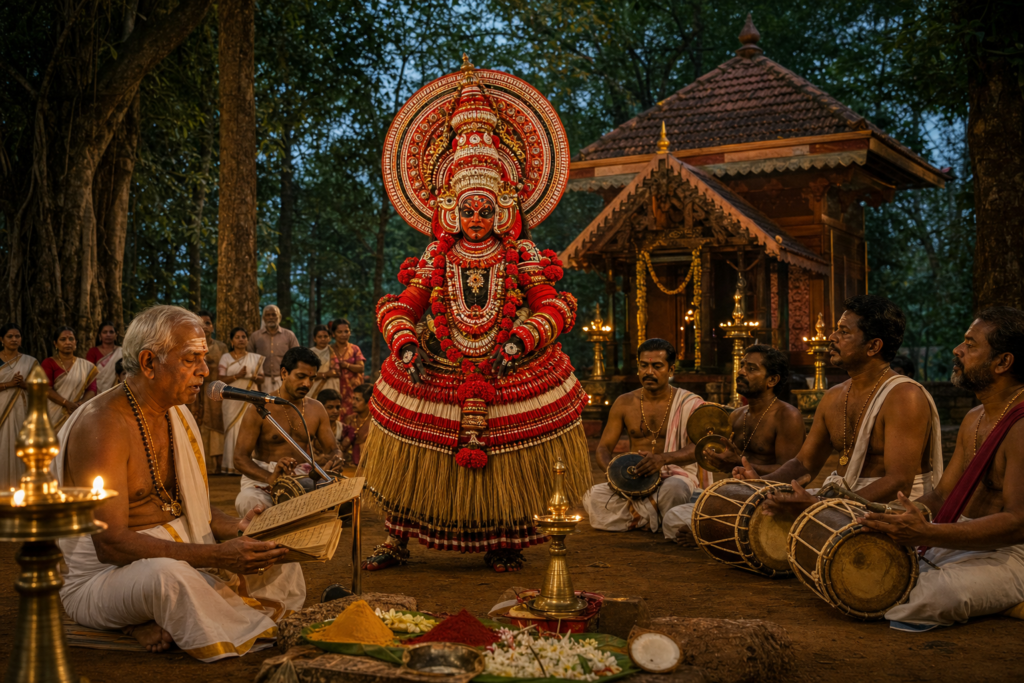
In the early sixteenth century, Mayapur-Navadvipa stood at the confluence of spiritual resurgence and evolving political authority. Within this milieu, Lord Caitanya Mahaprabhu’s public sankirtanacongregational chanting of the divine namesintersected dramatically with the jurisdiction of the local Chief Magistrate, the Chand Kazi, who functioned as the qadi under Sultan Ala-ud-din Husain Shah of Bengal. The episode commonly remembered as the breaking of the mrdanga has become emblematic in Gaudiya Vaishnava memory for how devotional courage, careful dialogue, and principled nonviolence can transform conflict into lasting reconciliation.
Primary narrations of this episode appear in Sri Navadvipa Dhama Mahatmya by Srila Bhaktivinoda Thakura and in the Gaudiya hagiographical corpus, notably Chaitanya Bhagavata and Chaitanya Charitamrita (Adi-lila). These sources situate the Chand Kazi not merely as a political figure but as a pivotal participant in a spiritual drama that culminates in mutual respect and social peace. The narrative thus functions as both sacred history and ethical instruction for handling intercommunal tensions with empathy, clarity, and resolve.
During Navadvipa-Mandala Parikrama, when Lord Nityananda Prabhu led Jiva Gosvami through the sacred environs of Navadvipa, the party entered the Chand Kazi’s village. There, according to Sri Navadvipa Dhama Mahatmya, the site was revealed as spiritually nondifferent from Mathura. This claim draws on a broader Gaudiya hermeneutic that maps Navadvipa’s geography onto the sacred topography of Krishna-lila, thereby framing historical spaces within enduring transcendent meanings.
The theological arc of the episode is intensified by a narrative parallel: Kamsa of Krishna-lila is said to have reappeared as the Chand Kazi in Gaura-lila. In this symbolic register, Sri Gauranga’s addressing the Kazi as “maternal uncle” becomes a deliberate gesture that invokes familial intimacy to dissolve fear and hostility. The result is a moral drama in which adversarial energy is carefully reframed and ultimately redirected toward understanding.
Historically, the Chand Kazi’s authority derived from Bengal Sultanate administration, and local magistrates bore responsibility for public order, including regulating late-night gatherings. Within that administrative context, the public sankirtanaamplified by drums such as the mrdangaoccasioned friction regarding noise, norms, and customary rights. The textual tradition summarizes this moment tersely: under the perceived mandate of Husain Shah, the mrdangas were broken to halt the kirtana processions.
The Gaudiya tradition responds to this rupture with a striking assertion of nonviolent resolve. Lord Caitanya mobilized a vast, peaceful sankirtana procession that advanced to the Kazi’s residence. The confrontation that followed was not an eruption of force but a model of transformative dialogue. In the narrative arc preserved in Chaitanya Charitamrita, the Lord’s presence is accompanied by the Nrsimhadeva motifan image of protective, dharmic power that inspires both awe and ethical self-reflection.
At the core of the exchange stands a mutual clarification of concerns: the Chand Kazi articulates administrative anxieties and religious sensibilities, while Lord Caitanya elucidates the theological and social significance of sankirtana as an expression of bhakti. In several tellings, the Kazi experiences an interior turningdescribed variously as a divinely induced fear giving way to humilityand ultimately takes shelter of Gauranga’s lotus feet. The resolution is explicit: Sri Caitanya grants prema, the love of God, and the Kazi pledges noninterference with kirtana in Navadvipa.
Gaudiya memory holds that the Kazi’s vow was honored by his descendants, symbolizing a durable social compact. The episode thereby becomes a template for Hindu-Muslim relations that privileges ethical persuasion over coercion, and shared civic peace over zero-sum contestation. Far from a mere miracle tale, it functions as a historically grounded, value-rich narrative that integrates devotion, law, and community harmony.
Sri Navadvipa Dhama Mahatmya further frames the Kazi’s village as Mathura within the metaphysics of dhama-tattva. This mapping does not claim geographical identity; rather, it declares a sacral equivalence that allows devotees to “see” Krishna-lila and Gaura-lila as interpenetrating planes of meaning. In that light, the transformation of a magistrate into a well-wisher is not only a political settlement but also a re-enactment of an older cosmic reconciliation in which the forces that obstruct dharma ultimately yield to compassion and wisdom.
Several technical terms shape the discourse here. Kirtana denotes congregational chanting, while sankirtana emphasizes its collective and universalizing force. The mrdanga is the double-headed clay drum that gives kirtana its heartbeat. Nrsimhadeva evokes the avatara whose protective ferocity defends devotees without degenerating into wanton violence. Prema, the goal of bhakti, signifies a refined, selfless love of God that overflows as empathy toward all beings.
Read through the lens of social ethics, the narrative advances several durable principles. First, principled public devotion and lawful civic administration need not be adversaries; each can be harmonized through dialogue and mutual restraint. Second, courage in defense of sacred duties is most potent when allied with nonviolence. Third, reconciliation is not capitulation: it is the moral victory achieved when fear yields to understanding and when dignity is protected for all parties.
In the broader tapestry of South Asian cultural heritage, these insights resonate beyond Gaudiya Vaishnavism. The emphasis on ahimsa, satya, and compassionate public discourse coheres with the ethical cores of Hinduism, Buddhism, Jainism, and Sikhism. Indeed, the very medium of kirtanadevotional singingfinds shared expression across Dharmic traditions and can serve as a bridge of empathy in interfaith dialogue, even as each tradition maintains its distinct theology and practice.
For contemporary readers concerned with Hindu-Muslim relations and interreligious coexistence, the Lord Caitanya–Chand Kazi encounter offers a historically situated case study. It illustrates how spiritual conviction, disciplined public action, and respectful conversation can de-escalate disputes, humanize opponents, and yield sustainable, community-wide solutions. In societies marked by plurality, this remains a powerful model of religious tolerance rooted in lived practice rather than mere proclamation.
Today, Mayapur continues to be a living center of bhakti practice, where annual parikramas recall the sacred geography recorded by Bhaktivinoda Thakura. Pilgrims consistently report a palpable sense of solidarity as diverse communities participate, observe, or engage in dialogue with devotees. It is difficult to remain unmoved by the memory of a magistrate and a saint choosing concord over conflictand by the living promise that devotion, rightly expressed, can strengthen civic peace.
Thus, the transformative encounter between Lord Caitanya and the Chand Kazi is more than a devotional remembrance; it is a civilizational resource. It teaches how the harmonizing power of sankirtana, the intellectual clarity of dharma, and the humility of genuine leadership can together transmute fear into friendship. In a world still seeking credible pathways to unity in diversity, Navadvipa’s luminous precedent remains both timely and instructive.
Inspired by this post on Dandavats.