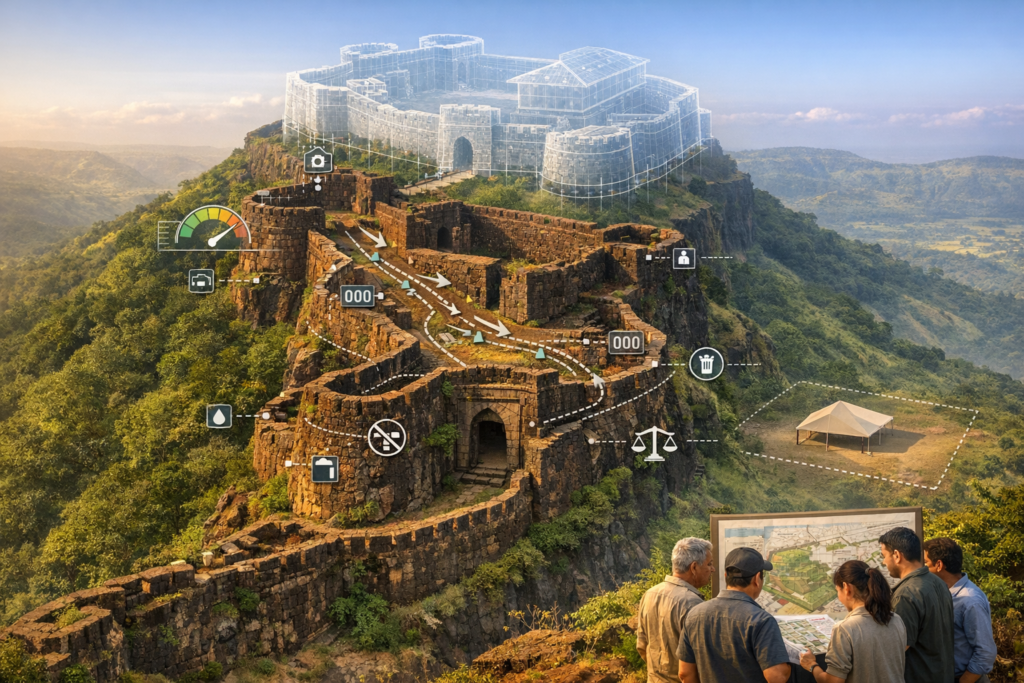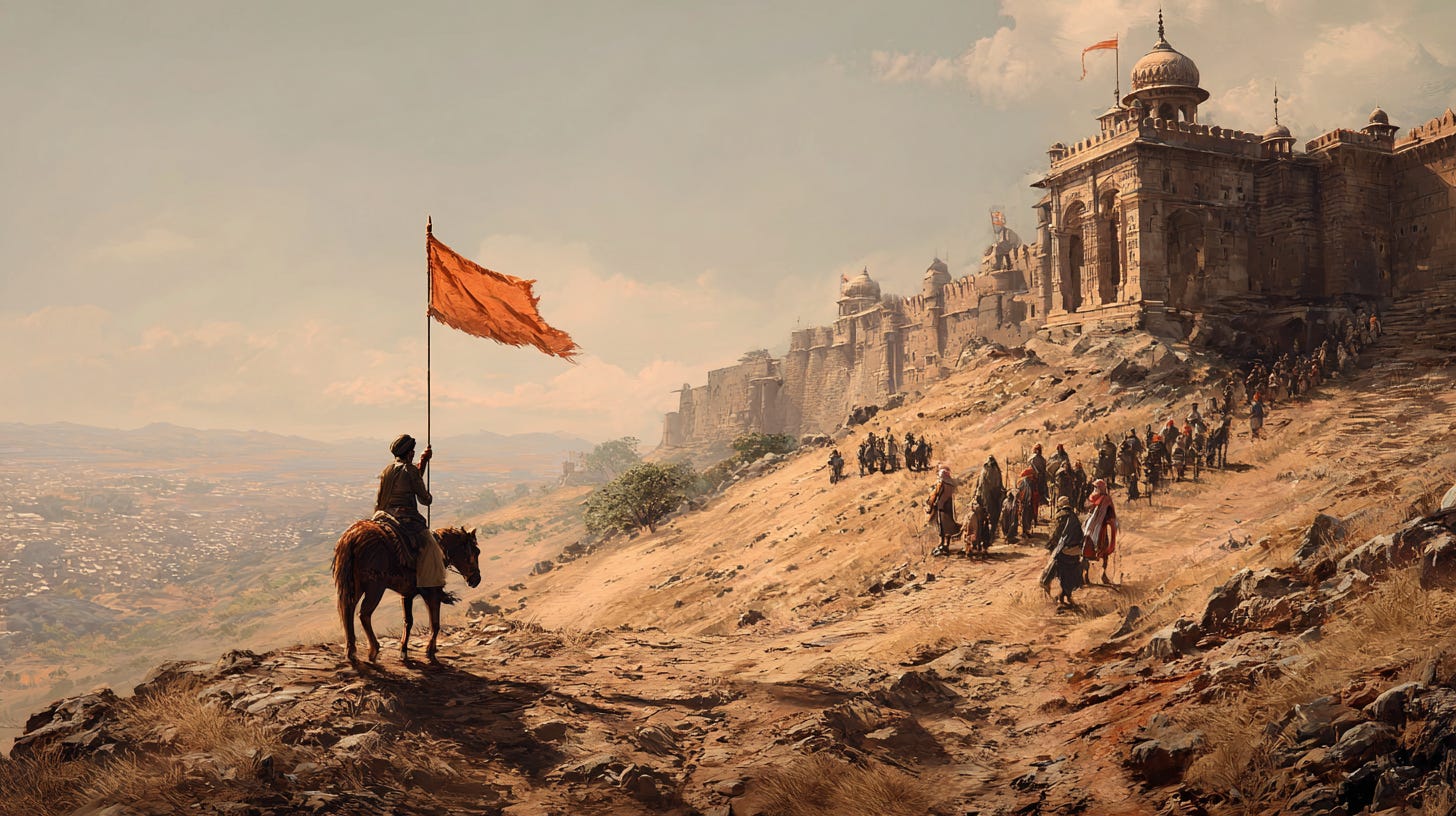
As the first quarter of the seventeenth century closed, Maharashtra witnessed the rise of Chhatrapati Shivaji, whose decisive capture of Torna fort announced a turning point in Indian history. That act was more than a military achievement; it signaled a civilizational resurgence grounded in kshatra, statecraft, and the ethical imperatives of dharma.
The ensuing momentum—memorialized in accounts of Shivaji’s grand procession in Bijapur—drew strength from a broad coalition. The Marathas found reliable partners in the Rajputs of Rajasthan, the Bundelas of the Vindhya region, and the Sikhs of Punjab, illustrating how shared dharmic values could align communities across regions and lineages.
Within a century of Shivaji’s emergence, the dominant imperial structures confronting this resurgence had grown fragile from within. The deeper lesson is not a sectarian one; it is that cohesive institutions—rooted in cultural memory, social organization, and moral purpose—can outlast externally imposed frameworks when guided by resilient civilizational norms.
The conclusion that premodern India lacked a stream of collective identity is untenable in the face of evidence. Reverence for Kautilya (author of the Arthasastra) and Emperor Chandragupta Maurya—who organized polity and defense at a subcontinental scale—has long animated collective memory within Hindu civilization.
Likewise, Pushyamitra Shunga’s frontier defense, the reputations associated with Shashanka and the Vikramaditya tradition, and the Gupta Empire’s Skandagupta resisting the Huns attest to continuity of purpose. These episodes reflect recurring patterns of institution-building and protective statecraft rather than isolated bursts of valor.
Coalitions formed repeatedly when the situation demanded: Yashodharman’s resistance in the northwest; subsequent political lineages such as the Maukharis, Pushyabhutis, and Palas guarding nodes of power; and later alliances that stabilized frontiers. Across centuries, the idiom of duty to deśa (homeland) and dharma (ethical order) remained legible.
Similar resolve is visible in the Chalukyas, the Pratiharas, and allied houses who checked early Arab incursions; in the armies from across North India that fought in Punjab under the Shahis against Ghazni; and in the Kshatriya confederations that protected Somnath. The rallying under Prithviraj Chauhan, and the enduring debate over Jayachandra’s choices, show how collaboration and dissent shaped outcomes in equal measure.
In the south, the Vijayanagara Empire exemplified civilizational renewal. Guided intellectually by Madhava Vidyaranya and Vedacharya Sayana, Harihara and Bukka aligned statecraft with the safeguarding of temples, scholarship, and economic life—an integrated model in which polity served dharmic society in plural, inclusive ways.
Cultural memory continues to honor figures such as Maharana Pratap for steadfast resistance, while discussions around Raja Man Singh highlight the complexities of accommodation and alliance. The guru–śiṣya bond between Samartha Ramdas and Shivaji is best understood as a synthesis of inner discipline with protective responsibility: spiritual clarity guiding the ethical use of power in defense of society.
Across these landscapes, dharmic unity included parallel contributions from Jain communities, monastic and mercantile networks that sustained learning and urban life, and the Sikh tradition—culminating in the Khalsa under Guru Gobind Singh—which fused spiritual sovereignty with civic courage. Such interconnected threads ground a civilizational fabric shared by Hinduism, Buddhism, Jainism, and Sikhism.
That the Hindu civilizational matrix remains vibrantly alive—after weathering invasions, imperial extractions, and internal fissures—constitutes a powerful empirical datum. Unlike many ancient polities that assimilated into their conquerors’ cultures, the Indian subcontinent preserved a recognizable core of thought, ritual, law, and aesthetics, adapting forms while conserving fundamentals.
In global perspective, this continuity places India among the few civilizations that still stand upon the same foundational traditions that animated their earliest textual and cultural horizons. The continuity has no discrete beginning or end; it is best described as a living stream that renews itself through reform, memory, and practice.
Interpreting the medieval centuries only as a period defined by external rule misses the more significant arc: cycles of challenge and regeneration within Indian history. A balanced, evidence-based reading recognizes how resistance, accommodation, institution-building, and reform coexisted and ultimately replenished dharmic society.
Historical records also show individuals and communities adopting other faiths for diverse reasons—coercion, patronage, social mobility, or conviction. These complex choices neither erase the centrality of Hindu civilizational memory nor diminish the subcontinent’s status as a shared homeland; rather, they invite nuanced engagement with layered identities and long durée structures that shaped everyday life.
Different labels appear in modern discourse—Hindutva among them—to describe civilizational self-articulation. Historically, the enduring substance has been a dharma-sustaining public order: plural in practice, resilient in spirit, and capable of collective action when life, learning, and liberty required defense.
Polemics that deny indigenous agency or reduce Indian history to a single axis of conflict obscure the verifiable record. A sound historiography—rooted in primary sources, archaeology, epigraphy, and comparative analysis—better captures how unity across dharmic traditions repeatedly restored balance and enabled society to endure and flourish.
Inspired by this post on Dharma Dispatch.