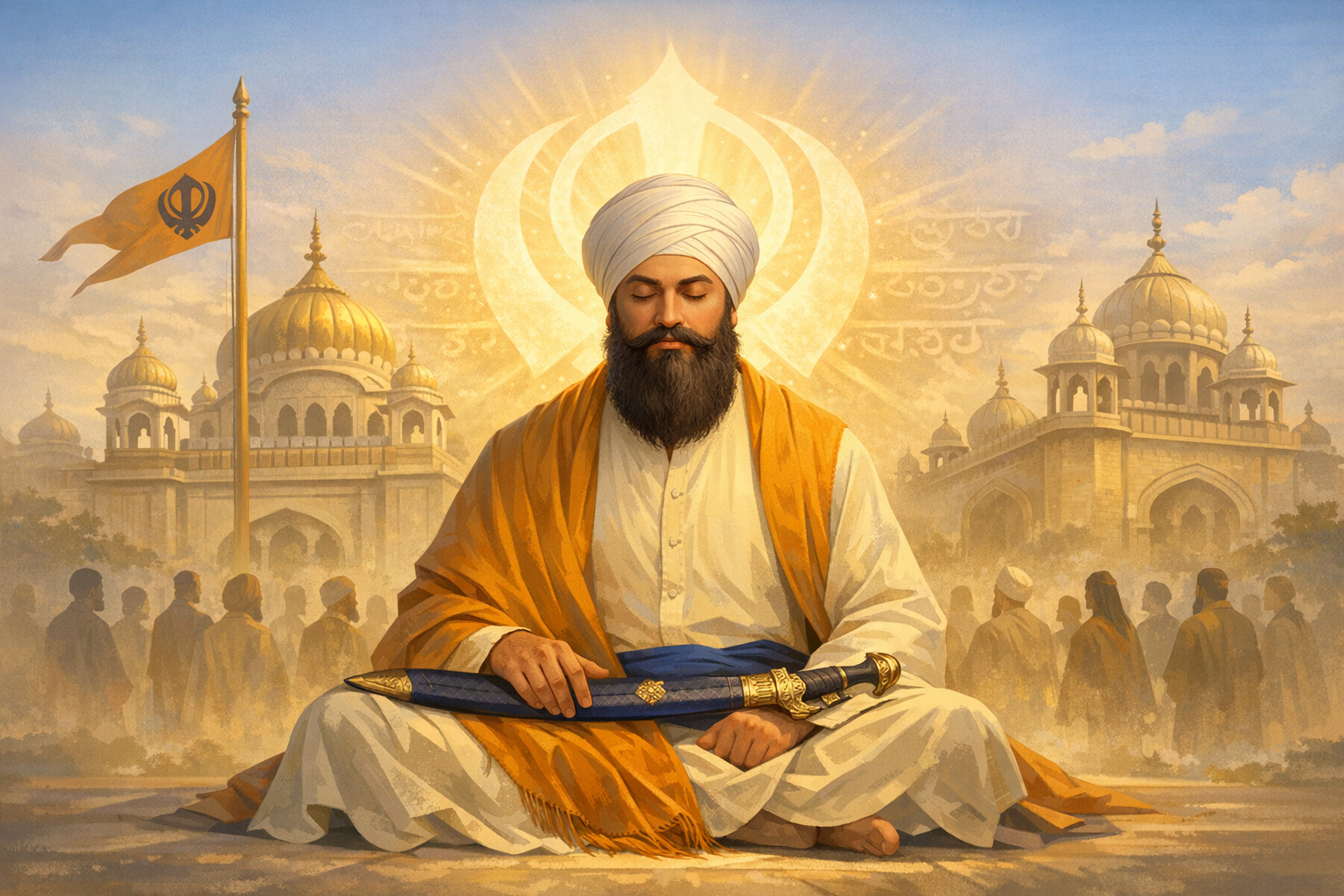
Marking the 350th year since the Shaheedi of Guru Tegh Bahadur Sahib Ji invites careful historical reflection on an event remembered across South Asia and the global Sikh diaspora as a decisive moral stand for freedom of conscience. In late 1675, the ninth Sikh Guru was executed publicly in Delhi under the Mughal state; his refusal to renounce his faith, coupled with his defense of the rights of others to their chosen traditions, transformed a moment of imperial coercion into a civilizational affirmation of dharma, pluralism, and human dignity. The remembrance reaches beyond the Sikh Panth, resonating deeply with the shared ethical core of Hinduism, Buddhism, Jainism, and Sikhism.
Set within the political and religious currents of the seventeenth century, the episode is inseparable from both Mughal centralization under Aurangzeb and the sociopolitical pressures that intensified in certain regions, notably Kashmir. Sikh, Persian, and later colonial-era accounts—despite variations in detail—converge on a consistent moral arc: Guru Tegh Bahadur upheld the liberty of those facing forced conversion and state-sanctioned religious pressure. In Sikh memory, a delegation of Kashmiri Pandits led by Pandit Kirpa Ram sought protection at Anandpur Sahib; the Guru’s response articulated a principle that would shape the subcontinent’s discourse on religious rights thereafter.
Born in 1621 in Amritsar to Guru Hargobind, the young Tyag Mal—later acclaimed as Guru Tegh Bahadur—embodied the Miri-Piri synthesis bequeathed to the Panth: mastery of spiritual discipline alongside preparedness for temporal responsibility. Trained in shastra (ethical-spiritual knowledge) and shastra (martial discipline), he received the honorific “Tegh Bahadur” (“brave of the sword”) after demonstrating valor in conflict. His bani (compositions) in the Guru Granth Sahib—particularly the saloks—stress fearlessness (nirbhau), compassion, inward detachment, and steadfastness: a philosophical basis for ethical courage in public life.
The appeal from Kashmir in 1675 is pivotal in Sikh tradition and Indian memory. Confronted with accounts of coercive conversion campaigns, the Guru is remembered as proposing a test: if the imperial court could compel the Guru to convert, the petitioners would follow; if not, the principle of freedom of conscience must stand reaffirmed. This framing reflects a sophisticated ethical calculus—sacral responsibility anchored in public reason—where the Guru assumes personal risk to universalize a right not contingent on any one community’s power or privilege.
Arrested near Agra and brought to Delhi, Guru Tegh Bahadur faced severe pressure to accept conversion. His steadfast refusal paralleled the unshakeable fidelity of his companions: Bhai Mati Das (sawn alive), Bhai Sati Das (wrapped in cotton and burned), and Bhai Dayal Das (boiled in a cauldron). Their martyrdoms, recorded in Sikh sources and echoed in later accounts, form an indivisible narrative of conscience under duress. On 24 November 1675 (11 Maghar in the Nanakshahi reckoning), the Guru was beheaded in Chandni Chowk—an act intended to terrorize, which instead forged a permanent beacon of resistance to spiritual compulsion.
The immediate aftermath is equally instructive for cultural memory and civic courage. As narrated in Sikh tradition, Bhai Jaita (later Bhai Jiwan Singh) carried the severed head to Anandpur Sahib for cremation, while Lakhi Shah Vanjara retrieved and cremated the body by setting his Delhi home ablaze to avoid detection. Today, Gurdwara Sis Ganj Sahib in Chandni Chowk marks the site of the execution and Gurdwara Rakab Ganj Sahib near Parliament in New Delhi commemorates the cremation of the body—both living institutions of remembrance, seva (service), and sangati (community).
Places of memory thus map an ethics of memory: Anandpur Sahib, where the appeal was received and where the Guru’s head was taken; Delhi, where courage met coercion in open square; and sites across Punjab and beyond where the saloks of the Guru are sung in kirtan, calling communities back to fearlessness without hatred (nirbhau, nirvair). Visitors to these shrines often describe moments of quiet resolve while listening to ardaas as the narrative of Shaheedi is retold—not to fuel grievance, but to recommit to dignity for all.
The interpretive legacy is vast. Guru Gobind Singh—Guru Tegh Bahadur’s son—explicitly invoked this martyrdom when articulating the mission that culminated in the formation of the Khalsa in 1699. In Sikh understanding, his father’s sacrifice established the moral threshold for sovereign selfhood, beyond communal demography or worldly advantage. The Khalsa’s initiation into a disciplined life (rehat) is inseparable from the Guru’s testimony that spiritual autonomy and social responsibility cannot be partitioned.
Methodologically, a balanced historical account engages Sikh sources (such as Guru Kian Sakhian and Bhat Vahi traditions), Persian chronicles of Mughal rule (e.g., compilations in the vein of Maasir-i-Alamgiri), and European traveler narratives (such as Niccolao Manucci), alongside modern scholarship in Punjabi, Hindi, and English. While individual texts vary in emphasis—some foregrounding political causation, others religious policy—scholarly syntheses consistently locate the Shaheedi within a broader struggle over conscience, policy, and public order in early modern India. Historians like Jadunath Sarkar and R. C. Majumdar, despite distinct frameworks, provide critical context on imperial ideology and resistance in the seventeenth century.
The philosophical core of the event aligns with the dharmic ideal that truth (satya) and non-harm (ahimsa) are advanced not only by personal asceticism but also by bearing witness in the public sphere when the vulnerable are threatened. This is a point of convergence across Hinduism, Buddhism, Jainism, and Sikhism: dharma is simultaneously inward discipline and outward duty. The Sikh aspiration of Sarbat da bhala (well-being of all) harmonizes with the civilizational ethos of Vasudhaiva Kutumbakam (the world as one family), affirming an Indian framework for pluralism grounded not in relativism but in principled compassion.
Doctrinally, Guru Tegh Bahadur’s bani warns against the tyranny of fear and the seduction of power. The saloks articulate an ontology of freedom—freedom from egoic compulsion and from unjust coercion—that underwrites a politics of conscience. Read alongside the Bhagavad Gita’s emphasis on swadharma, the Buddhist cultivation of karuna, and the Jain vow of ahimsa, the Guru’s message reveals a shared civilizational grammar: spiritual sovereignty is not an exit from society but its ethical foundation.
The legal-political reverberations of this legacy are visible in modern India’s constitutional promise of religious freedom—freedom of belief, practice, and propagation—ideals nurtured across centuries of Indian debate and struggle. While the Constitution is a twentieth-century artifact, its spirit is illuminated by such early modern testimonies. In public discourse, the Shaheedi functions not as a sectarian emblem but as an Indian endowment to global conversations on rights and responsibilities in multi-faith societies.
Commemoration practices during Shaheedi observances, especially around 24 November (11 Maghar), typically include kirtan, paath (scriptural recitation), ardaas, and langar. Communities often organize interfaith dialogues, blood donation drives, and educational seminars to foreground the universal implications of the Guru’s stand. For families and educators, narrating the lives of Bhai Mati Das, Bhai Sati Das, and Bhai Dayal Das alongside the Guru’s final hours helps younger generations understand that spiritual conviction and civic courage can be lived without rancor.
A concise timeline sharpens understanding: 1621—birth in Amritsar; mid-1630s—martial valor earns the title “Tegh Bahadur”; 1664—recognized as the ninth Sikh Guru after the interlude at Baba Bakala; 1675—appeal from Kashmir, arrest near Agra, martyrdom in Delhi; 1699—Guru Gobind Singh institutes the Khalsa, explicitly linking its ethos to the Shaheedi. By 1783, under Sardar Baghel Singh’s leadership, historic gurdwaras in Delhi, including Sis Ganj Sahib, are established, formalizing the city’s memoryscape.
For many visitors at Gurdwara Sis Ganj Sahib and Gurdwara Rakab Ganj Sahib today, the atmosphere fuses solemnity with resolve. Quiet acts of seva—serving water to passersby, sharing langar, offering a patient ear—become micro-affirmations of the very freedom the Guru defended. The experience is often described less as nostalgia and more as ethical rehearsal: practicing, in small, the large courage once modeled in full.
In scholarly and civic terms alike, three lessons emerge. First, freedom of conscience is indivisible; protecting it for others safeguards it for oneself. Second, institutional memory—embodied in gurdwaras, archives, and family narration—must be cultivated to resist both amnesia and politicized distortion. Third, inter-dharmic solidarity is not merely a historical note but a contemporary necessity: Hindu, Buddhist, Jain, and Sikh communities flourish together when they defend the sacred space of each person’s sincere quest.
Constructive observance during the 350th year can include reading Guru Tegh Bahadur’s saloks in translation and, where possible, in the original; visiting sites of memory in Delhi and Anandpur Sahib; convening interfaith study circles on pluralism in Indian traditions; and encouraging students to compare sources (Sikh, Persian, European) to understand how historical narratives are formed and refined. Such practices turn remembrance into learning and learning into responsible citizenship.
Seen in the full arc of Indian history, the Shaheedi of Guru Tegh Bahadur Sahib Ji stands as one of the most compelling articulations of dharma in public life—courageous without cruelty, rooted without exclusion, and universal without erasing difference. Its message remains clear and contemporary: spiritual freedom and social harmony rise and fall together. To honor this legacy is to guard the rights of all to walk their chosen paths, and to do so with the humility and fearlessness the Guru so luminously exemplified.
Inspired by this post on SikhNet – News.