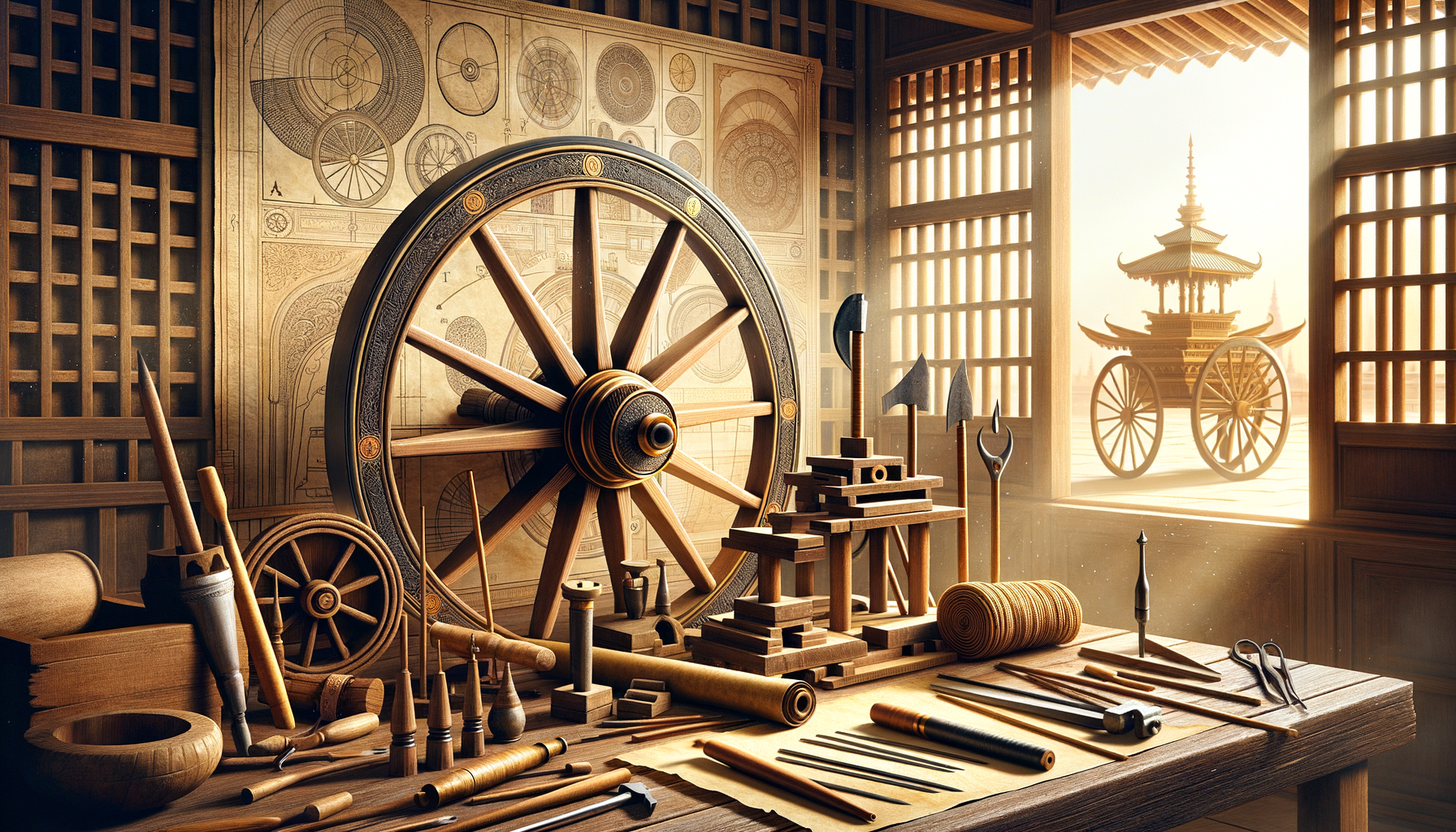
Rathakara, literally “chariot-maker,” designates a master craftsperson whose work stood at the intersection of engineering, ritual, and aesthetics in Ancient India. More than a woodworker, the rathakara oversaw the entire system of body, wheel, axle, and yoke, ensuring structural harmony, safety, and sacred propriety for warfare, ceremony, and civic life. This role illuminates how technology and spirituality were integrated within Hindu society and allied Dharmic traditions.
Classical Sanskrit sources, from Vedic hymns to later Dharmasastra literature, attest to the rathakara as an esteemed artisan whose social description varies across texts and regions. Such variation reflects the dynamism of premodern India rather than a single, uniform hierarchy. Within these sources, the rathakara appears both as a technical expert and as a participant in ritual protocols, demonstrating a craft identity that bridged practical utility and sacred observance.
Technically, the rathakara worked with precise measurements (such as angula and hasta), selected appropriate timbers, balanced wheel geometry, and calibrated axle–yoke alignment to achieve smooth motion and durability. Joinery, shock absorption, and weight distribution were optimized through experience and empirical reasoning. The result was a mobile platform that met exacting standards for speed, stability, and purpose—whether in battle formations, royal processions, or temple festivals.
Economically, the rathakara often belonged to organized guilds (shreni) that coordinated supply chains of timber, metals, leather, and fiber. In keeping with insights found in the Arthasastra regarding artisans and statecraft, chariot-making supported military readiness, trade logistics, and ceremonial prestige. Royal patronage and temple economies sustained these specialists, while guild norms safeguarded quality and training.
Ritually, chariot construction followed consecration practices and calendrical timing. Dimensions, materials, and iconographic details served not only functional aims but also sacred symbolism. This ritualized engineering remains visible in temple ratha traditions, most famously the Jagannath Ratha Yatra at Puri, where hereditary artisans craft monumental chariots to exact specifications each year. Here, the rathakara’s craft embodies both devotion and technical mastery.
Across Dharmic communities, the chariot became a shared cultural and spiritual medium. Hindu temple towns, Buddhist and Jain processional traditions, and later Sikh artisanal values converged on respect for skilled workmanship, ethical labor, and communal service. The rathakara’s legacy, therefore, supports unity among Hinduism, Buddhism, Jainism, and Sikhism by highlighting a common ethos: technology in service of the sacred and society.
Symbolically, the chariot provided a powerful vehicle for philosophical reflection. The Katha Upanishad’s chariot allegory links self, intellect, mind, senses, and body in a disciplined whole. In Buddhist discourse, the well-known chariot simile clarifies questions of identity and composition. Jain ratha processions, too, use the moving car as a symbol of spiritual journey. These convergences show a shared Dharmic language that fosters intertradition dialogue and mutual understanding.
Training typically combined apprenticeship and community transmission. Lineages preserved methods for selecting timber, curing materials, fitting metal bands, and tuning assemblies. While Dharmashastra texts discuss social roles in varying terms, the day-to-day reality of the rathakara’s workshop prioritized competence, ethics, and responsibility—values that resonate with the wider Dharmic commitment to right action and skillful means.
Material culture in this craft also modeled sustainability. Repairable parts, seasonal resource management, and community reuse practices minimized waste. Such choices align with contemporary interest in circular design and heritage conservation, demonstrating how ancient solutions anticipated modern priorities without sacrificing performance.
Continuities endure in Odisha, Tamil Nadu, and other regions where temple chariots remain central to living traditions. Annual reconstructions preserve measurements, joinery techniques, and ritual sequences. In these spaces, the rathakara’s knowledge continues to serve as living heritage—technically sound, liturgically meaningful, and socially unifying.
Reconsidering the rathakara dispels the misconception that chariot-making was a marginal trade. On the contrary, it was pivotal to defense, diplomacy, devotion, and festival culture across Ancient India. The profession’s presence in Vedic culture, its treatment in Dharmasastra discourse, and its ongoing role in Temple Construction underscore a craft identity that integrated science, art, and spirituality.
Ultimately, the rathakara exemplifies a complete synthesis: proven engineering, careful ritual, and shared Dharmic symbolism. Recognizing this legacy invites present-day collaboration across Hindu, Buddhist, Jain, and Sikh communities in conserving heritage skills, teaching ethical craftsmanship, and celebrating unity through a technology that once literally and figuratively moved civilizations.
Inspired by this post on Hindu Blog.