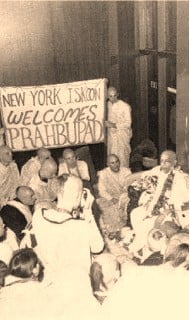
In the late 1960s, devotees from several ISKCON centersBuffalo, Columbus, New Vrindaban, Pittsburgh, Philadelphia, and Washington, D.C.converged on Boston to greet Srila Prabhupada, capturing a formative moment in the history of ISKCON Press and the broader Hare Krishna movement. Their coordinated journey reflects the early organizational energy of a growing bhakti tradition and the communal bonds that undergirded the movement’s expansion.
On the day of arrival, a school bus was rented to transport the assembled devotees from the Boston temple at 38 N. Beacon Street to the airport. The practical decision to travel together in a single bus exemplified a grassroots efficiency that characterized many early ISKCON activities, including the collaborative ethos that would later support editorial, printing, and distribution efforts connected with ISKCON’s publishing work.
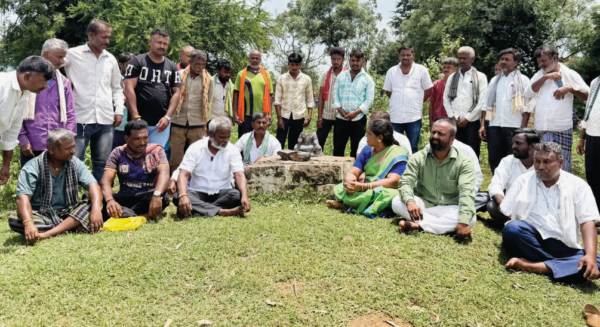
The welcome was documented in a series of photographs that have become valuable historical records. In these images, a banner reads “ISKCON New York Welcomes Prabhupada,” with Swarup Das holding one end and Rohini Kumar the other. Notably, the word “Prabhupada” appears misspelleda small yet telling detail that reveals a movement in transition, as many were still adjusting from the familiar honorific “Swamiji” to “Prabhupada,” signaling deepening reverence and evolving discipleship.
As a microhistory of devotion, the scene conveys the joy, anticipation, and collective purpose that animated early ISKCON gatherings. The careful coordination, shared responsibilities, and celebratory welcome illustrate how the community’s emotional commitment shaped its institutional resilience. These moments of unity helped cultivate an environment in which ideas, texts, and teachings could be disseminated with convictionan environment essential to the narrative often associated with ISKCON Press and its role in preserving and sharing Gaudiya Vaishnava literature.
Viewed through a dharmic lens, the welcome in Boston resonates with the shared values of seva, humility, and spiritual fellowship that are cherished across Hindu, Buddhist, Jain, and Sikh traditions. The emphasis on respectful address, collective action, and heartfelt reception demonstrates how devotional practice can build bridges of understanding, strengthening unity while honoring distinct paths within the broader dharmic family.
In sum, the Boston reception for Srila Prabhupada offers a vivid window into early ISKCON history: geographically expansive yet intimately coordinated, simultaneously earnest and evolving, and firmly rooted in the bhakti tradition. The photographs and remembered details capture not only a joyous welcome but also the ethos of a movement learning to name its teacher, shape its identity, and carry its message forward with clarity and care.
Inspired by this post on Dandavats.