Comparative inquiry into living traditions suggests that resonances between Vedic culture and certain Native American lifeways are not only possible but instructive. A dialogue with Felicity O’rourke, a member of the Anishnaabi community, provides a nuanced point of departure: she recounts a family lineage in which ancestral teachings survived as a way of life rather than as formal, explicitly named spiritual practice. This lived continuity, though understated, opens a space to examine how values, symbols, and ritual logics that are central to Vedic traditions sometimes find functional echoes in Native American customswithout presuming direct historical diffusion or erasing distinct identities.
Methodologically, the analysis proceeds in the spirit of Comparative Religion and Comparative Studies. It emphasizes typological parallels, functional equivalence, and convergent cultural evolution rather than claims of common origin. The approach recognizes emic perspectives (how communities understand themselves) while employing etic tools (analytical categories) to frame recurring patternssacred fire, ritual sound, directional cosmology, rites of passage, and elder-mediated transmissioncommon across many ancient societies.
O’rourke’s testimony highlights a phenomenon familiar to historians of Indigenous communities: under the pressure of boarding school regimes and assimilationist policies, elders often safeguarded teachings by embodying them in everyday conduct while avoiding explicit transmission that might draw punitive scrutiny. In her family, a great-grandmother was a knowledge bearer who withheld specifics from younger generations, resulting in a heritage that persisted implicitly even as documentary traces vanished. The resulting “archival silence” is not a deficit of authenticity; rather, it reflects the historical cost of survival under coercive conditions.
This distinctionreligion as a codified system versus religion as a lifewayis pivotal. Vedic culture is frequently described as a “Hindu way of life,” integrating the sacred into ordinary acts such as food, speech, hospitality, and stewardship. Many Native American traditions likewise embed the sacred in daily reciprocity with land, kin, and community. When O’rourke notes that her family carried teachings as lifestyle more than as labeled spirituality, it resonates with the Vedic intuition that dharma is lived before it is theorized.
Orality is a further bridge. The Vedic world preserved śruti with exacting mnemonic techniques, recitation canons, and guru–śiṣya discipline; many Native American communities similarly entrusted elders and designated knowledge keepers with songs, narratives, and instructions tied to seasonal, communal, or initiatory contexts. Although the formal structures differ, both prioritize fidelity in transmission, ethical eligibility of the recipient, and the conviction that voice, memory, and relationship constitute reliable vessels for truth.
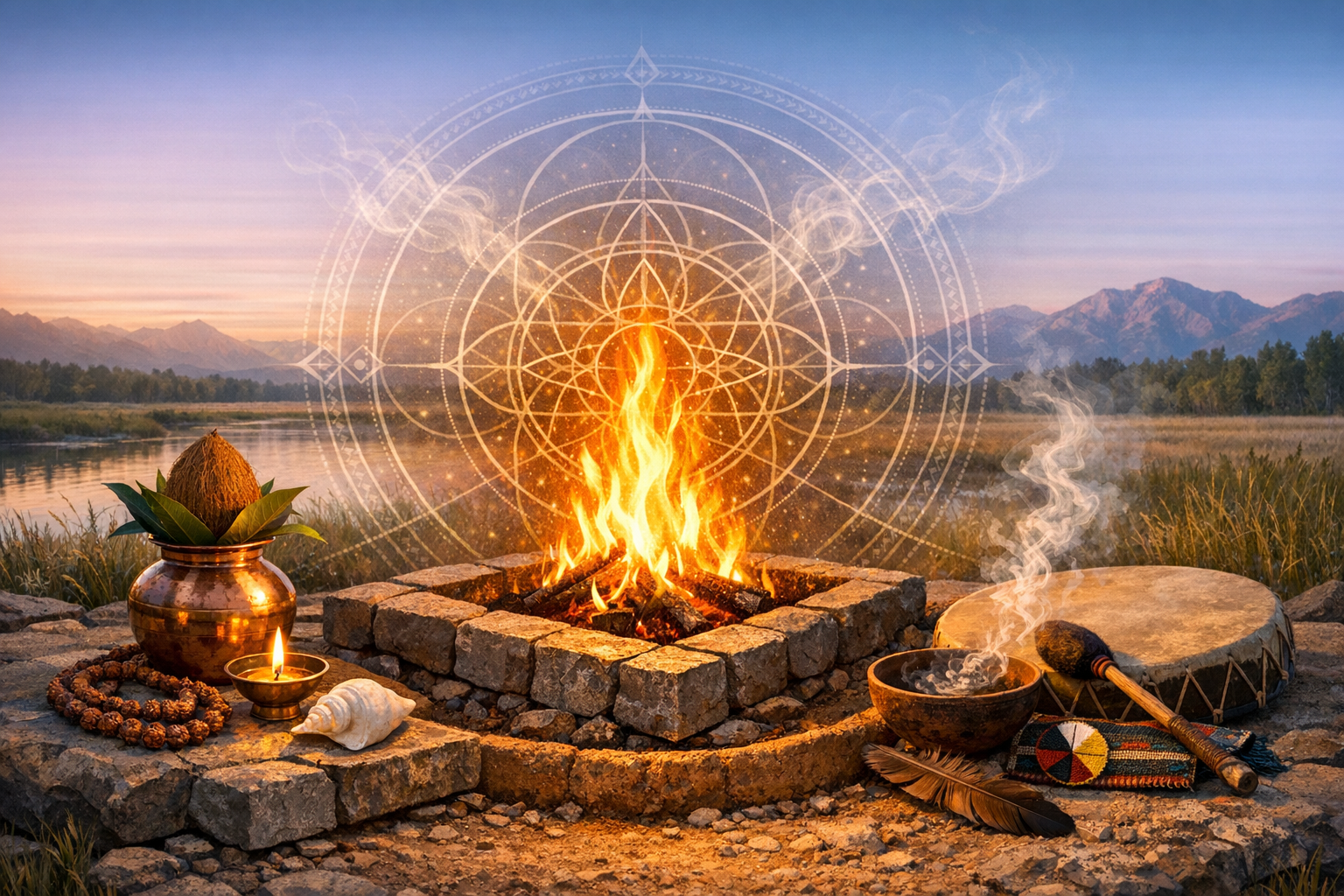
Fire and smoke, central to Vedic yajña and homa, offer a clear functional analogy. Agni, the ritual fire, mediates offerings between human and divine, purifies intention, and sacralizes space. In numerous Native American ceremonies, sacred fire and the controlled use of smoke play purificatory and connective roles, preparing participants and environments for prayer, remembrance, or treaty. While the theologies differ, the ritual grammarpurification, consecration, witnessdisplays striking structural similarity.
Sound and rhythm, too, converge as “technologies of the sacred.” Vedic practice treats mantra, japa, and kīrtan as vehicles of remembrance (smaraṇa), concentration (ekāgratā), and attunement to cosmic order (ṛta). Across Native American traditions, ceremonial song and drum often organize communal participation and shift awareness, with vocables, cadence, and entrainment coordinating breath, heart rate, and attention. The Gaudiya Vaiṣṇava emphasis on congregational kīrtan, for example, shares with many Indigenous songs a communal, embodied logic of devotion and solidarity, even as meanings and lineages remain distinct.
Cosmological mapping provides another meeting point. Vedic culture recognizes guardians of the directions (Dikpālas) and deploys mandala geometry in altar design, temple orientation, and meditation aids. Numerous Native American traditions likewise orient ritual space through the four directions and center, often represented in medicine-wheel configurations. In both, directional symbolism orders experience, aligns activity with a larger cosmos, and encodes ethical or initiatory pathways.
Sacred geography reinforces the parallel. Vedic tīrtha-yātrā binds the devotee to rivers, mountains, and springs viewed as thresholds where the human and divine interface. Many Native communities maintain relationships with specific landscapes, ancestral sites, and waters as living beings, renewing those ties through seasonal observances, offerings, and journeying. The shared intuition is that place is not backdrop but participanta moral subject with claims upon human conduct.
Kinship structures in both spheres have also served to regulate marriage, transmit memory, and organize responsibility. Vedic gotra systematizes exogamy and remembrance of rishis; numerous Native American peoples elaborate clan lineagesoften animal-associatedto index obligation and belonging. The categories and rules are not interchangeable, yet each communities’ design ties identity to ancestry and ethical restraint.
Rites of passage show convergences of function and aim. Vedic saṃskāras rhythm life from pre-birth to funeral rites, conferring refinement (saṃskāra) and social recognition. Many Native American communities maintain naming ceremonies, first-harvest acknowledgments, coming-of-age observances, and practices of fasting or solitude. Across these, vow (vrata), ordeal, instruction, and communal witnessing mark thresholds that bind the person to a shared moral world.
Ethical horizons overlap in significant ways. Vedic thought orients conduct to dharma and ṛta, emphasizing gratitude, stewardship, and non-harm (ahiṃsā) as civilizational ideals. Numerous Native traditions articulate reciprocity with Mother Earth, restraint in taking life, and responsibility toward future generations. These values also animate the wider dharmic family: Buddhism’s compassion (karuṇā), Jainism’s ahiṃsā paramo dharma, and Sikhism’s seva and sarbat da bhala. Such convergences support unity in spiritual diversity without flattening difference.
O’rourke’s account draws attention to the role of elders. In Vedic contexts, the guru mediates knowledge and character formation; in many Native communities, grandmothers, uncles, and designated knowledge keepers hold parallel authority. Assimilationist policies targeted precisely these intergenerational conduits. The lingering effectsshame, strategic silence, lost documentationexplain why a family can be profoundly Native in lifeway yet appear “undocumented” to external institutions.
For researchers and communities alike, the absence of paperwork is not the absence of heritage. Reliance on oral history, community validation, and embodied practice can ethically complement archives. This stance resists the reduction of identity to records produced under colonial regimes and affirms that lived continuitiesfoodways, etiquette, spatial orientations, and ritualized speechcarry evidentiary weight.
Consider also convergent spiritual disciplines. Tapas in Vedic understanding includes fasting, silence, and controlled exposure to austerity for clarity and commitment. Many Native American practices place the seeker in solitude and fasting for guidance. The mechanicsdiscipline, attentional sharpening, and vowdemonstrate humanly intelligible methods for cultivating insight, even as metaphysical narratives differ.
Any comparison of sacred traditions requires guardrails. Parallels do not license assertions of lineage, equivalence, or appropriation. They do, however, illuminate how human communities, when left to cultivate long relationships with land, sound, fire, and kin, recurrently generate ritual systems that aim at gratitude, restraint, and right relationship. A respectful hermeneutic maintains difference while learning from functional resemblance.
Such learning bears practical fruit. Recognizing resonances between Vedic traditions and Native American customs encourages alliances that oppose cultural erasure and support Cultural Heritage preservation. It also aligns with the dharmic affirmation of pluralityIshta as the freedom to approach the sacred in many waysand with Interfaith Dialogue that honors distinct pathways while seeking shared goods. In an era of ecological crisis and social fragmentation, these convergences suggest common ethical ground: reverence for life, truthful speech, service, and humility before the more-than-human world.
O’rourke’s experienceteachings lived quietly amid historical pressureexemplifies resilience. It is difficult to miss the quiet pain in such narratives, yet just as evident is the persistence of meaning. Set alongside Vedic culture’s integration of the sacred into daily action, her testimony clarifies a central insight of Comparative Religion: deep structures of ritual and ethics recur where communities protect memory through relationship, practice, and care. Attending to these echoes honors both traditions and advances unity in spiritual diversity across Hinduism, Buddhism, Jainism, and Sikhism while extending empathy to Indigenous lifeways beyond South Asia.
Inspired by this post on Dandavats.