
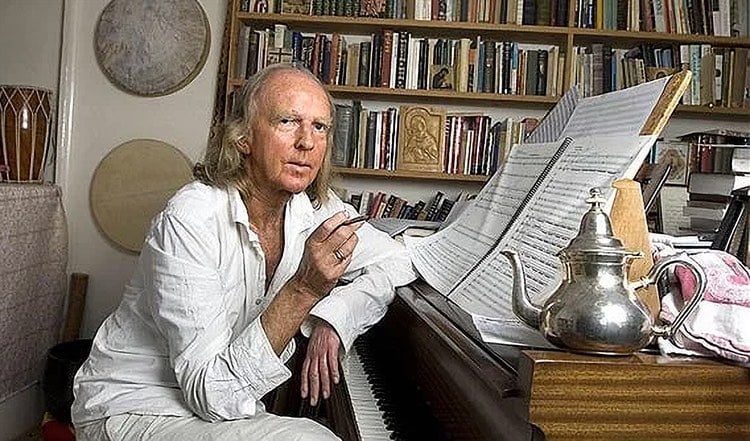
Sir John Tavener’s Krishna stands at a remarkable meeting point between Western classical music, Vaishnava bhakti, Sanskrit sacred language, and the wider search for divine beauty across traditions. The story begins not as a conventional commission or institutional project, but as a devotional and artistic encounter: Ranchor Prime, a disciple of ISKCON founder A. C. Bhaktivedanta Swami Prabhupada, was drawn into the work when the British composer urgently needed help shaping a libretto based on the life of Krishna.
In January 2005, Ian Roberts informed Ranchor Prime that Tavener was working on a major composition about Krishna and needed guidance after the death of his Sanskrit adviser from Manchester. The proposed introduction came through Brother Aiden, an Orthodox monk and mutual friend. That detail is important because Tavener’s musical imagination was never limited to aesthetics alone. His mature works often treated music as a vehicle for prayer, contemplation, symbolic theology, and inward transformation.
Tavener was already known internationally for compositions such as The Protecting Veil, The Lamb, and Song for Athene, the latter reaching a large public audience when it was performed at the funeral of Diana, Princess of Wales. Yet his reputation cannot be understood only through public success. His deeper artistic identity was shaped by spiritual seriousness, ritual pacing, long melodic lines, silence, repetition, and a fascination with sacred traditions that treated sound as an offering rather than mere entertainment.
The composition Krishna, completed in 2005 and later brought to the stage posthumously, belongs to this late spiritual phase. Tavener described the work as a “mystic pantomime,” a phrase that signals its distance from ordinary dramatic opera. Rather than relying on psychological realism, rapid plot movement, or theatrical conflict, the work presents sacred episodes as contemplative tableaux. This structure is especially appropriate for Krishna-lila, where narrative, theology, rasa, and devotion are inseparable.
Ranchor Prime’s role is best understood as a bridge between traditions. He brought knowledge of Krishna bhakti, Sanskrit vocabulary, mantra, and devotional sensibility into a conversation with a composer formed by Western music and Orthodox Christian spirituality. Such collaboration demonstrates how Hindu spiritual traditions can enter global artistic spaces without losing their rootedness. It also shows how sincere engagement across faiths can deepen respect rather than flatten difference.
The technical challenge facing Tavener was substantial. Krishna’s life is not a single linear biography in the modern sense; it is a sacred field of episodes, moods, revelations, and relationships. The child Krishna of Vrindavan, the beloved of Radha, the protector of devotees, the speaker of divine wisdom, and the cosmic form of Bhagavan all require different musical and theological registers. A conventional operatic plot could easily reduce this richness. Tavener’s solution was to build a sequence of scenes that function more like meditative icons than theatrical chapters.
This approach resonates with the bhakti tradition. In Vaishnava practice, remembrance of Krishna is often cultivated through hearing, chanting, singing, visualizing, and meditating upon divine pastimes. Kirtan, japa, temple worship, poetry, painting, and drama all become ways of entering relationship with the divine. Tavener’s Krishna adapts that sensibility into the language of contemporary classical music, using repetition, drone-like sonorities, choral textures, and ritualized pacing to evoke contemplation.
The libretto’s use of Sanskrit and English also carries symbolic force. Sanskrit gives the work proximity to sacred sound, mantra, and the textual world of Hindu Dharma. English allows the listener to follow the narrative frame and reflect upon meaning. The combination reflects a wider reality of modern Hindu spirituality in the diaspora: devotion often moves across languages, yet retains its inner center through names, mantras, and inherited sacred vocabulary.
From a musical perspective, Tavener’s style is especially suited to sacred stasis. His works frequently avoid conventional development in favor of luminous repetition and vertical contemplation. In Krishna, this means that time can feel suspended. The listener is not pushed forward only by plot, but invited into a field of sound where mantra, melody, percussion, silence, and choral weight create an atmosphere of ritual attention.
The 2026 world premiere at Grange Park Opera, directed by David Pountney and conducted by Mark Shanahan, confirmed both the ambition and difficulty of the work. Reports from the production describe a Celestial Narrator, singers representing different aspects or ages of Krishna, extensive choral writing, Sanskrit passages, ritual percussion, and visual design drawing from Indian artistic traditions. The staging made visible what had remained for years in manuscript and memory: Tavener’s attempt to translate Krishna bhakti into a Western operatic frame.
Critical responses to the premiere varied, which is not surprising. A work shaped by devotion, symbolism, and ritual pacing will not satisfy every expectation of modern opera. Some listeners may seek dramatic urgency; others may value the meditative unfolding. The more important question is not whether Krishna behaves like conventional opera, but whether it opens a space in which sacred narrative can be encountered with seriousness.
That question matters for Hindu cultural heritage. Too often, sacred Indian themes are either treated as exotic ornament or simplified into decorative spirituality. A respectful artistic treatment of Krishna must recognize theological depth, emotional intimacy, and philosophical complexity. Krishna is not merely a mythic hero or aesthetic symbol; in Vaishnava understanding, Krishna is the Supreme Person, the source of beauty, compassion, play, and divine love.
The emotional power of this story lies in the trust required for such a collaboration. Ranchor Prime did not enter the project as a detached consultant. His own life had been shaped by ISKCON, Srila Prabhupada, Vrindavan, Sanskrit learning, ecology, and devotional service. Tavener approached Krishna from another spiritual background, but with a seriousness that made the meeting possible. Their exchange shows that interfaith respect becomes meaningful when it is grounded in humility and disciplined listening.
This has wider relevance for dharmic unity. Hinduism, Buddhism, Jainism, and Sikhism all preserve distinct teachings, practices, and metaphysical frameworks, yet they also share a civilizational respect for discipline, sacred sound, compassion, self-transformation, and liberation from ego-centered life. A work such as Krishna can be appreciated within that larger dharmic landscape when it encourages reverence, ethical reflection, and openness to spiritual depth.
Krishna bhakti, in particular, has always been carried through song. From the poetry of the Alvars and the songs of Mirabai to the kirtan traditions of Gaudiya Vaishnavism and the global chanting of the Hare Krishna movement, music has served as a living vessel of devotion. Tavener’s project belongs to a different musical lineage, but it enters the same broad question: how can sound carry longing for the divine?
The answer is not merely technical. Sacred music depends on intention. A scale, drone, rhythm, or choral texture can be analyzed academically, but the listener also senses whether the work is reaching toward transcendence. Tavener’s best music often creates that impression through restraint. It does not always explain; it invokes. It does not always dramatize; it contemplates. In the context of Krishna, that quality can become a musical form of darshan, a disciplined attempt to behold rather than possess the sacred subject.
There is also a caution. Any cross-cultural sacred composition must avoid reducing Hindu traditions to spectacle. Krishna-lila is not a collection of exotic images; it is a living devotional reality for millions. The use of Sanskrit, Indian visual motifs, and sacred narratives demands theological literacy and cultural care. Ranchor Prime’s involvement therefore becomes more than an anecdote. It represents the need for rooted voices to guide global presentations of Hindu Dharma.
At its strongest, Tavener’s Krishna reminds modern audiences that devotion can still challenge elite artistic spaces. Opera houses are often associated with prestige, technique, and cultural hierarchy. Bhakti brings a different criterion: sincerity. The divine name can be sung by trained professionals, temple devotees, children, monks, scholars, or ordinary seekers. Its deepest value is not social status, but the capacity to awaken remembrance.
The story of this composition therefore reaches beyond one composer and one opera. It points to the continuing global life of Krishna consciousness, the role of ISKCON in carrying Vaishnava teachings into modern cultural settings, and the ability of sacred art to create unexpected friendships. It also highlights the responsibility of artists, scholars, and devotees to collaborate carefully when translating dharmic themes for wider audiences.
Sir John Tavener’s Krishna vision remains compelling because it is not only about music. It is about longing, translation, reverence, and the search for a sound-world adequate to divine play. Through the meeting of Tavener, Ranchor Prime, Ian Roberts, Brother Aiden, Sanskrit guidance, and Vaishnava devotion, the work becomes a case study in how sacred traditions travel: not by losing their identity, but by inviting sincere hearts to listen more deeply.
Inspired by this post on Dandavats.








Leave a Reply
You must be logged in to post a comment.